





China's CCTV paves the way for global news distribution with Sony's Hive
China Central Television leverages the power of public and private cloud, plus a unified content platform, to create a global collaboration network for its journalists.

In a world where the line between linear and web television is increasingly blurred, television networks are constantly looking for new ways to attract and retain audiences. This innovative approach is being implemented by China Central Television (CCTV). The national public television network based in Beijing broadcasts 43 television channels, five of them international in English, French, Spanish, Russian and Arabic. With a wide range of news, documentaries, comedy, entertainment and soap operas, it has an audience of more than one billion viewers. Its facilities are spread across 31 Chinese regional offices, as well as two branches, five central offices and 63 regional offices, all of which are abroad.
CCTV's forward-thinking vision for global news production has been to create a collaborative platform accessible to all its journalists and offices, allowing staff to freely exchange content and access planning and scheduling functions.
Effective adoption of private and public cloud is a major reason for CCTV's success. It is about using a completely software-based platform that benefits both strategies, while avoiding their inherent limitations.
Liu Wanming, technical director of news at CCTV, highlights that "the globalization of news requires the delivery of a global perspective with a local understanding. Our goal is to provide immediate access to content from all our regions, from a wide set of creative tools, to make the localization of these stories available to the public and their devices."
Partnering with developer Sobey for the system at its headquarters in Beijing, CCTV has chosen Hive, Sony's unified content platform.
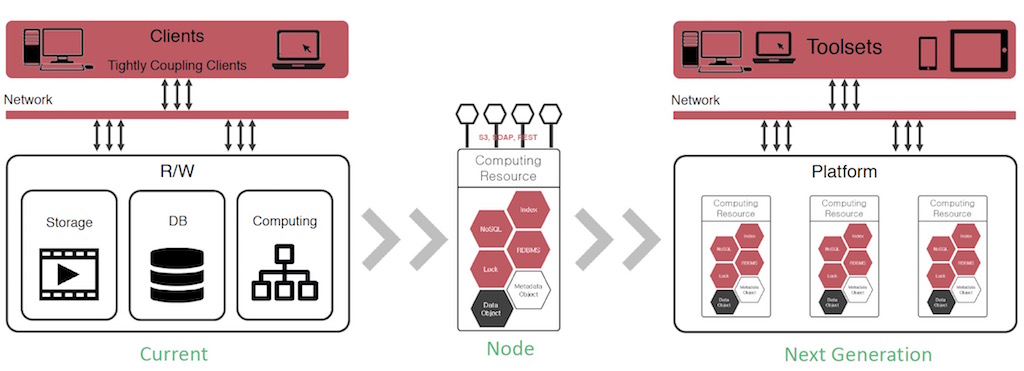
Using distributed microservices technology as a backdrop and building operations analytics through customizable dashboards as a priority, Hive optimizes and controls today's news production operations.
Open APIs
Open APIs enable the integration of many diverse building and creative tools into the Hive system. For the first time, journalists from different groups and with different experiences can access the same content, at the same time and using their tools to craft their own story and adapt it to their specific audience or device.
Each journalist can access their own tools such as web editing, creations with WeChat, professional editing, a web portal for any medium, image creations, creations for H5 mobile devices, social networks (Weibo/Twitter/Facebook/YouTube)...
The private cloud effectively functions as an on-premise data center, storing and managing metadata, proxies, and high-resolution footage to facilitate content sharing and new media production. The public cloud contains duplicate copies of all files, synchronized with the private cloud.
Through China's public cloud services, journalists can access material, manipulate user-generated content, and produce new materials locally for distribution on social media.
Offshore editorial
Regardless of where the journalist is located, they will be able to create an Editing Decision List (EDL) and create a complete story package using material collected from anywhere in the world. The initial work done in the field with proxies will then be published to the main system and linked to the centrally hosted high-resolution material.
Shi Qiang, project manager at CCTV, comments: "Providing the easiest access to content, securely, from literally anywhere, requires a single platform capable of running in cloud-native private and public environments. Our ability to reduce engineering, integration, training and support costs with just this overall architecture, while ensuring scalability and flexibility in deciding where to place platforms and which partners to collaborate with, is absolutely crucial to the success of this project."
The solution is being carried out in two phases, although the first elements have already been implemented for its live presentation in February 2017.
Phase 1 includes the construction of CCTV's new headquarters in China, which will feature full public and private cloud capabilities. With it, only the production of new media can initially be managed, while television news will be produced using an old system.
Phase 2 will see an improvement and expansion of the headquarters to cover television and new media production at the same time. Throughout 2017 the system will be updated in the American and European regions.
Despite the differences with the Chinese market, European channels can learn from CCTV's valuable experience. And now Sony is making exactly the same innovative platform available to European customers under the name Media Backbone Hive.
This journalist-focused networked production system is built on a unified content platform and uses hyperconverged node technology. Powerful, scalable and flexible like no other system, it is ideal for any broadcaster or other media organization looking for ways to improve the efficiency of their workflows and attract new audiences.
Richard Scott, head of Sony Media Solutions, emphasizes that "the issues that CCTV addresses are the ones that are most on all our clients' minds, specifically, collaboration, management, the ability to adapt stories to local audiences and be able to deliver those stories on their preferred device. The commercial reality of diverse teams working on different systems and waiting for copy of content cannot continue indefinitely. Hive combines the cost-effective, agile and flexible technology of the Internet with the quality, management and collaboration of broadcast television systems."
Did you like this article?
Subscribe to our NEWSLETTER and you won't miss anything.
Related articles
 CCTV installs Lawo V__matrix in the first all-IP mobile studio in China
 The Chinese CCTV had Ross Video for the production of its documentary series 'Mission to the Moon'
 Ross Virtual Solutions Enhance Popular Spring Gala on Chinese CCTV
 Chinese national television (CCTV) launches its first 4K channel
 The Chinese CCTV integrates Clear-Com intercom systems for its communications over IP
 China's CCTV broadcasts the Spring Festival with the help of Ross robotics
 Sony promotes news production for new generation audiences with Hive
 Lawo equips the new mobile unit of the Chinese CCTV
 'Pocoyó' will reach more than 250 million children through China Central Television (CCTV)
 Chinese CCTV increases its fleet of Ultra Slow Motion SprintCam systems
 Artear-Todo Noticias closes an agreement with the Chinese CCTV
 The new headquarters of Chinese CCTV, ready for the London Olympic Games
 Chinese CCTV awards Vitec an important contract
 The Chinese CCTV edits its news in the field on a laptop with Edius