





Advertising investment in television resists the challenge of new media
According to the latest Infoadex report, television, which continues to be the first medium by business volume with a 40.0% share of all conventional media, decreases five tenths compared to the percentage it had in 2016.
InfoAdex, a leading company in the control and investigation of the advertising sector in Spain, has announced the Study of Advertising Investment in Spain 2018. According to this annual study, which is now in its twenty-fourth edition, the estimated real investment recorded by the advertising market stood at a volume of 12,287.5 million euros, which represents a growth of 1.8% over the 12,067.0 million euros that were reached in the previous year.
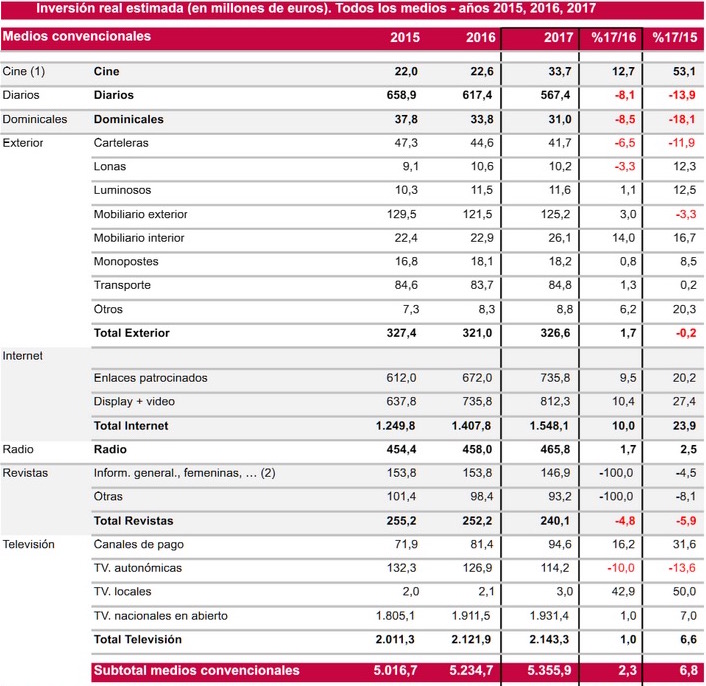
The growth rate in 2017 of conventional media has been 2.3%, going from the 5,234.7 million euros that were registered in 2016 to the 5,355.9 million of investment in 2017. As a consequence, the percentage that conventional media obtained out of the total market in 2017 was 43.6%, a figure that is two tenths higher compared to the previous year.
In turn, the so-called non-conventional media represented 56.4% of the total investment in 2017, with 6,931.6 million euros invested in the year, 1.5% higher than the 6,832.2 million registered in 2016.
The estimated real investment in conventional media reached 5,355.9 million euros during 2017, a figure that represents a growth of 2.3% over that recorded in 2016. During the year being analyzed, all print media have suffered falls in their investment ratios (daily newspapers -8.1%, magazines -4.8% and Sundays -8.5%). The rest of the conventional media have increased their business figures.
Television advertising
The television medium grew by 1.0% compared to the previous year and placed its share at 40.0% of all conventional media, losing five tenths compared to the percentage it had in 2016.
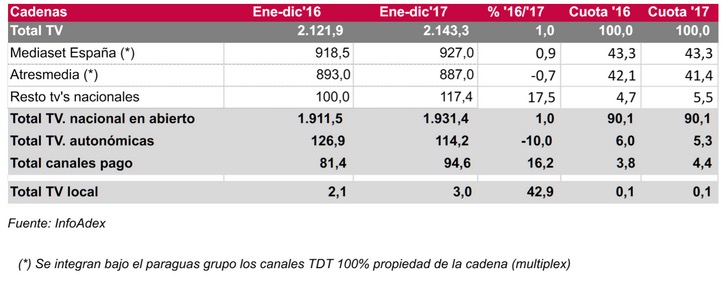
The investment growth experienced by the television medium in 2017 was 1.0%, placing its figure at 2,143.3 million euros compared to 2,121.9 million the previous year. The estimated real investment achieved by national free-to-air television stations has reached a figure of 1,931.4 million euros, with a growth of 1.0% over the 1,911.5 million that this group registered in 2016, while regional televisions represent an amount of 114.2 million euros, which means a drop of -10.0% in their investment figure. In payment channels, the total invested in 2017 was 94.6 million, a figure that is 16.2% higher than the previous year, which was 81.4 million euros. Local televisions have recorded a growth of 42.9% compared to 2016, which places their investment figure at 3.0 million euros.
The analysis of the estimated real investment in the television medium has been carried out based on the control of InfoAdex and thanks to the data provided by a panel of advertisers, the collaboration of the technical committee of the investment study and the declarations of advertising income made in most cases by the television networks themselves.
This year, the study maintains the classification of television operators incorporated in the 2011 edition and divides them into four groups: free-to-air national television, regional television, pay channels and local television.
For greater clarity in the analysis of the data, in the group of national free-to-air television stations, all those that have not reached an investment volume equal to or greater than 40 million euros in 2017 are included in the “Rest” section.
In 2017, the advertising investment of national free-to-air television stations controlled by InfoAdex stood at 1,931.4 million euros, which represents a growth of 1.0% compared to 2016. This group of television stations accounts for 90.1% of the total investment received by the medium.
Mediaset España, leader by its absolute figure, has reached an investment of 927.0 million in 2017, registering a growth of 0.9% compared to the same period of the previous year and reaching a share of 43.3% of investment in television.
For its part, Atresmedia obtained an advertising turnover of 887.0 million compared to 893.0 million in 2016, achieving a market share of 41.4% in 2017, which has meant a decrease in investment volume of -0.7%.
The regional TV group registered 114.2 million in 2017, which translates into a share of the total investment in television of 5.3%.
In 2017, pay channels recorded an advertising investment of 94.6 million euros compared to 81.4 million the previous year, reaching 4.4% of the medium's total advertising turnover.
Internet, newspapers and outdoors
The Internet consolidates its second position by investment volume within conventional media and as a whole has had a growth in 2017 of 10.0%, with a volume of advertising investment of 1,548.1 million euros compared to 1,407.8 million in 2016. The percentage that the Internet represents over the total investment in 2017 in the conventional media chapter is 28.9%.
The newspaper media, which reached an advertising investment volume of 567.4 million euros in 2017, occupies third place, representing 10.6% of the total advertising investment collected in conventional media, which has meant a loss of share of 1.2 points compared to what it had in 2016. The advertising investment obtained by newspapers in 2017 is -8.1% below the previous year's figure, which was 617.4 million euros.
In fourth place by investment volume is the radio medium, which received an investment of 465.8 million euros in 2017, while in the previous year this investment was 458.0 million, which places the evolution of this medium at a growth of 1.7%. Radio accounts for 8.7% of advertising investment directed at conventional media, so its share has remained the same as that obtained in 2016.
Outdoor is the fifth medium in terms of its volume of advertising investment and represents 6.1% of the total media analyzed, maintaining the same participation as the previous year. Foreign investment in 2017 was 326.6 million euros, presenting an increase of 1.7% compared to the 321.0 million that was registered in the previous year.
En sexto lugar aparece el medio revistas, con una bajada del -4,8% que le ha supuesto pasar de los 252,2 millones de euros que obtuvo en 2016 a los 240,1 millones que se han conseguido en 2017. El peso que el medio revistas tiene sobre el total de los medios convencionales se ha situado con ello en el 4,5%, con una pérdida de tres décimas frente al 4,8% que ostentaba en 2016.
La inversión en cine en séptimo lugar, fue de 33,7 millones de euros lo que supone un 0,6% del reparto porcentual en medios convencionales, incrementando dos décimas la cuota de 2016 y ascendiendo un puesto en el ranking de medios por inversión. Con ello el crecimiento interanual registrado por el medio cine ha sido del 12,7%, (teniendo en cuenta que la cifra absoluta para 2016 son 29,9 millones de euros ya que se ha producido una actualización del año 2016 no reflejada en el cuadro que se muestra más adelante).
El medio dominicales, que es el que tiene una menor cifra absoluta dentro de los medios convencionales, representa el 0,6% sobre los 5.355,9 millones de euros que éstos han sumado en 2017, manteniendo estable su participación en los medios convencionales. Dominicales ha experimentado un decrecimiento en su cifra del -8,5%, al pasar de los 33,8 millones que tenía en 2016 a los 31,0 millones obtenidos en 2017.
Medios no convencionales
Bajo la denominación genérica de medios no convencionales se recogen el conjunto de medios publicitarios que, habitualmente, aparecen asimismo enmarcados bajo la expresión inglesa “below the line”.
Conviene nuevamente destacar que el presente estudio versa sobre la inversión publicitaria que se lleva a cabo en los distintos medios, enfoque que es diferente del que es también posible efectuar clasificando la actividad publicitaria por las distintas técnicas de comunicación o estrategias que pueden ser utilizadas. Para evitar interpretaciones que puedan ser equívocas, no debe hacerse abstracción de este planteamiento de partida a la hora de analizar los resultados y extraer posibles conclusiones.
También hay que tener en cuenta en este apartado, la redefinición del marketing móvil que a partir del 2012 incluye: mensajería, advergaming, apps y otros, quedando excluidos los formatos gráficos y los enlaces patrocinados que se incorporan a Internet de medios convencionales.
En el año 2017 la inversión real estimada en medios no convencionales se situó en 6.931,6 millones de euros, lo que supone un crecimiento de la inversión interanual del 1,5% con respecto a los 6.832,2 millones que se registraron en el año anterior.
Del conjunto de quince medios que componen el grupo, hay siete que presentan crecimiento respecto al año anterior, mostrando los otros ocho restantes una disminución de su volumen de inversión comparado con el que obtuvieron en 2016.
Ordenando los medios de mayor a menor según su cifra de inversión, el que mayor porcentaje alcanza es el mailing personalizado, que representa un 30,5% del total de los medios no convencionales. En 2017 recibió una inversión de 2.112,8 millones de euros frente a los 2.045,5 millones recibidos en el año anterior, habiendo experimentado un incremento interanual del 3,3%. En el mailing personalizado se incluyen todos los envíos personalizados a domicilio y lugares de trabajo, lo que se denomina “mailing con respuesta y publicidad directa”, y no se contemplan los gastos que corresponden al franqueo de los envíos.
El segundo medio de este grupo por su cifra de inversión es P.L.V., merchandising, señalizaciones y rótulos, cuya cuota de participación sobre la suma total de este grupo de medios es del 23,6%. En 2017 este medio ha experimentado un crecimiento de su cifra del 2,5% alcanzando los 1.636,7 millones de euros frente los 1.596,1 millones que mostraba en el año precedente.
Aparece en tercer lugar la inversión publicitaria del marketing telefónico que en 2017 se ha situado en una cifra de 1.427,8 millones de euros, lo que ha supuesto un incremento del 3,2% respecto a los 1.383,8 millones de 2016. El marketing telefónico representa un 20,6% sobre los 6.931,6 millones de euros que aporta la inversión total de los medios no convencionales.
En cuarta posición se sitúa actos de patrocinio, mecenazgo, marketing social, R.S.C., epígrafe que incluye acciones y eventos de distinto tipo como conciertos, espectáculos, fundaciones, exposiciones, actos culturales, contribuciones activas y voluntarias al mejoramiento social, económico y ambiental por parte de las empresas, etc. En 2017 ha recibido una inversión de 526,4 millones de euros, una cifra que es un -1,3% menor que la registrada un año antes, lo que le ha llevado a significar el 7,6% del total de la inversión de los medios no convencionales.
El medio que aparece en quinta posición es buzoneo y folletos con 382,0 millones, lo que ha supuesto una disminución del -13,0% respecto a la cifra de 439,1 millones invertida en 2016. En buzoneo y folletos se recoge toda la publicidad que es repartida sin personalización, lo que quiere decir que no tiene ni nombre, ni dirección de destinatario, en domicilios y lugares de trabajo. Su participación sobre el total de medios no convencionales es del 5,5%.
La inversión en actos de patrocinio deportivo aparece en sexto lugar por su volumen sobre el total, y supone el 5,2% de la cifra de los medios no convencionales. Su cifra de inversión ha aumentado en 2017 un 4,6%, hasta situarse en los 358,6 millones de euros frente a los 342,8 del año anterior.
Anuarios, guías y directorios, séptimo medio por inversión con 131,4 millones de euros y que representa el 1,9% dentro de los medios no convencionales, registra un descenso en la inversión del -0,2% frente a los 131,6 millones que supuso en 2016.
En el siguiente puesto por volumen de negocio en medios no convencionales está el apartado de ferias y exposiciones, que se sitúa en el 1,2% del total al obtener una inversión de 80,7 millones de euros en 2017, lo que supone un decremento interanual del -7,0% con respecto a los 86,8 millones invertidos en 2016.
El noveno puesto lo ocupa animación en el punto de venta con una inversión de 66,0 millones, lo que supone un decrecimiento del -2,8% con respecto a los 67,9 millones invertidos en 2016.
Catálogos se encuentra en décima posición con una inversión de 47,0 millones de euros y una pérdida del -7,0% respecto a 2016, situando su participación en el 0,7%.
Aparece a continuación mensajería, advergaming, apps y otros (dentro de marketing móvil) que en su conjunto registra un total de 37,3 millones de euros y con un incremento interanual del 12,1%.
Regalos publicitarios off line obtiene en 2017 una cifra de 36,4 millones de euros, habiendo presentado un decrecimiento en la inversión del -10,4% con respecto al año anterior y con una cuota del 0,5% sobre el total de los medios no convencionales.
Las tarjetas de fidelización off line han sufrido un decrecimiento en su inversión del -4,0%, situándose en una cifra de 31,9 millones de euros frente a los 33,3 millones del ejercicio anterior.
En penúltimo lugar aparecen los juegos promocionales off line, cuya inversión se incrementa en un 24,7% situándose en los 29,2 millones de euros y ganando una posición con un 0,4% sobre el total de medios no convencionales.
Por último, encontramos las publicaciones de empresa (en las que se incluyen las revistas corporativas, los boletines y las memorias, entre otras publicaciones), que han experimentado una subida respecto a 2016 del 13,1%, colocándose en un volumen de inversión de 27,3 millones de euros, 3,1 millones más que el año anterior.
Did you like this article?
Subscribe to our NEWSLETTER and you won't miss anything.
Related articles
 Digital, benefiting from the great drop in advertising investment in film and television
 Generation Z and increased ad spending drive podcast creation
 eSports are emerging as the new attraction for advertising investment
 Television advertising investment grew for the third consecutive year
Television advertising investment in 2017 will grow by 5.3%
Television advertising investment grew for the third consecutive year
Television advertising investment in 2017 will grow by 5.3%
 Advertising investment on television grows 6.4% in the first nine months of the year
 Advertising investment on television in the first half of the year increases by 8.4%
 Advertising investment on television decreases by 16.5%
 Advertising investment in pay and open television is already similar in the United States
 Monaco brings together the world of sport, television and new media
In 2011, the Internet will be, after TV, the second medium in advertising investment
Monaco brings together the world of sport, television and new media
In 2011, the Internet will be, after TV, the second medium in advertising investment
 'Felipe and Letizia' resist the challenge of 'Hispania'
 Internet, new DTT and pay channels, the only media whose advertising investment will grow in 2010
 PanoramaAudiovisual.com is born: other times, new media…