





This is the new generation of Maestro, Avid's real-time graphics engine and rendering platform
The new video and graphics hardware rendering platform gives users the performance, scalability and format support they need to produce stunning broadcast graphics, virtual studios, augmented reality and video content in the highest quality possible.
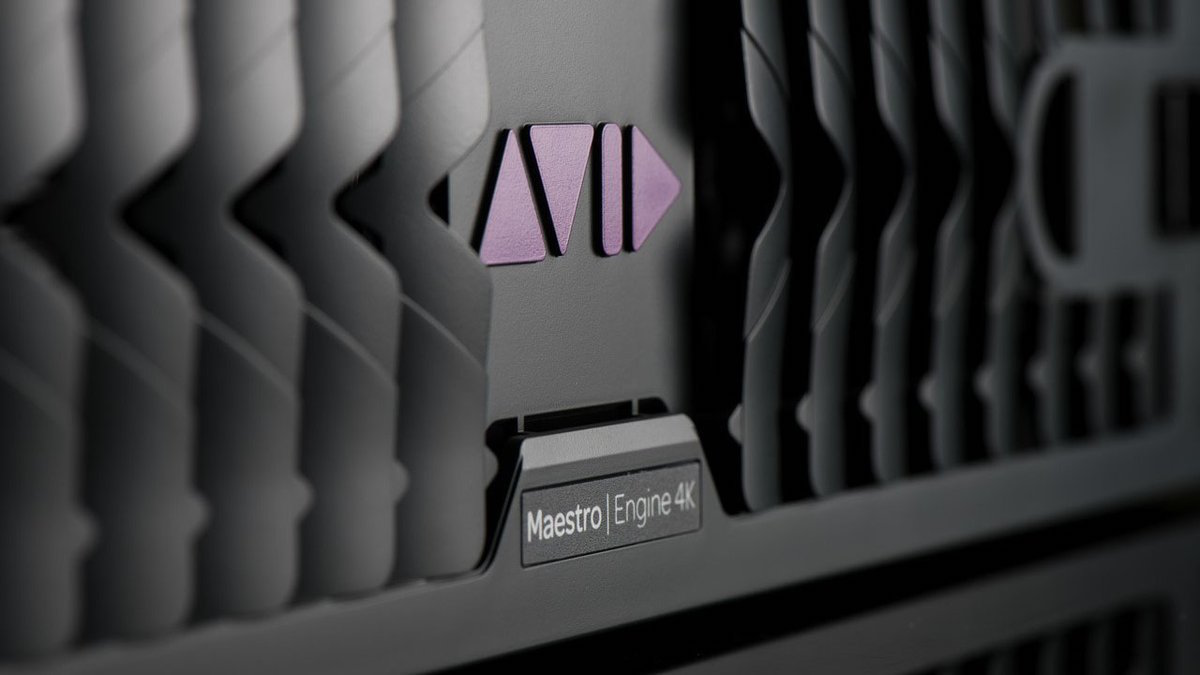
Avid has announced in IBC 2018 the new generation Maestro, his real-time graphics engine and rendering platform. The engine scales from HD and 1080P to UHD supporting SDI and video over IP interfaces. With Maestro Engine, broadcasters can produce graphics, virtual studios, augmented reality and video wall content with the highest quality achievable in the industry.
As a successor to Avid HDVG, Maestro Engine allows broadcasters to introduce new production capacities, including 3G, UHD, HDR and IP workflows, alongside your existing HD/SD SDI workflows, with minimal disruption. Available in two configurations (Maestro Engine and Maestro Engine 4K), the platform works with all Maestro graphics suite solutions, providing performance, scalability and format support to exceed customers' current and future streaming requirements.
Maestro Engine is Available in two hardware configurations that can be scaled for any production need. The base Maestro Engine system offers up to eight video inserts and up to four outputs, including fill and key, to handle most standard CG and dual-channel production needs. To tackle the most demanding UHD, video wall and virtual studio productions, Maestro Engine 4K offers up to 16 video inserts and up to eight outputs, or up to four fill and four key outputs for UHD production.
With improved performance and rendering power, Maestro Engine works across all Maestro graphics suite creation and control solutions, both new and old, providing backwards compatibility so existing content and production will continue to run smoothly.
Avid's solution not only works with any SDI infrastructure, but facilitates the transition to video over IP using a broadcaster's existing 10Gb fiber network and field-swappable interface cards, so they can gradually upgrade at their own pace to experience greater cost savings and increased bandwidth for high-resolution media.
Maestro Engine works in conjunction with Maestro RenderEngine software, providing advanced graphics rendering of the highest quality possible, whether on screen or in the studio. You can also direct content to multiple canvases, scale content up or down, and crop content. This makes it easy to preview large-scale video walls with a single feed in high definition, reducing system complexity and cost.
To elevate virtual studio productions to cinematic quality, Maestro Engine 4K works with both Maestro RenderEngine and Unreal Engine Epic. Users gain the power and flexibility to present stunning virtual environments full of realism, depth and detail. Since only Avid engines can run simultaneously on a single Maestro Engine 4K, users can render all elements of the virtual studio using Unreal Engine while overlaying data-driven augmented reality graphics with Maestro RenderEngine.
With a proprietary I/O card that offers ultra low latency video transfera, Maestro Engine maintains a constant two frame delay from input to output for seamless object mapping and audio handling. The Maestro engine is also capable of real-time graphics, compositing and video rendering, with scalable inputs, fills and key outputs. Its open API allows users to create their own control applications.
Avid's platform is built for the broadcast needs of today and tomorrow, supporting SD, HD and UHD HDR workflows (coming soon). It offers interface cards that can be changed in the field, so users can transition from SDI to IP when they are ready. New technologies and features will be supported through software updates.
Maestro Engine manages live video sources and plays video stored on your local drive, Avid Nexis, or other network storage device. It has two 1GbE connections and a 10GbE option for the most demanding video transfers. Users can create compelling images using video clips as background elements or as textures mapped onto scene objects. Master Engine supports a wide range of codecs, including Avid DNxHD/DNxHR, XDCAM 50, AVC-I, XAVC-I and QT RLE.
Finally, note that Users do not need to install additional client software nor have a systems administrator connected to the engine room to manage and configure settings. Maestro Engine uses a web-based interface for management of all systems. Users can configure and make changes to access rights, video formats, genlock sources, input and output mapping, and other settings from any computer or device on their network, from anywhere.
Did you like this article?
Subscribe to our NEWSLETTER and you won't miss anything.
Related articles
 ChyronHego debuts in Las Vegas, Fresh, a new graphic rendering solution that integrates the Unreal Engine 4
 Ventuz revolutionizes its real-time 3D graphics suite
 Broadcast Pix will debut its new real-time 3D graphics system fX3D at NAB
 wTVision provides real-time data and graphics coverage to numerous football leagues
 wTVision will showcase its MCR, PCR, graphics and real-time data solutions for sports at IBC 2013
 Orad will present its new transportable solution for real-time rendering HDVG 2Go at IBC
 3D graphics in real time, and now in 4K, with Brainstorm Multimedia
 Chyron Axis: Real-Time Cloud-to-Ground Graphics
 Real-time graphics and playout automation solutions from wTVision at NAB
 Real-time 3D rendering, cross-platform distribution and centralized workflows, protagonists of the Vizrt booth at NAB 2012
 Meztura WebKeyer: generation of real-time graphics based on Web platforms
 wTVision presents its real-time graphics solutions at IBC
 Brainstorm real-time graphics on BBC, Antena 3 and Channel 9
 Morpho 3D 2.0: spectacular real-time graphics with Orad at Broadcast'09