





The members of the SGAE approve the reform of the statutes by 85.19% of the votes
Los nuevos estatutos suponen la adecuación definitiva de la entidad al nuevo marco legal español y europeo y el cumplimiento de una exigencia del Ministerio de Cultura y de la Confederación Internacional de Sociedades de Autores y Compositores (CISAC).
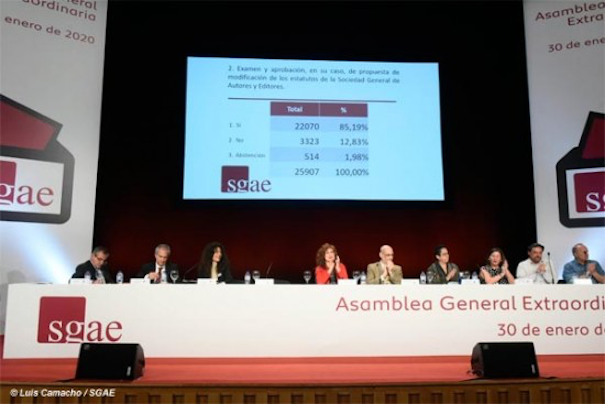
Los socios de la General Society of Authors and Editors (SGAE) han aprobado la reforma de estatutos de la entidad por mayoría de más de los 2/3 de la Extraordinary General Assembly celebrada este jueves, 30 de enero, en Madrid. De un total de 25.907 votos, 22.070 (85,19%) han sido a favor, 3.323 en contra (12,83%) y 514 se han abstenido (1,98%).
Tras conocerse los resultados Pilar Jurado, presidenta de la SGAE, ha “agradecido a los socios estatutarios su participación”, y afirmado que “el respaldo mayoritario de la Asamblea es un sí al futuro de la SGAE, que afrontamos con seguridad jurídica y un elevado nivel de consenso interno. Haber superado el 80% de votos afirmativos significa que estos son los estatutos del acuerdo y del diálogo.” Su aprobación supone la adecuación definitiva de la entidad al nuevo marco legal español y europeo y el cumplimiento de una exigencia del Ministerio de Cultura y de la Confederación Internacional de Sociedades de Autores y Compositores (CISAC).
Jurado ha querido también “agradecer, de manera expresa, el trabajo intenso que durante estos meses ha realizado toda la Junta Directiva”, donde están representados los cuatro colegios de la SGAE (Pequeño Derecho, Gran Derecho, Obras Audiovisuales y Editores Musicales), a sus respectivos vicepresidentes y a los y profesionales de la SGAE. “Sin su esfuerzo –ha señalado la presidenta de la entidad-, este amplio respaldo a los estatutos no habría sido posible”.
Esta reforma viene motivada por los cambios introducidos en la Ley de Propiedad Intelectual, derivados del Real Decreto-ley 2/2018, de 13 de abril, por el que se incorpora al ordenamiento jurídico español la Directiva 2014/26/UE del Parlamento Europeo y del Consejo, de 26 de febrero de 2014, y la Directiva (UE) 2017/1564 del Parlamento Europeo y del Consejo, de 13 de septiembre de 2017.
Según la presidenta de la entidad, los nuevos estatutos servirán para “dar aún más voz a los autores y creadores en la toma de decisiones, y hacer la entidad más moderna, flexible, transparente”. En este sentido, una de las principales novedades de estos estatutos es que todos los socios que estén en activo tendrán al menos un voto en la asamblea. Además, la entidad se obliga a publicar un “informe anual de transparencia” sobre los descuentos de administración, las actividades culturales y asistenciales y la actividad financiera. Lo realizará la Junta Directiva dentro de los tres primeros meses del año y se someterá a la votación de la Asamblea dentro de los seis primeros meses del año.
Los estatutos también prevén una comisión de supervisión independiente. En cuanto a los repartos, recogen en detalle la política general de los mismos y los principios del sistema establecido. El Reglamento de Reparto deberá ser ratificado por la Asamblea General.
Jurado ha resaltado asimismo que los autores tendrán “más derechos y más libertad”, pudiendo decidir si mantienen o retiran parcialmente de la SGAE los derechos de sus obras en función de la categoría, el tipo de obra o los países donde su creación genere derechos. Este cambio obligará a la entidad a ser más competitiva y adecuar constantemente su oferta de servicios a las necesidades específicas de cada socio.
Más poder a los sectores y los territorios
Los nuevos estatutos aspiran a ser integradores y representativos de todos los socios de la SGAE atendiendo a sectores tradicionalmente más minoritarios, como el de coreografía, aportando una nueva definición de obra coreográfica y un nuevo sistema de reparto para este sector; y también regulan la participación de los Consejos Territoriales, que entran a formar parte de la estructura organizativa dependiendo directamente de la Junta Directiva.
Con estos estatutos la SGAE se transforma para mirar al futuro y defender los derechos de autor en un mundo digital y global en el que la industria cultural evoluciona continuamente y hay que buscar cada día nuevas fórmulas.
Did you like this article?
Subscribe to our NEWSLETTER and you won't miss anything.
Related articles
 The RTVE unions stand up to the Government for the modification of the statutes that will give executive power to Elena Sánchez
 The SGAE allocates more than 15 million euros to support its partners
 COITT-AEGITT approve an ambitious strategic plan for 2020
 The SGAE creates an Audiovisual Division to offer comprehensive and specialized management to its members
 The SGAE Foundation calls for the first time 'SGAE Documentary 2019'
 UTECA modifies its statutes including the sole membership requirement
 The SGAE Foundation opens the call 'SGAE en Corto 2018'
 The SGAE Foundation announces the XII SGAE Script Award for Feature Film Julio Alejandro
 The Government gives the green light to the reform of the Cinema Law
 The SGAE Foundation announces the XI SGAE Script Award for Feature Film Julio Alejandro
 Partial reform of the Intellectual Property Law
 'Protagonistas, el reality' ends with more than 9 million votes and 20 million visits on the website
 Carlton Cuse, producer of 'Perdidos', will give a master class to SGAE members
 Seminar: A reform of the Intellectual Property Law?