





The coronavirus puts the networks in Spain to the test with video accounting for 70% of traffic
Most streaming entertainment service companies are adjusting video quality to respond to these spikes and maintain service.

The crisis derived from coronavirus COVID-19 is assuming a 40% increase in traffic on Spanish networks.
Calls through cellular networks have grown by 50%, and the use of mobile data by 25%. For its part, traffic from instant messaging platforms such as WhatsApp has multiplied by five.
With the measures of tele-working and tele-teaching Widely implemented, Internet networks are registering large increases in traffic. Despite this, the service has remained stable for users, without network outages or significant mishaps.
Spain has one of the best telecommunications networks in all of Europe. 88% of homes have access to ultra-fast broadband networks. It also stands out in mobile connectivity. According to Cisco's Annual Internet Report, Spain currently enjoys the highest average 4G speed in Western Europe.
Video impact
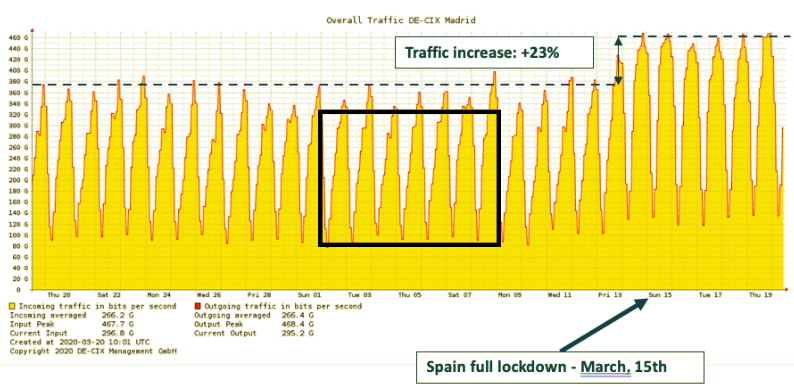
The peak of the highest Internet growth in Spain coincides with March 15 onwards, with a growth of 23% according to data from the Madrid Internet Exchange (not including the direct connection of many Cloud SaaS providers with ISPs).
Video is one of the main reasons for this increase. It already represents the 70% of Internet traffic in Spain, and in 2022 it will account for 80%.
Video conferencing and streaming services are playing a key role in this growth. Given this scenario, most streaming entertainment service companies are adjusting the video quality to respond to these peaks and maintain the service. Netflix (with 51 million users in Europe) has agreed with the EU to lower the speed of content delivery by 25% to help reduce its traffic on European networks.
Uploaded content is also responsible for the occasional slowdown of networks, including cloud gaming with multi-player connections, videos from IP cameras, and the storage and sharing of personal files in the cloud.
Even if your Internet service is stable, upload and download speeds at home may be affected. Service providers are continually monitoring their infrastructure to plan for the proper functioning of networks during periods of peak demand. Cisco works with many of them in this regard, with new processors and software-based automation solutions for the Internet of the Future.
Andrew Vilamitjana, general director of Cisco Spain, thanked “the telecommunications service providers for their commitment and effort to keep Internet networks operational at this very necessary time.”
“Along with health, education, food and supplies, media, security forces and public services, the availability of the Internet and telecommunications networks in general is essential for us to overcome this unprecedented crisis,” concludes Vilamitjana.
Did you like this article?
Subscribe to our NEWSLETTER and you won't miss anything.
Related articles
 Netflix tests shuffle playback
 The rising wave of Internet traffic in times of coronavirus
 Operators advise rational use of networks to face increases in traffic due to the impact of the coronavirus
 PyeongChang 2018 tests 8K and 5G production
 Video will continue to dominate IP traffic, representing 82% in 2021
 The German HD+ operator puts TVKey to the test
 Israeli operator YES tests new Cisco Infinite Video Platform Labs platform
 WeLab tests the new Varicam LT
 The increase in smart devices, mobile video and 4G networks will multiply global mobile data traffic by 8
 Poznan Supercomputing and Networking Center (PSNC) tests live streaming over IP 3D 8K
 Sky tests 4K capture at Emirates Stadium
 DVB-T2 Lite is put to the test to be seen first at IBC 2011
 3D and HD will multiply video traffic on the Internet by thirteen in 2014
 Planet 51 is tested in Spain