





American Public Television streamlines remote work as a result of COVID-19 with Axle ai
Axle ai along with key networking technologies such as VPN and cloud storage have allowed APT to immediately develop a remote media management flow.
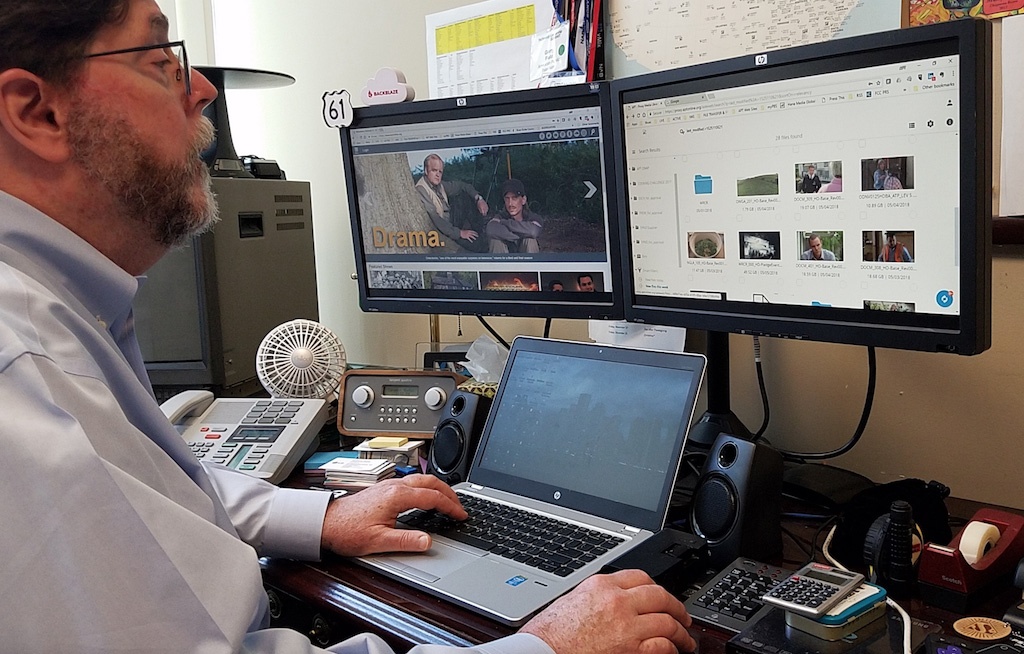
When the staff of American Public Television (APT), like many media companies, faced with the prospect of suddenly working from home due to coronavirus lockdown measures, they were prepared.
APT licenses and distributes content to public broadcasters in the United States. Operating with a modest staff, they have amassed a current and legacy catalog of hundreds of series and programs spanning documentaries, education, travel, entertainment, news and current affairs programs ranging from Lidia's Kitchen to Rick Steves' Europe to the Doc Martin Murders and Midsomer.
A few years ago, APT workflows were tied to physical media such as tapes and hard drives. By implementing technology Axle you have, they were able to economically transition to a browser-based shared media workflow. So, when recently faced with COVID-19 work restrictions, they were able to quickly navigate to a distributed approach almost overnight.
APT's vice president of technology, Gerry Field, comments that “Axle ai, as well as some of the other key networking technologies we have implemented, such as VPN and cloud storage, were the difference between being completely disconnected from our business due to COVID-19, and being able to operate at almost regular capacity.”
APT began transitioning to digital distribution and file-based workflows, with the goal of “turning our viewing rooms into ingest rooms, and moving our viewing capabilities to everyone's desktop.” Baffled by the cost and complexity of the MAM systems they investigated, Field and his team turned to affordable Axle ai software, which leverages industry standards and cost-effective storage to simplify network video workflows.
"If the content comes in file form, great. If it comes in tape form, we ingest, and in any case create proxies for viewing through Axle. Everything that is presented to us comes as a file in a broadcast format. We have broken down the limited on-prem 'silos' we had before, and extend access to more content on the desktop regardless of location. Of course, this same capability has allowed us to handle the shift to a fully remote workforce, which would have been previously unthinkable,” adds Gerry Field.
 Easy adoption
"Above all, the hub made it possible to get a system appropriately scaled for what we need, and for the resources we have. The two equal parts are cost and complexity. There are many asset management products on the market that, particularly for my needs, are wildly oversized. We needed something that could be easily installed and that would give us access, quickly, to the content we need to see." I was able to get it up and running in three days and have the A.I. Axle will enter the adoption cycle. From there, the biggest challenge was getting some people used to going into a screening room to the screening in their browser, and building their trust,” says Field.
The fact that Axle is not technically demanding was very important: "APT has a good talented and technically aware staff, but we are not the type of company that has a deep engineering department, or a group of editors. You could possibly do deeper and more interesting things with a more expensive system, but my experience with things like that is that they sound good, but they end up being a ship's anchor."
As the APT moves to a new system of interconnecting member public television stations, Axle has been integrated with the APT's back-end commercial systems, so information on licenses and media access rights is linked to axle. "That's important since APT owns very little programming; almost all of it is licensed for distribution under contracts. Under the new system, "the material goes into our cloud, is synced from our cloud to local storage and axle makes proxy copies for selection and tracking." Gerry has seen APT's use of Axle's AI grow, especially for reviewing subscription spots and to help providers negotiate with subscribers. "In addition to the full-length programs, we now include promos, reels of spark, clips and other promotional material related to the program.” Gerry said staff are now using the hub to make programming notes, “extending desktop screen access to collaboration and sharing feedback on content as well.”
Did you like this article?
Subscribe to our NEWSLETTER and you won't miss anything.
Related articles
 Vitec streamlines workflows helping broadcast professionals do more with less
 AEQ returns to IBC 2022 with news for remote work environments
 CNC Medios (Chile) is committed to new remote work formulas with AEQ technology
 Mediaset sigue apostando por la combinación del trabajo presencial y remoto
 Equidia structures its remote workflow in Blackmagic Design products
 Mediapro relies on HP technology for its operators and editors to work remotely
 KST Streamlines Production Workflows with the Help of AJA Solutions
 Axle ai launches remote work solution for Avid Media Composer
 American Public Television selects Cinegy for its centralized archive
 Colorfront streamlines the work of dailies
 Primestream streamlines collaborative work
 EVS makes workflows faster and more efficient
 ProHD GY-HM750: JVC's new shoulder camcorder streamlines your workflow
 TIBA in Buenos Aires streamlines HD graphics workflows with Miranda