





AEQ equips À Punt FM with IP and Visual Radio technology
The Valencian public broadcaster awards AEQ the supply and installation of the equipment for its production center in Burjassot (Valencia).
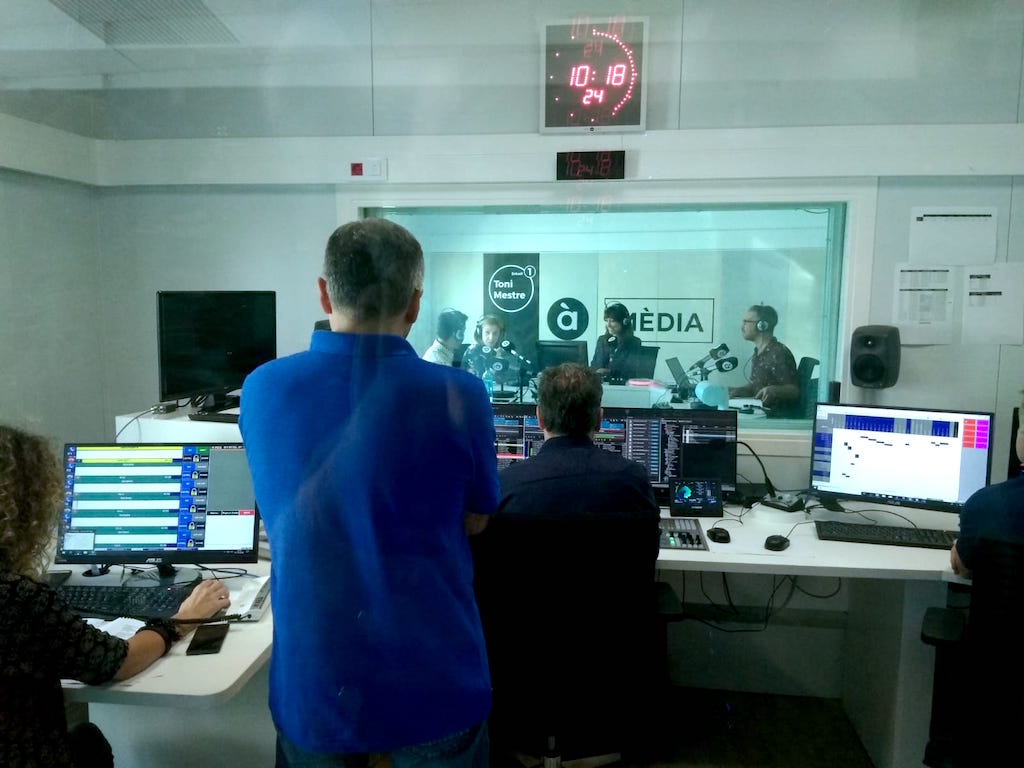
At Punt FM, the main station of the Valencian Media Corporation (CVMC), the public communication group of the Valencian Community, which broadcasts from the Burjassot Program Production Center (Valencia) a general programming with special attention to information, as well as sports, music and culture It has the most current broadcast technology from AEQ.
À Punt engineers received in-depth advice to develop the conditions of the installation to be implemented in the reopening and reflected it in a specification of a public tender that AEQ won, offering important improvements subject to compliance with the conditions of the specifications, resulting in a very powerful, flexible and reliable system.
The technical solution is based on the IP Dante audio standard. This technology facilitates everything from installation to operation. Dante is a reliable, stable, powerful, standardized solution that offers the possibility of redounding systems to generate greater peace of mind in the operation.
The system has in the central control the automatic redundancy offered by Dante, and as is usual in AEQ projects, at the same time a parallel installation in AES-EBU digital audio format has been proposed that would allow, in the event of an extremely serious contingency, to continue with the operation/broadcast through patch switching.
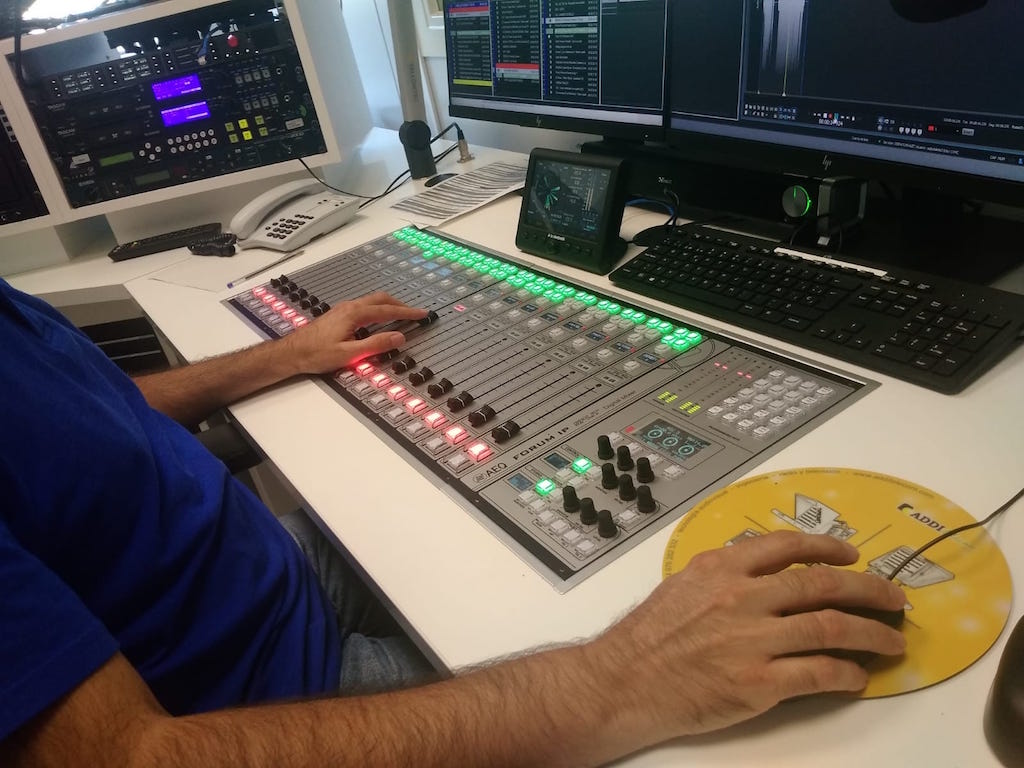
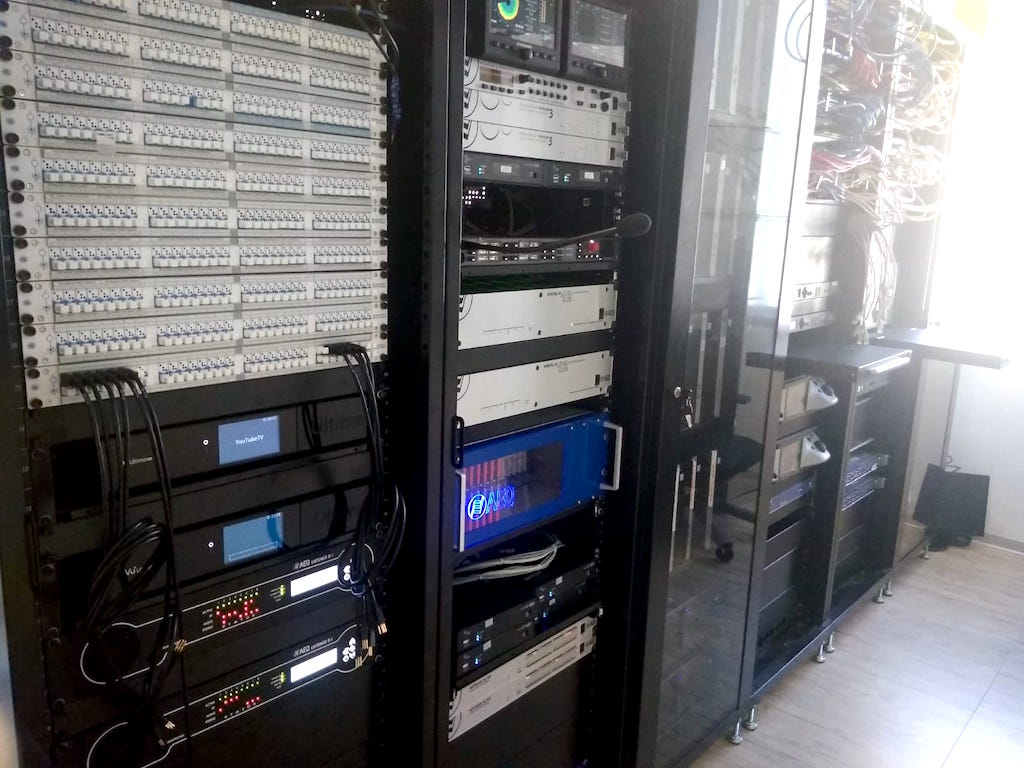
Routing is done with a BC-2000 Digital Matrix Router with TDM Technology, interconnected by IP using Dante protocol on structured cabling to studies that have as their main element a Forum Split IP digital mixer. Two of them, intended for live music and music publishing, additionally incorporate a console Yamaha TF1 which is related to the rest of the technical elements through the Dante network.
In the central control, as another source of sound, a multiple communications system for telephone lines has been installed, consisting of two devices Systel IP 12, each equivalent to 12 IP phones connected to a digital audio matrix. This system allows access to any line at any time, even moving all lines to a studio if necessary.
Also included are IP audiocodecs, audio processors and Broadcast Pix's Radio visual system, integrated with AEQ consoles and processors.
Regarding the audiocoders, AEQ incorporated, centralized in the technical room and present in the matrix, IP/ISDN audiocodecs and multicodec control software to manage them flexibly from central control and studios. The incorporated models are the stationary ones Phoenix Stratos y Phoenix Venus.
External broadcasts and reporters' interventions are based on the laptop Phoenix Alio, as well as a Smartphone-based reporter system with an audio kit.
The built-in array is AEQ BC 2000D Router. It is a solution based on security and redundancy at both the hardware and software levels, in order to ensure its operation 24 hours a day, 7 days a week.
This matrix is scalable and adds, distributes and processes with TDM technology. In this project, it has been sized with a total of 352 inputs by 352 outputs, 256 AoIP Dante, 64 AES digital and 32 analog.
The proposed watches of the brand Gorgy Timing They were installed in the various areas: technical room, controls and booths, booths and performers' room. They will be synchronized with the master clock system located in the TV technical room, using the NTP protocol. The synchronization is also entered into the BC 2000-D matrix, and is transported over the Dante AoIP network to all digital equipment on the network using PTP: Precision Time Protocol according to IEEE1588 recommendation.
Audio processors
As far as audio processing is concerned, two processors were installed Optimod-FM 8700i with Xponential Loudness for real-time processing of both conventional and musical programs for both FM and Internet. An application has also been installed Omnia 9/XE for real-time processing of the signal going to the Internet. On the same PC on which this application runs, the control software is used BeatRig LevelOne v2 to monitor and normalize all audio files at the -23 LUFS level. (EBU R128).
The listening and measurement systems are made up of various complementary systems. on the one hand, a
pair of bi-amplified active monitors Genelec 8020 DPM preceded by a 10-way stereo analog source selector/mixer. RM-M2 106 reference monitors. Occupying 1U of rack mounting, they offer high resolution and accurate measurement of between 1 and 4 stereo audio sources. Two TC Electronics meters, Clarity M with LCD display, have also been installed.
The installation also includes two Wavenet Octopus II AM/FM Multireceivers, a system composed of eight receivers that allows listening in the AM and FM spectrum. A Vu+ Último, a high-definition receiver that incorporates an advanced interchangeable triple tuning system, has also been included. The user decides which tuners they need: DVB-S2 (HD satellite) and DVB-C/T (cable and DTT, both in HD). There are also two 32” televisions connected to the matrix.
The studies
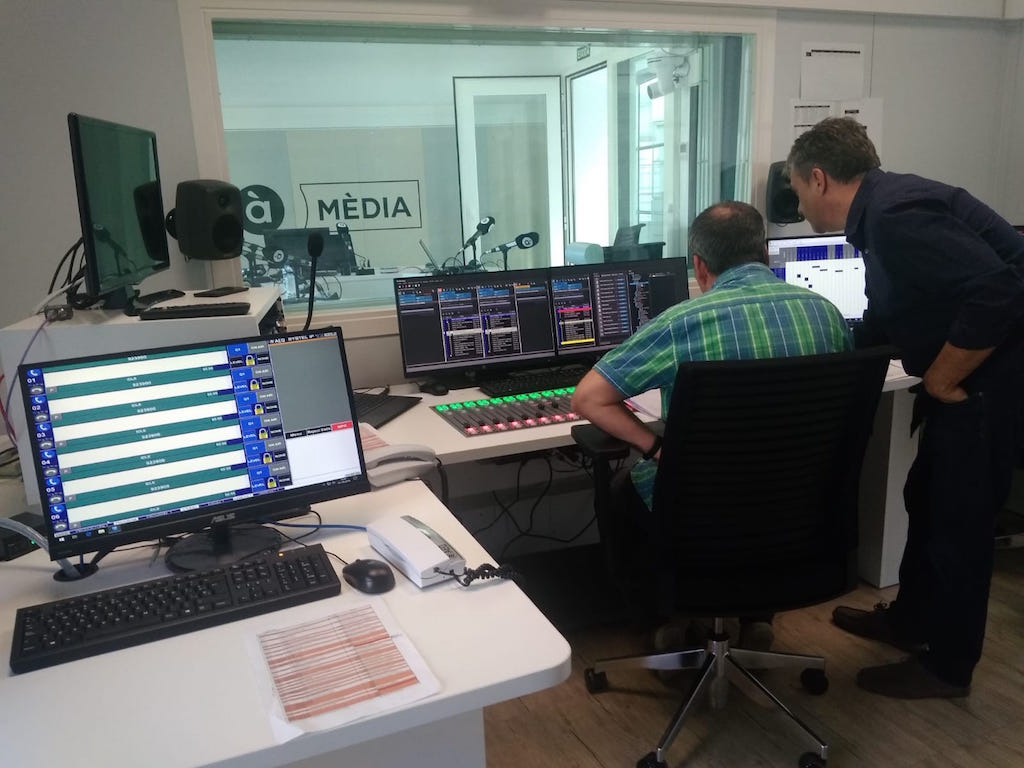
À Punt FM has launched four radio studios. The main component is a digital broadcast mixer Forum Split about AEQ composed of a control surface with 16 faders, and separate electronics in a silent chassis with 19" rack format. The application was added Forum Screen To help control, an R128 loudness meter for programming and recording on a screen separate from the surface.
Furthermore, in two studies a camera automation system to produce Visual Radio via data command through the mixer's Ethernet interface. In two studios, a second console has also been incorporated Yamaha TF1 and auxiliary equipment for recording and editing musical sound.
The system of control of matrix circuits that affect each study is dual: by hardware through the AEQ NCB-100 panel and by software, with the RTC BC-2000 Router.
The management of communications, both VoIP telephony and IP/RDSI audiocodecs, is carried out with their corresponding software applications. The Systel IP management application was installed on a PC with a touch screen. The control of audiocodecs has its dedicated software tool, Phoenix Control
All local equipment has also been included (CD media players, USB, effects modules, active monitors...) As a separate system, an audio and news automation system compatible with that of television has been incorporated. A PC and an independent order module have been installed in the production station.
The control has functions to be able to do self control (monitor cutout and headphone jack). The audio table has a self-control microphone, with pantograph and elastic suspension, being the command microphone for the specific technician.
The local equipment of each studio consists of Tascam SS-CDR250N multi-format CD/USB player recorders with remote triggering, CUE points and the ability to play PCM, MP3 and AAC. In addition, they are MP3 recorder.
The effects module is the model SPX2000 From Yamaha, while inheriting the standard interface and popular programs of its predecessors, it brings a new dimension to the SPX sound with advanced REV-X reverb algorithms and 24-bit, 96 kHz audio processing.
In control monitoring, À Punt FM has a pair of bi-amplified active monitors from the brand Genelec, model 8020 DPM.
At the control there is also a television intended to serve as a reference for the sound technician and the user of the production station. The audio output is present on the sound board.
The PC to control the matrix, the IP Systel, the audiocodecs... is physically in the central control room and is controlled from this studio using KVM extenders. It has the following software applications installed: RTC matrix control BC2000 Router, Systel IP User, and Phoenix Control.
Communication
A PC was also installed in the control HP model Prodesk 400G intended for the system of communications and matrix control, as well as other additional programs or services (programs or control interfaces of other equipment). This equipment is also physically in the central control cold room, and is controlled using KVM extenders from the controller's position.
The configuration provided in the control allows orders to be given from the audio table and from the production station, differentiating the microphones for producer and operator orders so that two people can give orders or speak with different circuits at the same time.
An HP Prodesk 400G SFF model PC has been installed in the production station and an additional panel to give individual commands to the communication lines with a microphone, headphones and speaker independent of the operator's speakers. The control of the Systel IP allows the producer to take control of the communications, freeing the operator from this task and it can also be carried out simultaneously.
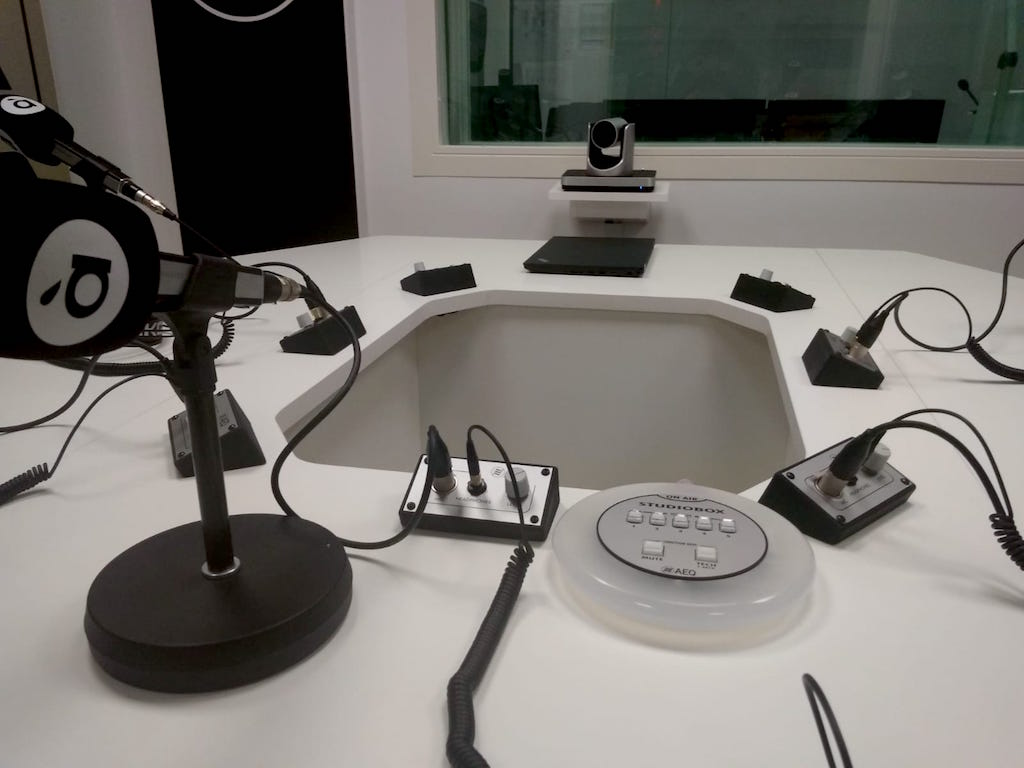
Locutories
Los Studies 1 and 3 incorporate the camera system with automatic and manual production for the production of streaming video. Broadcast Pix.
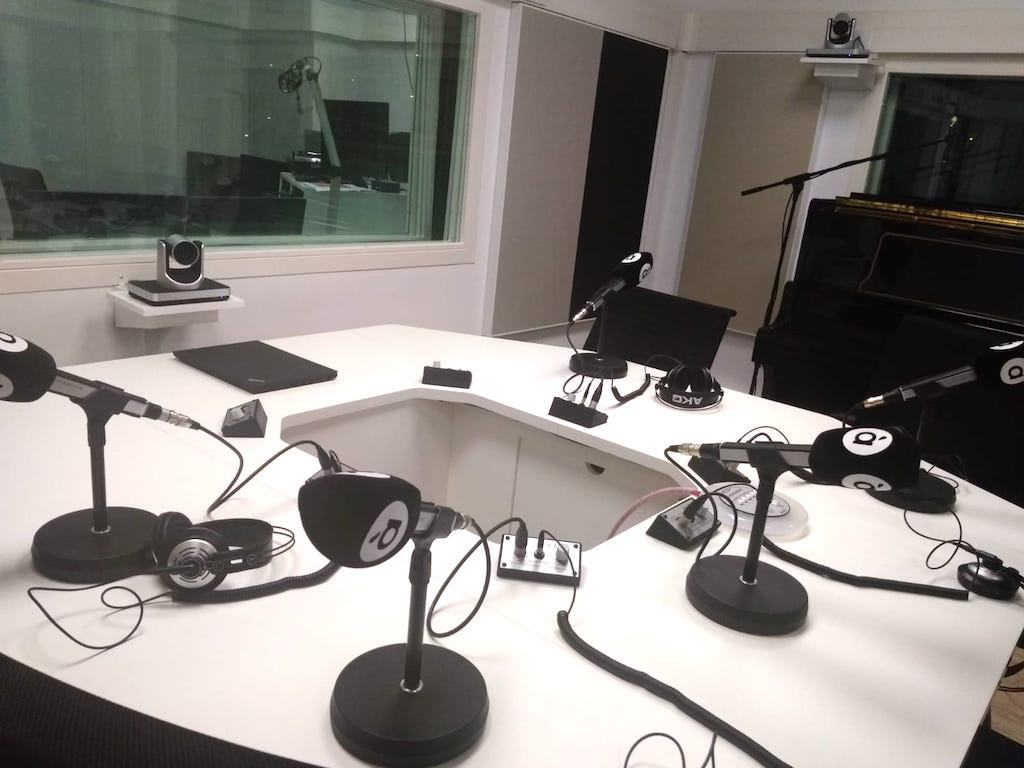
In the studio 1 lobby, 7 fixed microphones and 1 wireless microphone were installed. Sennheiser as well as 7 headphones AKG, model K141, one for each position. To monitor the booth through loudspeakers, the same equipment is used as in the controls, the Genelec 8020.
Each studio has a common voice cutting system and desktop on-air signaling on the table, on the wall and on the doors. Two units were supplied AEQ Netbox 4 MH with Dante IP connectivity to be able to connect up to 8 microphones, 8 headphones and two line outputs. Netbox 4 MH allows the microphones, headphones, GPIO's, etc., of each studio to be available in all the studios directly and without the need to modify the wiring, even without acting on the BC-2000 D Router matrix.
He Study 2 It can be operated in self-control mode, and has a booth for 6 microphones, and does not have a visual radio system.
He Study 3 It has been planned as a studio for taking live sound and recordings, advertising, dubbing... with an auxiliary console for this function, Yamaha brand, model TF1 and also with a Dante interface. Local equipment for production is also incorporated, such as CD media players, USB, effects modules, active monitors...
In its booth there are two areas, one for radio use, similar to that of the previous studios, and another dedicated to live sound or recording of musical groups.
As there was no furniture in this part, the installation of primary and secondary headphone jacks, as well as control lights were installed on a panel.
This area incorporates a camera system with automatic production for streaming production, mainly of musical events produced with the BROADCAST PIX video mixer.
To carry out these musical performances in the parlor, basic equipment was supplied to provide sound for small musical performances (amplifiers, injection boxes, etc.)
It has also been planned that the Study 4 can be operated in self-control or as a studio for live sound recording and recordings, advertising, dubbing, etc., with an auxiliary console for this function, Yamaha brand, model TF1.
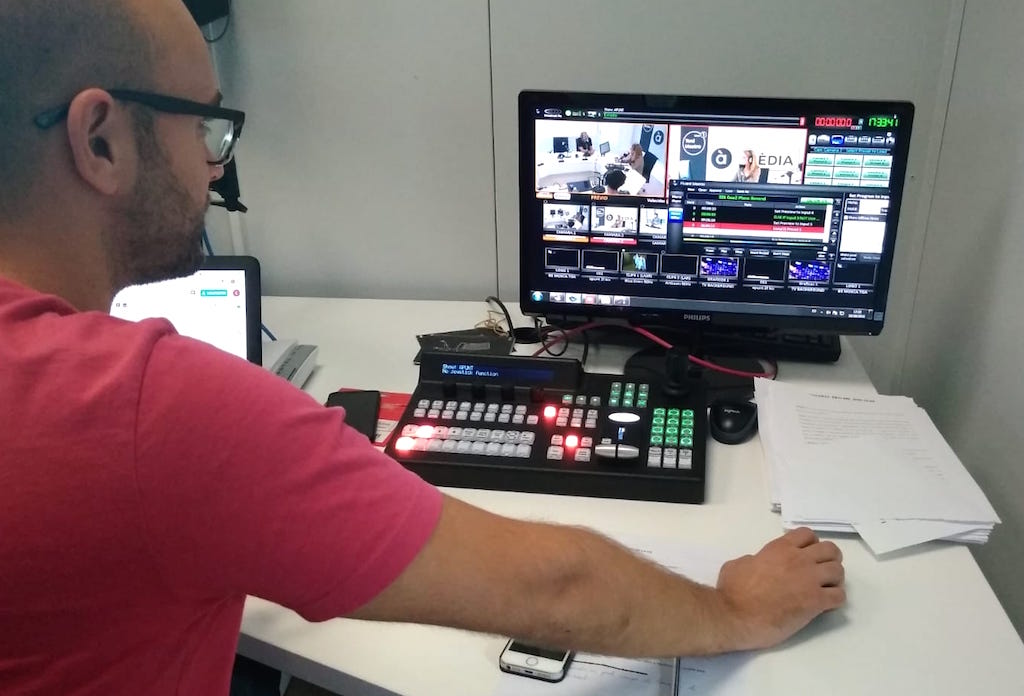
Visual Radio System
The concept of a system Visual Radio of the type installed in studios 1 and 3, allows the generation of visual content that accompanies the typical radio broadcast mainly in Internet environments.
The generation of this content is increasingly demanding and resembles the production of a television channel itself. This is because consumers of said content do not separate the source and increasingly demand higher quality.
The solution adopted from Broadcast Pix is emerging as a “channel in a box” which offers a large amount of resources for production of said contents, currently being a system used by small and medium-sized TV channels as a global solution for the generation of their broadcast signal.
A key point that differentiates the needs of these television channels and the production of a radio station itself is that in this case there are usually no resources for the personalized creation of the video signal.
Broadcast Pix allows, through its control software, perform automated programming macros based on external events, which come from the Forum sound console through the IP network, allow obtaining an automatic creation of the video signal for broadcast, closely approximating the result that can be obtained in the manual production itself, thanks to the number of factors, conditionals, programming and external variables, that this system puts into play to pre-program the edition of the final signal.
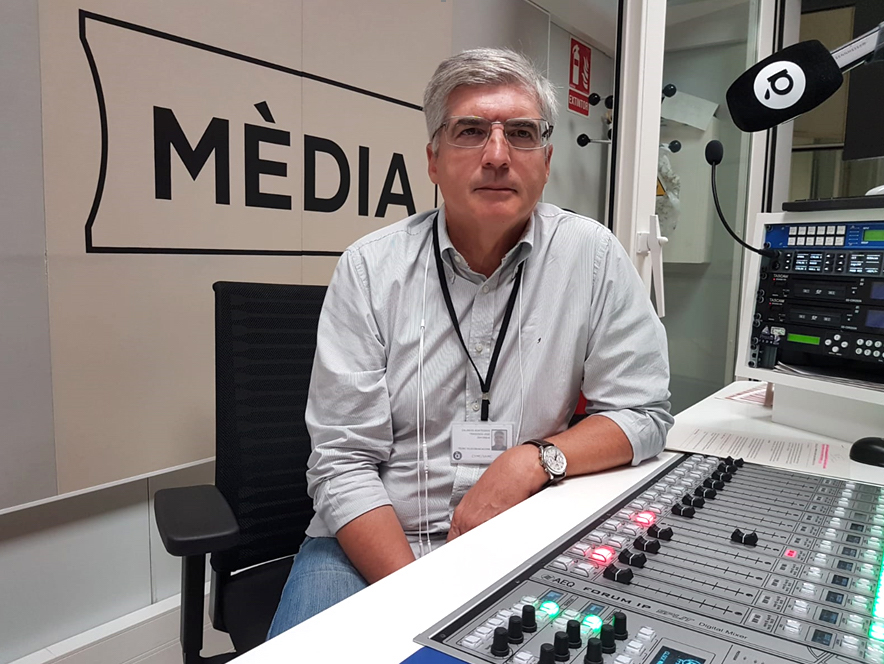 Broadcast Pix systems for Visual Radio with AEQ consoles have been integrated by the company Broad Service Technical Support who developed them in À Punt.
The entire À Punt FM project was developed by the AEQ Systems Engineering Department with the coordination of Bernardo Saiz and supervised by the engineer of the Valencian Media Corporation, Francisco Calabuig.
Did you like this article?
Subscribe to our NEWSLETTER and you won't miss anything.
Related articles
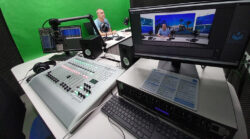 RTV Melilla launches a visual radio studio designed and integrated by Broad Service
 Radio Bio Bio equips its facilities with AEQ digital audio consoles
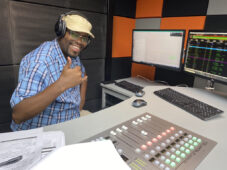 South African Adventist World Radio equips its main studio with AEQ technology
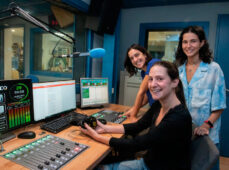 Radio Desvern equips its main studio with the AEQ Forum IP Split console
 CV Radio, the independent and plural station of Valencia, is equipped with AEQ
 À Punt Media Televisión equips its studios with lighting and control equipment from ETC, Claypaky and MA Lighting
 The Argentine station Cadena 3 equips its studios with AEQ technology
 Faro equips its new HD mobile unit with the latest AEQ-Kroma technology
 Belgian public radio RTBF creates a visual studio powered by Blackmagic Design
 Radio Granollers equips its studios with AEQ solutions
 Radio Nacional de Argentina equips its latest studio with AEQ Forum
 The Serbian Visual Impact equips its new mobile unit with Miranda
 The Catalan Xarxa equips its radio studios with AEQ digital consoles
 The Mexican Radio Institute (IMER) equips ten studios with AEQ Forum