





Bauer Studios (Germany) enters immersive audio with Dolby and Neumann
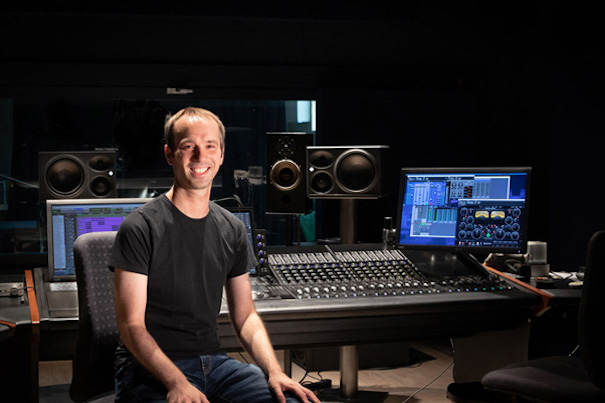
Con sede en Ludwigsburg, Bauer Studios es uno de los principales estudios de grabación de Alemania y un referente en el sector de la grabación desde hace más de 70 años. Ahora, ha rediseñado su estudio 2, optimizado por Markus Bertram (de MB Akustik), equipándolo con sonido inmersivo con Dolby Atmos y monitorización de Neumann.
All the biggest names in German pop music have recorded here, such as Udo Jürgens, Reinhard Mey and Herbert Grönemeyer, to name a few. But also international stars, such as Stevie Wonder, Chaka Khan, Miles Davis, Pat Metheney and Al Di Meola. Although it is not limited exclusively to the dominant musical styles. Bauer Studios has earned an excellent reputation, primarily for its high-quality jazz recordings, including the legendary live recording revered by jazz lovers around the world: Keith Jarrett's The Köln Concert.
The jewel in the crown of Bauer Studios has always been Studio 1, with its analog mixing console Neve and its large 180 square meter room for live recording, a space with the capacity to host orchestras and big bands. And also for the series Studio concert, which is recorded with a live audience on 2-track analog tape and then distributed exclusively on vinyl through Bauer Studios' own record label.
Since 2017, Bauer Studios has been run by a new management duo, Bettina Bertók-Thumm y Michael Thumm. Pero la filosofía de los fundadores se sigue manteniendo inalterable. Después de todo, Bauer Studios siempre se ha caracterizado por su espíritu pionero. Cuando Bauer Studios abrió sus puertas en diciembre de 1948, fue el primer estudio de grabación privado de Alemania. A finales de 1950, Bauer Studios se convirtió en pionero de la estereofonía. Así que no es nada extraño que se dediquen ahora a explorar las posibilidades del sonido inmersivo.
“Traditionally we are always looking to the future,” explains Thumm, sound engineer and general manager. "What's beyond stereo? What's next? We love exploring new facets and I think that's why we're still in the gap 70 years later."
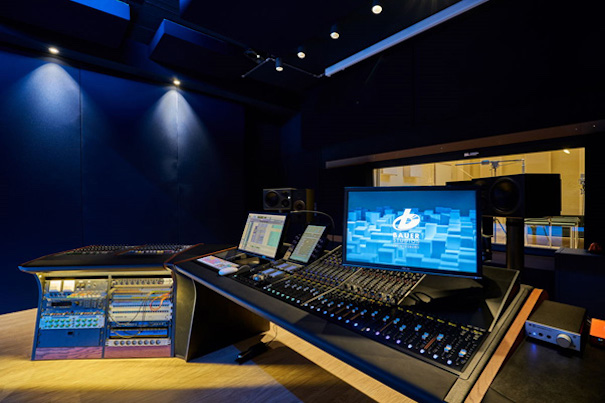
Reconvert a studio with immersive audio
It was proposed to reconvert Studio 2, a room that was used very little and was somewhat outdated, in a space for film sound mixing. Or, at least, that was the original idea. Both Michael Thumm and his collaborator Bettina Bertók-Thumm had completed their Tonmeister (sound engineering) studies at the Babelsberg Konrad Wolf film and television school (now film school) in the city of Potsdam. That is why they were very familiar with multichannel formats, since film productions have been using immersive surround sound for some time, and are now increasingly delving into immersive audio formats.
In the words of Michael Thumm: "We quickly realized that to build a studio in 2017 it would be absurd not to take into account the immersive format. It didn't make a big difference to bolt four more speakers to the ceiling. Since we wanted movie sound, we deliberately decided to go for Dolby Atmos, even though Auro 3D was more important in music productions at the time. It seemed to us that Dolby's ties to the film industry would give it greater influence in the market. And that "This is precisely what is happening now. For example, Universal is mixing its entire catalog of classic titles in Dolby Atmos format at Capitol Studios in Los Angeles."
The newly redesigned Studio 2, optimized by Markus Bertram (from MB Akustik), therefore had to be equipped with a monitoring system that was compatible with surround sound formats and also Dolby Atmos. When it came to selecting the speakers, the decision was quick and Neumann brand studio monitors were chosen as the first option.
Neumann monitors
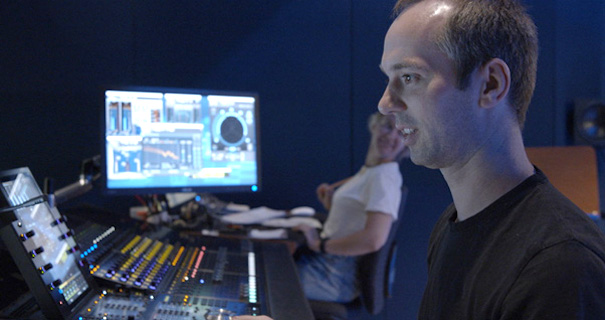
“The decision to use Neumann actually had nothing to do with immersive sound,” explains Michael Thumm. The decisive factor was compatibility with other studies and with the listening experience of its sound engineers. "Neumann monitors equip many television mixing rooms, they are used in universities and also in many recording studios. We spoke to many fellow sound engineers before making our decision and asked them what studio monitors they knew and which one they preferred. I personally like Neumann studio monitors because I have used them frequently and they have always given me very good results. The sound engineers who work with us here at Bauer Studios also agreed to choose Neumann monitors. Furthermore, We usually rent our Studio 2 to external sound engineers. That's why we were looking for speakers that everyone would find comfortable to use. Everyone knew the Neumann monitors and often exclaimed: 'I have the small format ones at home!'”
The uniform sound image offered by the KH range also plays an important role in the Studio 2 monitoring system, because several models are used: "Five KH 310s form the surrounding circle. If necessary, we can add two more KH 310s for the 7.1 configuration. The subwoofer is a KH 870 and we use four KH 80 DSP monitors for the height channels. So we have a 5.1.4 or 7.1.4”.
New mixing and listening experiences
Among the first productions to use the new possibilities was Who are 4 (2019), a documentary commemorating the 30th anniversary of German rap pioneers Die Fantastischen Vier. "Post-production was originally carried out in Dolby Atmos. In the music sector there are some proposals, but there is not much demand, for now."
El motivo, evidentemente, se debe en parte a la pandemia del coronavirus, ya que muchas producciones no pudieron llevarse a cabo. Pero en lugar de sumirse en la depresión, en Bauer Studios decidieron aprovechar el tiempo sabiamente. En palabras de Michael Thumm: “Para los ocho ingenieros de sonido empleados en Bauer Studios, fue la oportunidad de adquirir experiencia en el audio inmersivo. Así que todos los ingenieros de sonido remezclaron sus producciones en Dolby Atmos. Nos familiarizamos con el formato, presentamos a los demás nuestras grabaciones, comentamos nuestros trabajos y nos divertimos intentando averiguar todo lo que podíamos hacer y si tenía alguna utilidad. Probamos varios enfoques y flujos de trabajo diferentes”.
The result is Freiheitsgrade (Degrees of freedom), a compilation of Bauer Studios productions, remixed in Dolby Atmos. The musical repertoire ranges from big band jazz and modern jazz to funk, pop and folk. Unlike other immersive productions, this work focuses primarily on acoustic music.
“It's very rewarding to hear the big sound, like that of big bands, in immersive audio, to feel the energy flowing through the room, even for people who prefer other types of music,” enthuses Thumm. "Like any sound engineer, I like to experiment. You have to ask yourself: What possibilities does this format offer? Or what can I do to improve this musical composition? I also don't have to lose sight of the listeners; for example, they should be able to notice that there are ceiling speakers. When I'm not doing cinema mixes, I can give the listener the opportunity to be in the center of the band. The space created makes the mixing process much easier, since I don't have to use as much equalization and compression to fit the music between two speakers. With sound immersive I can make the montage with much more precision and present it to the listener in a more transparent way. I really enjoy exploring all the possibilities that this field offers,” he concludes.
Did you like this article?
Subscribe to our NEWSLETTER and you won't miss anything.
Related articles
 Neumann improves the treatment of immersive audio via headphones with version 1.5 of RIME
 Audio-Technica inaugurates an immersive showroom with Dolby Atmos technology in Madrid
 NoiseHouse enters fully into immersive audio with The Ones active monitors from Genelec
 Neumann RIME: an integrated solution for immersive audio monitoring in headphones
 Dorna Sports bets on immersive audio in MotoGP with the 8.0 Concept microphones from Audio-Technica
 Australian Hype Republic makes the leap into immersive audio with Dolby and Genelec
 Dolby will share its experiences with immersive audio at Eurovision at the 4K-HDR Summit
 Axis Audio studios (Nashville) are committed to immersive audio with Neumann monitors
 MediaHyperium (California) dives into immersive audio with Neumann
 Audio Lisbon immerses itself in immersive audio with Genelec
 Audioguy Studios emphasizes the benefits of immersive audio with Genelec
 Sennheiser and Neumann enhance virtual and augmented reality with the best immersive audio
 Aragonia and Palafox Cinemas provide their rooms with Dolby Atmos immersive audio
 Anton/Bauer will collaborate hand in hand with Panasonic during the Olympic Games