





‘The Desperate Hour’, shot with Blackmagic’s URSA Mini Pro 12K
Phillip Noyce (director) and John Brawley (director of photography) opted for the URSA Mini Pro 12K from Blackmagic to rotate The Desperate Hour.
The Despertate Hour was filmed during the peak of the Covid-19 outbreak in a region far from Northern Ontario (Australia). In addition to the challenges of filming during the pandemic, the story posed interesting challenges As for photography. Although the majority of the film is characterized by a single actress (Naomi Watts), because the character is constantly running through steep terrain, it was essential to choose the right approach for the photographic direction. Brawley decided to opt for the camera URSA Mini Pro 12K of Blackmagic Design both for its compact size and for the great resolution it offers: “Filming presented several challenges, because the main character jogs, runs or walks quickly for most of the film.”
For Brawley, the key piece of the production was having a film camera that had a versatility such that it could be manipulated in different ways, and thus guarantee broad coverage in different circumstances, despite the challenges of shooting. Brawley implemented the use of four URSA Mini Pro 12K cameras and placed one of them on the back of an electric motorcycle, mounted to a head SRH3 stabilized and motorized with remote control to film a large part of the shots: "I thought it was fantastic, because it is a compact and lightweight solution, suitable for a motorcycle. When you try to weave through the trees and avoid obstacles, you need a light head and camera."
A second camera was set up following studio parameters, while the third unit was used to capture complementary shots or work with Watts' body doubles. Likewise, there was a fourth backup device. The head of photography also used the model Pocket Cinema Camera 6K for additional shots.
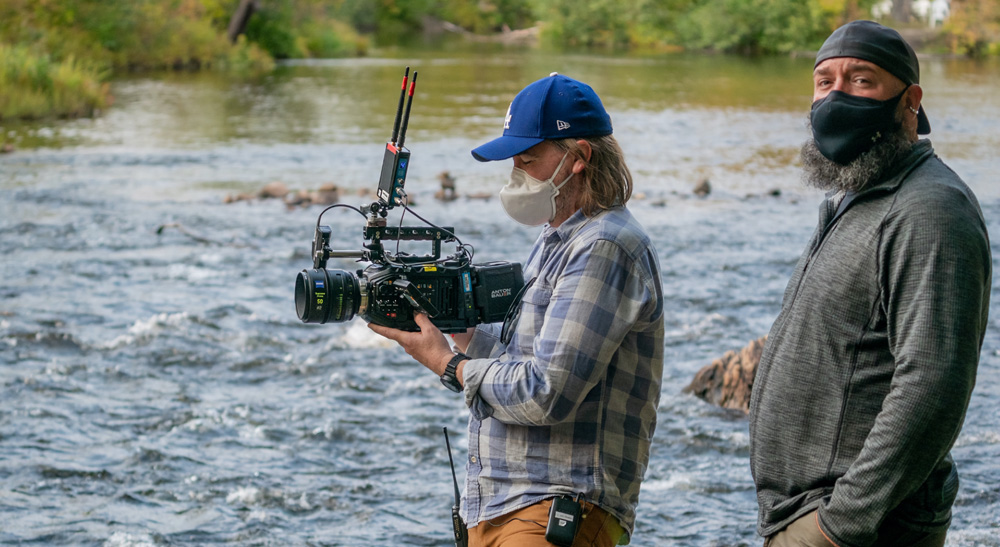
Shoot in 8K and 12K
Brawley y Noyce They decided to bet, from the first moment, on the 12K and 8K resolutions, which helped the duo to stabilize the shots in whatever chaos was necessary. Furthermore, Brawley highlights the possibility offered by URSA Mini Pro 12K of Blackmagic to work in 8K mode without reducing the field of view: "One of the benefits is that the reading time of the rotating shutter is reduced by half. The reading speed on the URSA Mini Pro 12K camera is around 15 milliseconds, but, when selecting the 8K resolution, the time is reduced by half, around 7 to 8 milliseconds. For scenes with a lot of action, especially in profile shots or when panning between trees, shooting in 8K with the rotating shutter helped eliminate the distortion of vertical lines. When we had to beat Naomi on the electric motorcycle, we filmed in 12K, but, where possible, we opted for 8K resolution.”
Brawley was aware that the 12K resolution (12.288 x 6480 pixeles) would be a cause for concern in several areas of work, since a higher resolution can lead to unforeseen events. “I had a talk with Naomi's stylists and makeup artists, because when they heard 12K they started saying: “Wait a minute, are you going to film with this camera a few centimeters from her face?! The funny thing is that when you work with a similar resolution, exactly the opposite happens. It's almost as if the pixel structure disappears and becomes flattering."
Brawley chose to combine 12K resolution with lenses Zeiss Supreme and obtained satisfactory results: "The first time I shot with URSA Mini Pro 12K cameras and Supreme lenses, the quality seemed like what a large format provides, that's how I would describe it, despite using a Super 35 mm sensor. The frames look fantastic at the edges, where peripheral shadowing occurs. I feel that this lens provides the quality that a larger format offers, so I think that the Supreme model complements well with the URSA Mini Pro 12K version."
 A shoot in Blackmagic RAW format
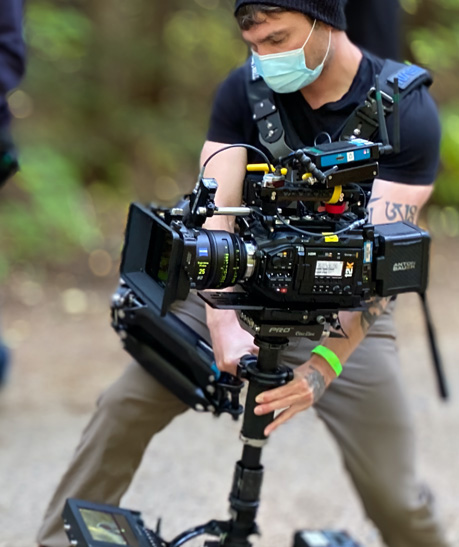
Beyond the technical aspects, Brawley knew that by combining the camera URSA Mini Pro 12K with the format Blackmagic RAW would get the images he needed for the feature film: "The sensor works in a unique way. We were shooting in winter and we knew that we had to pay close attention to the colors of the forest. The production design team chose the location for the appearance of the environment, but the place itself was also an extremely central element. The URSA Mini Pro 12K model provides that intensity, those nuances and captures those small subtleties that do justice to reality, because the autumn colors in that forest are "Particularly during color grading, you can see more subtleties. When you look at Naomi's face, you can see the color of the sky reflected in her forehead."
The compression mode selected during filming was also essential for the data management. Brawley highlights some of the differences that the Blackmagic RAW format offers compared to other codecs: "I used Blackmagic RAW's constant quality Q settings. I shot most of the footage with the Q3 option, because using it at 12K, it works out to about a terabyte per hour and it looks fantastic. The constant quality settings are interesting, as the bitrate fluctuates within a certain range, depending on the motion and depending on the element in focus. Therefore, If something is out of focus, less data is used. Otherwise, more is used. It was interesting to realize that and work through it, but at no point did I feel like I had exhausted the compression limit.”
In short, Brawley's decision to turn to the camera URSA Mini Pro 12K was founded on various reasons that added value to the final product: "The reasons why I chose the URSA Mini Pro 12K model are countless, but fundamentally, we realized that we could have four cameras on set for the price of one, and all of them gave us the additional resolution that we might need to stabilize and resize the shots. The size of these devices is smaller than that of other film equipment, so I also preferred to opt for them, especially for long shots where you have to hold the camera. The camera was handheld. In addition, being a lighter unit made it easier to work with the stabilized head. In short, the reasons are numerous, including the image quality. Phillip attended the premiere at the Toronto International Film Festival and said that the images were amazing. Ultimately, that is the best basis for choosing any camera.
Did you like this article?
Subscribe to our NEWSLETTER and you won't miss anything.
Related articles
 Blackmagic's URSA Mini Pro 12K leads journeys between universes in 'Do I Know You From Somewhere?'
 The Chilean soap opera 'Al sur del corazón', shot with Blackmagic's URSA Mini Pro 12K
 The award-winning documentary series 'Welcome to Wrexham', shot with Blackmagic's URSA Mini Pro 12K
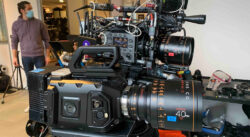 The VFX of 'Marinette' were recorded with the Blackmagic URSA Mini Pro 12K
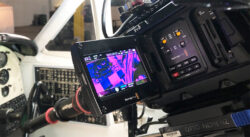 ‘On a Wing and a Prayer’ de Prime Video, rodada con la URSA Mini Pro 12K de Blackmagic
 Disney’s ‘Rise’, filmed with Blackmagic’s URSA Mini Pro 12K
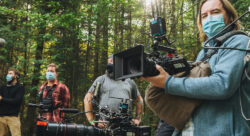 ‘The Desperate Hour’, filmed with the URSA Mini Pro 12K by Blackmagic
 ‘Night Caller’, shot with the URSA Mini Pro 4.6K G2 by Blackmagic Design
 Blackmagic's URSA Mini Pro 12K, star of Kia's new campaign
 HBO's 'Hurricane', shot with an Ursa Mini Pro 4.6K camera
 Working in 12K resolution is now a reality with the Blackmagic Ursa Mini Pro
 The Tribeca Film Festival premieres the science fiction short 'Zero', filmed with Blackmagic's Ursa Mini Pro
 Weezer shoots its latest video clip with Blackmagic's Ursa Mini Pro
 Blackmagic Ursa Mini Pro combines the image quality of Ursa Mini 4.6K with the features of a broadcast camera