





Intelligence and Artificial AI. Unstoppable and Active AI. Let's Try to Take Advantage of It AI


David Corral, head of innovation at Spanish Radiotelevision (RTVE), analyzes in depth Artificial Intelligence applied in broadcast and media contexts, balancing threats, challenges and opportunities.
If there is a technology that could profoundly change our world, as it is already doing, this is it. artificial intelligence (AI). Major political decisions, million-dollar economic investments in all sectors, promising advances along with the risk of harmful threats define a technology that has a substantial transformative impact, in many ways, on our lives and activities, including the media.
Throughout our history, the media have been users and communicators of the possibilities of innovations such as the printing press, the telegraph, the telephone, the radio, computers, the Internet, smart devices... and now AI, which reaches a speed and in very different circumstances to those that existed when the technologies that preceded it were available in our newsrooms. It is a time of challenges, but also of many opportunities, such as being able to decide your best use or what to use it for.
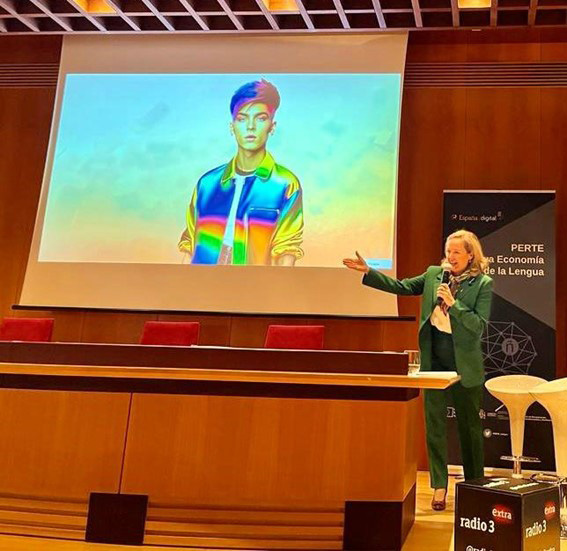
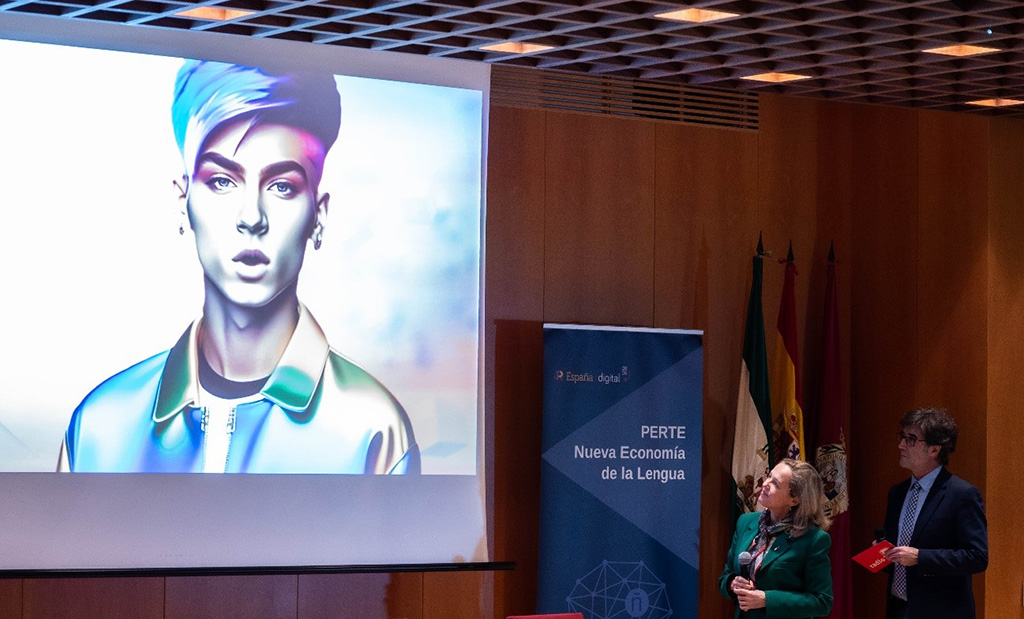
The first vice president and minister of Economic Affairs and Digital Transformation, Nadia Calviño, speaks with RTVE's Hiperia at the Cádiz Language Congress
The race for AI
"Good morning. It is 8 in the morning. Today the weather forecast is good, with sunny skies and pleasant temperatures. You have appointments on your agenda with... I recommend that you use a route through... and this means of transport. Your vehicle has a 64% charge. Don't forget, you must congratulate... on his birthday. The outstanding news of the day is...". This message, with the voices of Siri, Alexa or Cortana, among others, “sounds” everyday and is common in most places in the globalized world that we live in. It is a world in which we live and cohabit with billions of connected devices that collect, analyze, manage and use a fundamental issue in the Fourth Industrial Revolution in which we find ourselves: data.
 Homes, vehicles, buildings, cities... as well as mobile phones, tablets, computers or televisions are discreetly connected around us, giving shape to IoT, the Internet of Things, in which artificial intelligence (AI) is key as it is a transformative technology that is defining its present and its future, like that of people, societies and nations.
Statesman, the statistics portal, estimates that in 2023 there will be 16.7 billion connected devices and that there will be, in 2027, 29.7 billion. Smart devices are already part of most people's daily lives, both in their personal and professional lives. The almost 8 billion inhabitants of the Earth have 8.6 billion mobile phones in their hands, in addition to billions of other smart devices, such as watches (smartwatches). With them we communicate, we inform ourselves, we entertain ourselves, we educate ourselves or we travel in a long list of possibilities in which AI has a lot to do with.
The great powers, in an intense struggle for geopolitical, economic, military and diplomatic hegemony, fight hard for the supremacy or control of different technologies, either directly or through large companies or technological institutions. The exploration and exploitation of Space or Cosmos, energy, quantum computing, the hypersonic world or microchips are some of the areas in dispute, but the race for Artificial Intelligence is the key in which governments and firms such as Microsoft, Alphabet, Apple o Amazon in the United States, or Tencent y Baidu in China, they are investing millionaire budgets to dominate the technological, industrial, scientific and social development that it can mean.
A competition that is very present in our lives and in which predominates three visions: Europa wants to regulate to guarantee better conditions for the development and use of this innovative technology with a humanistic approach that takes into account opportunities and threats, USA has maintained, until now, confidence in the self-regulation of markets and business interests in the face of the omnipresence and control of China about their technologies and their users.
AI Game Rules
Throughout the world and in recent years, different legislations have been passed, such as the EU Artificial Intelligence Law (the first comprehensive law on AI in the world), or in Spain the National Artificial Intelligence Strategy, which aims to provide the development of inclusive, sustainable and citizen-focused AI and which is one of the main elements of the Digital Spain 2026 Agenda. But it was at the end of 2023 when decisive steps were taken with the launch in the United Nations of its High Level Advisory Body on artificial intelligence or the executive order signed, of about 100 pages, by the US president, Joe Biden, to control the development of artificial intelligence systems and their application in all sectors of society in the face of the risks that this new technology poses, a technology that, in the words of Biden, “is the most transcendental of recent history.”
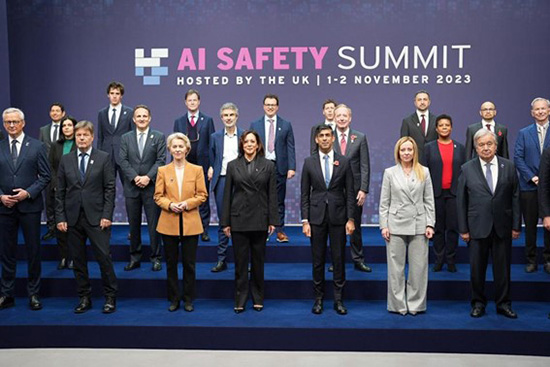
World leaders have committed to AI Safety Summit to work for one More humanistic, reliable, transparent and secure AI to avoid damage “catastrophic“.
Just hours after this signing, the main world leaders in the sector met in London. AI Safety Summit. From this summit, in which the United States, China, Europe and dozens of countries have been represented along with companies, civil society and AI experts, the first major international declaration for the regulation of artificial intelligence. In it, they have committed to working for a More humanistic, reliable, transparent and secure AI to avoid “catastrophic” damage, which is why they have requested international collaboration to tackle these dangers and be able to protect privacy, improve civil rights, protect consumers, support workers and promote innovation, among other issues.
Bletchley Declaration
AI is, by far, one of the main and most active assets in world stock markets. 85% of European and American companies consider that it should be a priority in the development of their business and nearly 35% of them use it directly or indirectly. If considered only from an economic point of view, AI can produce a 7% increase in global GDP over a 10-year period according to a study by Goldman Sachs. More optimistic is the forecast of the global strategic consulting firm McKinsey. In their estimates, AI could generate additional global economic output of about $13 trillion between now and 2030, which would mean an increase in global GDP of approximately 1.2% annually. If we talk about our country, the consulting firm Advice Strategic Consultants considers that AI in the productive and service economy, in business activity, in public administrations, in large companies, SMEs and microenterprises, would mean an increase of about 17,446 million euros each year to the Gross Domestic Product, the equivalent of an annual growth of 1.2% from 2023 to 2030.
This growing adoption of intelligent tools in companies is a reality in sectors such as healthcare, pharmaceuticals, food, legal, finance, security, engineering, technology, cybersecurity, public or private administration, logistics and transportation, or energy. In them, the analysis of huge amounts of data It is accelerating processes that allow us to have more precise and cheaper drugs, with spaceships that will take us further and faster, with cleaner energy, with new materials; multiple possibilities and advances of which The media are not, nor can we be, alien…or, at least, try.
And the media? What is done? Since when?
Although it may seem surprising, the AI is not a recent invention. It is, in fact, older than the Internet. The British Alan Turing, the brilliant mathematician who deciphered the Nazi codes of the Enigma machine and one of the fathers of computer science and modern computing, stated in his 1936 study “Calculatable Numbers” that machines were capable, by themselves, of solving any mathematical problem that could be represented by an algorithm. Although, in the field of artificial intelligence, in which he is considered one of its fathers, his main recognition is for the 1950 test that bears his name, a test that allows us to determine whether a machine is intelligent or not based on the answers it provides, whether or not they are indistinguishable from those that a human being would give. The concept of artificial intelligence, as such, is the name given in 1956 by John McCarthy, Marvin Minsky and Claude Shannon to “the science and ingenuity of making intelligent machines, especially intelligent calculation programs” at the Darthmouth Conference (United States).
The artificial intelligence has two uses: the one we know or are aware, y which we do not know or are not aware of.
And if AI is not so recent, the same goes for its use in the media. We can think of artificial intelligence as having two uses: we know or are aware, y which we do not know or are not aware of. This second case is all the technology and tools based on AI that we find and use in browsers, mobile phones and their APPs, in digital services, computers, communications networks, cameras, editing software or recommendation systems such as those of audio and video platforms, among others.
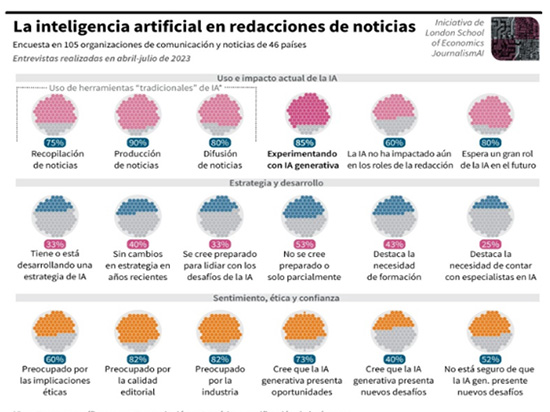
Use of AI in JournalismAI newsrooms
In the case of conscious application, the origins were like those of conventional media with printing, text. In 2010, the first work began in different US media and in 2013, the US news agency Associated Press began using “Automated Insights” technology to generate stories from structured data and natural language (NLG). First it was sports news and later economic reports. That same year Automated Insights, founded in the USA in 2007, produced 300 million pieces of content, an amount that exceeded the conventional output of the major media outlets combined. The following year, the amount rose to one billion and in 2016 production was already more than one and a half billion pieces of content.
The American newspaper The Washington Post He has been using “Heliograf” since 2016 to write news about politics and sports. In its first year it produced hundreds of articles and won an award for “its excellence in the use of bots”, specifically for its coverage of the 2016 US presidential elections. Bloomberg, to name a few other cases, relies on “Cyborg” to convert financial reports into news, Forbes with “Bertie” to help journalists by collecting data and generating drafts, and the New York Times, a medium that has always stood out for being at the forefront of technology, with “Editor” for automatic text review.
Among the Chinese pioneers is “Dreamwriter” from the technology giant Tencent and, if we talk about Europe, cases such as those of the French newspaper stand out The World with “Syllabs”, the BBC British with “Arria NLG” or the YLE Finlandesa, both public radio and television stations and partners of the EBU/UER and both with departments specifically dedicated to AI research, such as RTVE. In our country, several media outlets have had experience covering sports results, or economics, meteorology or lotteries, in most cases with the “Gabriele” technology from the Spanish company. Narrative.
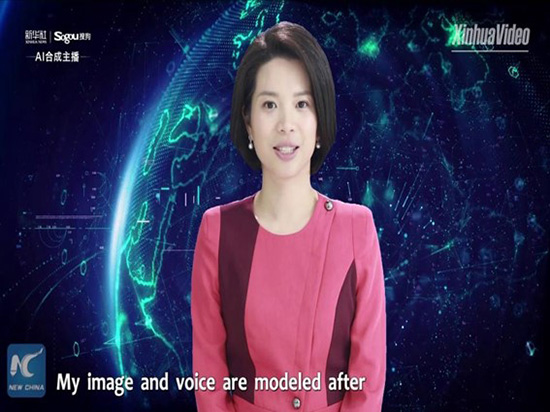
Chinese TV AI Presenter
And generative AI arrived…
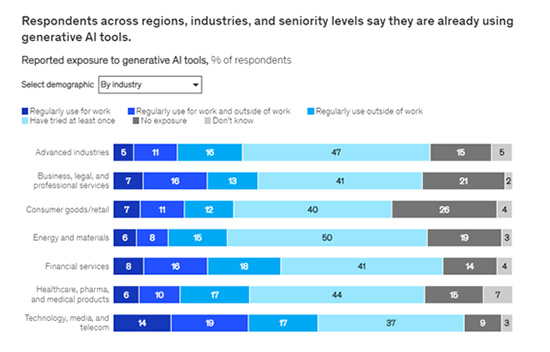
The AI revolution for the media, and probably not the last, has been recent and has a name or label: “generative”. ChatGPT, GPT-3, DALL-E, Whisper, Midjourney, Runway, MusicLM, Copilot, Bard, Grok or Llama These are just a few of the major tools that have been released in recent months, not to mention the dozens and dozens that emerge weekly or are developed by major technology companies. They have been trained with advanced neural networks to learn by “studying” gigantic repositories of text, images, video or audio so that their algorithms are capable of generating, from these existing data (created, until now, by humans), new images, audios, voices, videos, texts, ideas, etc. that can be considered “original” or “unique”.
But the real revolution and impact for the media, and for users and consumers in general, is that, unlike previous technologies, and more pronounced the older or analogue, is that They are not exclusive, they are not specific, they are not difficult to obtain and, very importantly, they are not impossible to acquire due to their price nor do they require extensive professional training to obtain good results. In recent years, we have seen how social networks and streaming channels have given more and more space and voice to new information and entertainment references, the UGC (user generated content/user generated content). They are people not linked to conventional media, such as streamers or influencers who, with affordable investments and equipment, have managed to bring together with their activity thousands of followers and obtain significant financial returns.
The impact of the Generative AI It is such that a study of KPMG claims that almost four out of five managers They consider this technology as the one that greater impact will have in your businesses in the coming years.
And after them has come the emergence and the dizzying pace at which artificial intelligence evolves, which has allowed these new generative tools, increasingly powerful, to be available for professionals and general public, and that they are free or very cheap and that their use is as simple as downloading an application or entering a website to, with little knowledge, begin to generate and distribute an almost unlimited amount of content or invent new formats and narratives. The impact of generative AI is such that a study of KPMG states that almost four out of every five managers consider this technology as the one that greater impact will have in your businesses in the coming years.
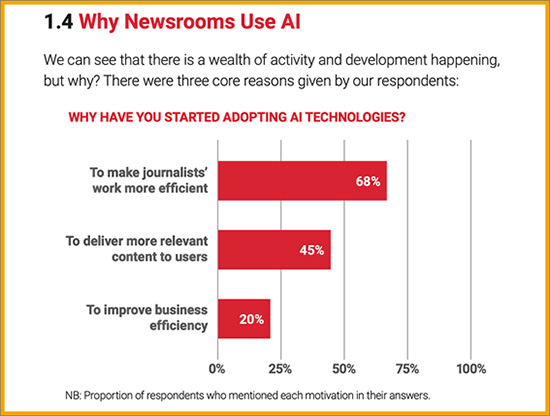
Use of AI in JournalismAI newsrooms
The market intelligence company IDC recently published a report predicting that investments in generative AI will increase from $16 billion this year to $143 billion in 2027. While generative AI represents only 9% of total AI spending in 2023, it is estimated to increase to 28% in five years. IDC has also highlighted in this market analysis that the growth rate of generative AI is more than double the growth rate of global AI spending, and that it is growing at a compound annual rate almost 13 times higher than global IT spending in the same period of time.
In a recent study of EBU/UER on artificial intelligence and its possibilities of use in the media, especially in the public, it is highlighted that among the members of the main global alliance, less than 1.7% of the staff is dedicated to the development or integration of AI although the 51% rate AI as a business priority in 5 years. 30% of those who use AI do not yet have a clear policy on its use and application and, since ChatGPT came to market, 76% have updated their business strategy but only 3% have it completely defined.
Possibilities, many
If we think about how we can use algorithms in our companies and newsrooms, the possibilities are not limited or scarce in what we already do and in what we still do not know. Among the main possibilities are:
- Get to know our viewers better or users making the best possible use of their data to personalize and recommend content that is informative, entertaining, interesting, etc. improving the efficiency and relevance of the information or entertainment offer.
- Adapt and modify these contents almost infinitely in length and format according to our style for each platform or distribution medium and according to the preferences of the recipient. It is a possibility for all audiences, national or outside our borders, to have the same opportunities and different ways to find and enjoy content.
- Offer content whose coverage is complicated, such as those on local issues of small towns, those on sports or minority issues, etc. Guaranteed the same right of access to information to everyone.
- Audience segmentation.
- Market analysis, obtaining detailed analyzes on public preferences and audiovisual market trends, being able to adjust the activity to better satisfy the demands of the public.
- In a scenario of excess or adjustment in the supply of content, platforms, channels, emission and reception systems, etc., adjust our activity to real demand of the audiences and the market.
- Help in the decision making and in planning, favoring anticipation.
- Automation of repetitive tasks in emissions, in work flows, etc.
- Automation of content on social networks.
- Content generation: text, audio, video, music, voices…
-

Hiperia, the IA presenter of RTVE's Radio 3 Extra
Avatars or synthetic presenters whose image and voice may be original or emulate real people.
- Automatic assembly, or audio and video assistance, or recommendation.
- Automatic completion, live or with recorded, audio and video material for broadcast.
- Remote production.
- Virtual sets equipped with immersive technologies.
- Instant extraction of audio/video clips or cuts for summaries (sports and politics, for example) or to quickly post on social networks.
- Improvement in sound quality reducing unwanted background noise, balancing levels, optimizing the final mix...
- Podcast creation or support.
- In documentary collections or archives, power metadata, work with semantic web, recognition of entities, images, voices, etc.
- Voice assistants that They give access to our content and services and allow us to have new communication channels, open and active, with our viewers and users to reconnect, as in any possible way, with the audiences.
- SEO improvement.
- Analysis of large databases and news gathering.
- systems news detection or alert.
- Enrich or complement content with material of different types, origins or suggestions depending on the topic and recipients.
-

RTVE IVERES project at www.iveres.es
tools content verification.
- Content moderation, curation and control and biases, hate speech, polarization, etc.
- Know and develop public opinion information on certain topics.
- Representation or generation of data graphs/infographics.
- Transformation, improvement and/or restoration of the image and audio quality.
- Transcription from audio and video to text.
- Translation and/or automatic subtitling of content on different broadcast and synchronization platforms, if they are audiovisual.
- Emissions and quality control with which it is spreading.
- User management and customization and subscription and advertising tracking.
- Emotion analysis and public reactions, activity on social networks, etc.
- Work with speech recognition and automation of the service through chatbots, smart speakers or similar systems.
- Collaborate and reinforce cybersecurity strategies, energy efficiency and accessibility.
- Monetization of content and activities.
- Create games, hobbies, such as questions, current challenges, etc.
- Improve processes, make them cheaper, respond to needs and the greater demand for activity (more broadcasts, more content, more languages, more platforms...).
- “Listen” to our activity to “measure” and evaluate it, to avoid biased or polarized content or to check, or adjust if necessary, the monitoring and compliance with the current internal and legal regulatory framework.
- Fight against content piracy, rights, signs... and identify those who commit it.

These are just some examples of possibilities of use. Applying them in our workflows in the most convenient way or deciding what we want or do not want to do with them will allow us to be competitors in the market and not be, irremediably, outside of it and the reality of societies that are being defined by the arrival and advances of new technologies.
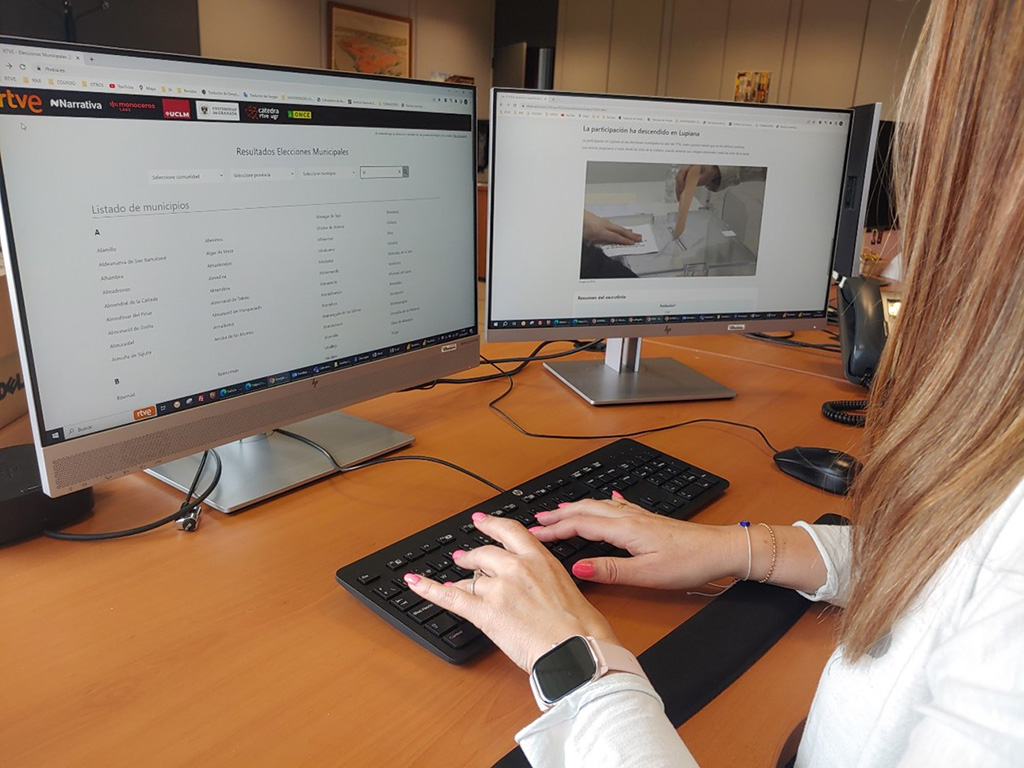
RTVE AI electoral coverage project at www.rtveia.es
Challenges, some
They are not few, but they are not difficult to assume and some of them are pure common sense and will simply seem obvious. At the top of the list are some issues that may be the most obvious, but they are, precisely because of that obviousness, the first:
- Our societies, our publics and audiences, demand a better knowledge and understanding of technologies, what is being done with them, what they are for or how they are influencing or will influence our lives. A recent survey conducted by Metroscopy reveals that 72% of Spaniards consider that the media offers mediocre information about the advances of AI, that 73% of those surveyed feel that the media generates more confusion than clarity on the subject and that 63% believe that the media, and this is our responsibility and objective, have a fundamental role in defending the general interest. Therefore, we must communicate information and relevant and unbiased content about technologies and trends to our societies, publics and audiences. This information is important so that people know the impact of technologies on their lives, the role of the media in digital societies and the importance of participating in the debate about the future of technologies.
- Have guides or standards for the use of AI, specific, for the media. It is essential to avoid risks, ensure responsible use and promote transparency. The standard should be known internally and public and open externally. The principles should be updated periodically.
- Day IA, understood as a set of technologies and algorithms, is another tool, It is never and should never be an end in itself and its objective should be to help us and not replace us. Professionals must decide what to do or how to work so that these tools help and not substitute, with humans always being responsible for the decision to use and supervise the activity of artificial intelligence. The same criteria of quality, rigor, diligence, independence, transparency, diversity, universality, inclusion, accessibility and reliability must be guaranteed and applied as in any other usual activity.
 Inform, entertain and educate by fulfilling and strengthening our democratic mandate and avoiding the mass production of low-quality content that lowers editorial standards. Apply the principle of transparency to synthetically generated content, communicating its authorship and explaining what has been done to inform consumers.
- Combat misinformation, polarization, discrimination or hate speech serving, in an equitable and fair manner, our citizens, audiences, societies and democracies, providing certainty and trust in our content, how we make it and what tools we work with so that everyone can access the available content and facilitating, with the commitment to promote democratic values, the same right of access to information to all citizens.
- Actively avoid bias, polarization, discrimination, stereotypes, absence of an ethical approach or actions that are not beneficial for society, the general public, media companies, content creators, respect for fundamental rights, etc.
- Respect the competition principles together with the established criteria of ethics and professional and business deontology and guarantee and protect the rights of authors, creators, holders of other rights and users, complying with current regulations or the established framework of use.
- Guarantee the protection, both physical and cybernetic (cybersecurity), of the personal data, its use and privacy respecting user data sovereignty and regulatory compliance.
- Investigate and innovate to know, in the present and in the future, the reality, possibilities and limitations of AI, like any other technology. Explore new experiences and possibilities of using AI in the production of content, its distribution or the services we offer through pilot projects, prototypes, collaborations or specific tests that guarantee the most optimal final result.
- Work, to the extent possible, to achieve a lower environmental impact and support the achievement of the Sustainable Development Goals.
- Support the strategies and policies for technological transformation and updating, humanistic and inclusive digital transition, media literacy and closing digital gaps.
- Trust and support Spanish companies and technology that use as reference language Spanish, a language that is official and of international reference, strategic for its extension, its cultural legacy and its economic impact (about 7% of the world's GDP).
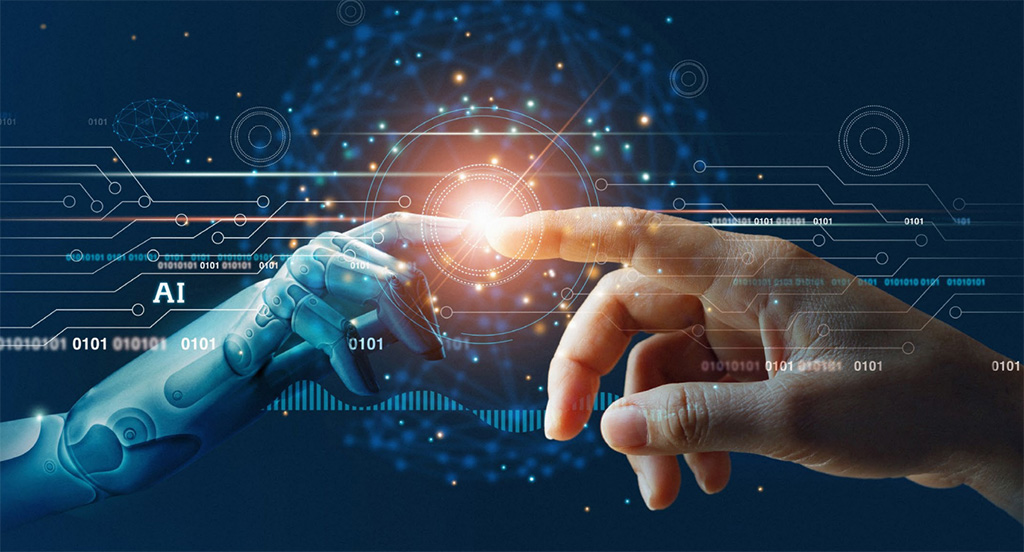

Employment, challenge and concern
Surely, the challenge that most concerns professionals, companies and educational institutions that must train future workers is the job transformation, of jobs, of the tasks that we must carry out or how we carry them out: a central issue in the digital transformation of society that is one of the main priorities of the EU and its member countries whose objective is to be competitive and technologically leading but respecting rights and our “digital sovereignty”.
The ability of machines, algorithms, to emulate the capabilities of human beings such as reasoning, learning, creativity and the ability to plan, are increasing and the terms are no longer foreign to us machine learning o machine learning, natural language processing, artificial neural networks, expert systems, data mining or data mining, computational linguistics, computer vision, prompt…It is a transformation in which barriers fall rapidly and in which technological vertigo is an increasingly common sensation in our societies.
As in previous industrial revolutions or economic transformations, a cyclical phenomenon will be repeated: the invention or transformation of jobs and profiles thanks to technological advances.
The survey Randstad Workmonitor Pulse shows a mixed perception of AI in the workplace: 47% of employees are enthusiastic, 39% have reservations. The majority, 52%, believe it will improve their career prospects, but only 13% have received AI training in the last year and 22% express a desire to receive such training. The data underscores the urgency for organizations to invest in training, especially as demand for AI skills increases. Failure to do so could lead to impacts on jobs and underutilization of the potential benefits of AI.
“History teaches us that technology does not lead to unemployment,” argue Deutsche Bank economists, and as the graph clearly reflects: “Unemployment has fluctuated in response to economic cycles, not technological waves.”
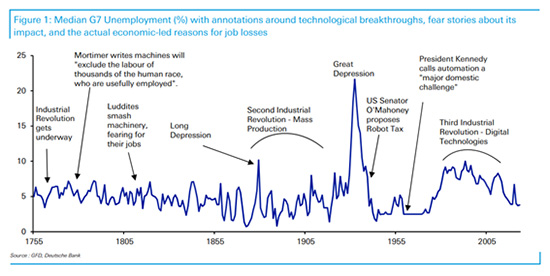
Economic cycles Deutsche Bank
Only 8% of workers in Spain believes that Generative Artificial Intelligence could make them lose their jobs, while 73% of Spanish workers say they already use this technology in their workplace, three percentage points above the global average, especially tools such as ChatGPT and Google Bard. These are the main results of the fourth edition of the study “Global Workforce of the Future 2023” prepared by The Adecco Group, which also highlights that almost eight out of ten workers in Spain (79%) believe that the impact of Generative AI on their work will be positive and point out its benefits: saving time on basic/routine tasks (28%), finding information very quickly (27%), help to obtain new ideas (24%) and streamlining communication processes (19%).
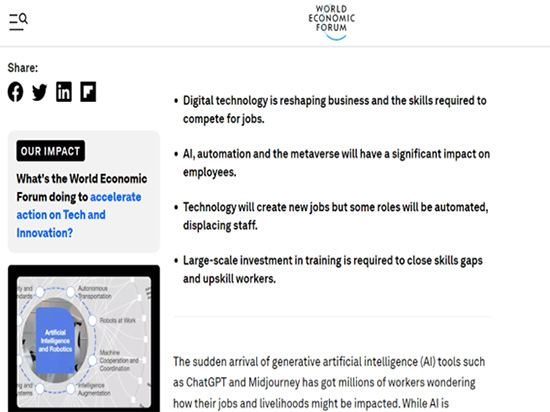
IMF Web – Impact of technologies
It's time to bet on training and adaptation continues, to encourage human capabilities and foster creativity in multidisciplinary teams that contribute the best of their knowledge and perspectives to develop new products and services that offer a unique experience or value for audiences and that allow them to keep pace with the gradual technological transformation that is modifying the media ecosystem and the definition of profiles and workflows.
According to the International Monetary Fund (IMF), AI will destroy tens of millions of jobs, but in return it will create many more. For reference, currently around 60% of employed people do so in jobs or occupations that did not exist a century ago. As in previous industrial revolutions or economic transformations, a cyclical phenomenon will be repeated: the invention or transformation of jobs and profiles thanks to technological advances.
The new AI profiles in televisions, radios, platforms...
In the case of the media, we could meet AI editors; specialist in prompts AI; AI developer or trainer; AI moderator; audio manager (AI); video manager (AI); digital infographic (AI); verifier (AI); SEO manager/writer (IA); social media manager (AI); cybersecurity expert for media and AI; editor/manager big data; growth hacker/audience development (AI); platform manager; experience and content designers; environmental impact manager or specialists; manager bots conversational; information architect; subscription/retention manager (IA); specialized linguist, etc, etc, etc…
Have still the great opportunity and capacity of decide what and how we want to be.
The prognosis, as on previous occasions, is that automate tasks so that they can be carried out in a much more efficient and affordable way, allowing human professionals to enhance and value their essential qualities such as emotional or creative intelligence, critical or analytical thinking, resilience and flexibility, the ability to relate and interpret... Issues that, in the case of the media, can allow us do better journalism, more personal, with greater depth and, fundamentally, telling in the best possible way, something that is of interest to our audiences and audiences: stories, real stories, original, interesting, true, more personal…human.
We still have the great opportunity and capacity to decide what and how we want to be. Surely better, it is in our hands.
David Corral
Innovation Manager RTVE

Did you like this article?
Subscribe to our NEWSLETTER and you won't miss anything.
Related articles
 Without people there is no intelligence (or artificial) in broadcasting
 The RTVE-UAB Chair publishes the 6th report on Artificial Intelligence and Journalism
 Limecraft proposes the concept of Media Intelligence versus Artificial Intelligence
 RTVE Institute promotes a new master's degree in Journalism and Artificial Intelligence
 RTVE launches 'Hiperia', a format created 100% with artificial intelligence
 Europe in the face of disinformation: artificial intelligence and alliances
 Vicomtech and RTVE present their advances in automatic subtitling using Artificial Intelligence
 VSN incorporates Artificial Intelligence into the RTVE Documentary Fund
 Making the Sustainable Development Goals visible in RTVE with Artificial Intelligence
 Technology and precision to cover the 4M election night on RTVE with Artificial Intelligence
 RTVE will test Artificial Intelligence to cover elections in small municipalities
 2020, a year of Artificial Intelligence in RTVE Innovation
 TVE's news programs implement artificial intelligence with Etiqmedia and Aicox
 The IV OI² Conference will reflect on artificial intelligence applied to journalism