





Cinegy Enables Interlaced H.264 on New Nvidia GPUs in Latest SDK
The Cinecoder video codec SDK Cinegy solves a highly demanded requirement by the broadcast industry: the ability for GPUs Nvidia can handle H.264 interlaced video processing.
Interlaced video format H.264 It is used throughout the world for the transmission of HDTV 1080i through over-the-air, satellite, cable or streaming television service providers. The majority of HD broadcasts continue to use this format, although adoption of newer progressive codecs and formats is increasing. For years, software developers and solution providers have been using H.264 encoding features of Nvidia GPUs, which became the cornerstone of many solutions for the multimedia industry.
With the introduction of the series Turing of GPU, Nvideo ended support for interlaced H.264. Although at first this announcement caused a certain earthquake in the industry, the availability of the previous generation of cards Nvidia Pascal served to minimize damage. However, the availability of Pascal-based hardware has ended and these cards no longer receive driver updates from Nvidia, significantly impacting many broadcast workflows.
The version 4.22 of the Cinecoder de Cinegy SDK addresses this challenge by allowing interlaced H.264 encoding using Nvidia GPU cards from generations Turing, Ampere y Ada Lovelace (current). These cards offer more performance, higher encoding capacity, and greater power efficiency, while the new cloud instances provide better value.”quality-price”, always according to Cinegy.
Jan Weigner, CTO of the company, describes the development as “a great achievement”, as well as a “great relief“Our customers were having a hard time finding a solution, especially after driver support for Pascal-based cards ended. New Nvidia cards can now be used for H.264 interlaced encoding, achieving much higher performance. Also, when considering cloud deployments, we don't have to limit ourselves to using AWS G3 instances, which were the AWS instances with Pascal series GPUs,” he explains.
First tests of H.264 interlaced, Nvidia and Cinegy
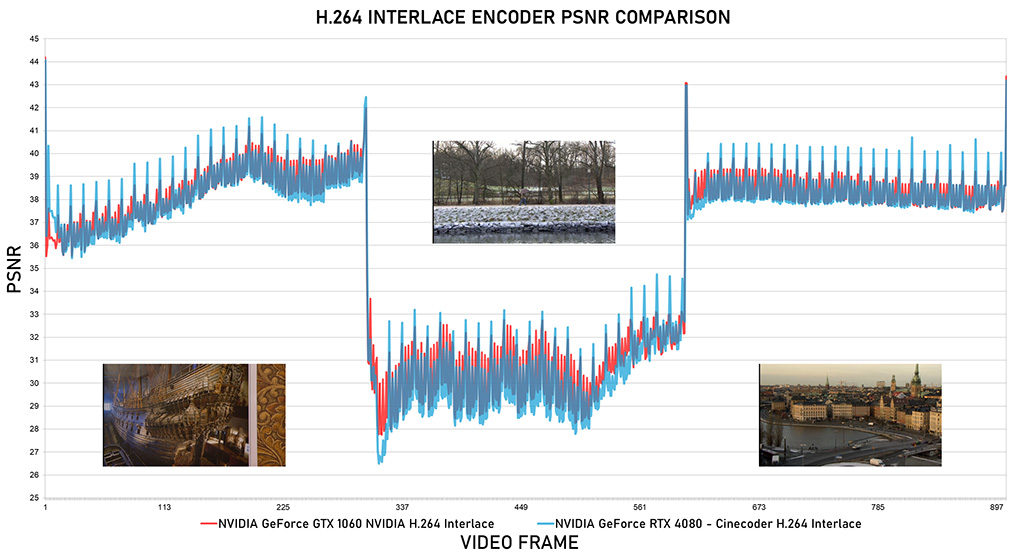
Los comparative analysis conducted with standard test clips demonstrate that Cinecoder's interlaced H.264 encoder for Nvidia GPUs “creates equal or better quality output” than Nvidia's original Pascal series hardware encoder.
He encoding performance in the GPUs Nvidia based on Ada Lovelace, Nvidia's current generation, is about 500 FPS for H.264 1080i per NVENC encoder unit, which means that cards with two NVENC units, such as the RTX 4070 Ti, RTX 4070 Ti Super, RTX 4080 and RTX 4090 (or their professional counterparts such as the RTX 4000 ADA and above) can encode at about 1000 FPS. If we translate this to 1080i50 or 1080i59.94, in theory you would get 20 or 16 streams with a single NVENC, or 40 or 32 streams if you use a GPU with two NVENCs. Theoretically, since there are usually other system overheads that reduce the number and Nvidia consumer cards have a hard limit on the number of output streams enabled, that makes a second NVENC unit “useless”, at least when encoding only HD streams.
"That's why professional Nvidia cards are purchased, such as the RTX 2000 Ada or higher, since they have no restrictions on the number of output streams. They also come in formats more suitable for use in servers, such as the RTX 2000E Ada, which is a single slot, half length and half height. It fits anywhere. Or the RTX 4000 Ada, which is also single slot, but full size," he adds. Weigner.
Cinegy's Cinecoder SDK can be purchased under license specifically to enable H.264 interlaced encoding on the Nvidia GPU or for all additional encoding, decoding and media handling features. It also includes Cinegy's proprietary Daniel2 codec, a video codec designed to run natively on GPUs, with over 10,000 FPS 4K encoding and 30,000 FPS 4K decoding.
Did you like this article?
Subscribe to our NEWSLETTER and you won't miss anything.
Related articles
 Atomos enables external 4:3 Open Gate RAW recording up to 48 fps with the Fujifilm GFX Eterna 55 camera
 Accedo enables the purchase of subscriptions via Smart TVs of the FloSports platform
 ARRI enables remote control of its cameras with the new Camera Companion app
 Cinegy Air Pro and Capture Pro add new options to Canal+ Polska's broadcast processes
 Fujifilm enables 8K 30fps recording on its new mirrorless GFX100 II
 Mediaset enables the Canarian disconnection of Telecinco through the Movistar+ IPTV signal
 Teradek enables remote camera control with the Bolt 4K Monitor Module TX
 Nagra enables OTT in the cloud for Montecable in Uruguay
 The latest from Silicon Valley, at the New Technologies Observatory, on July 17 and 18 in Malaga
 Mountain incorporates Nvidia's new Maxwell graphics into its equipment
 Cinegy presents version 9.6 of Cinegy Air Pro at NAB 2014
 Cinegy will show version 9.6 of Cinegy Air Pro at NAB 2014
 New end-to-end solutions for 3D streaming from Nvidia
 Cinegy to reveal new digital workflow tools at IBC'09