





The European Parliament builds its streaming platform around Norsk
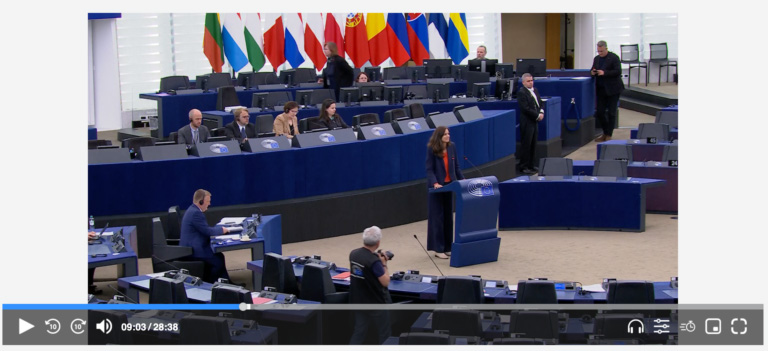
G&L Systemhaus, a systems integrator specialized in video and audio streaming solutions, implements a powerful streaming platform in the European Parliament using Norwegian as a critical technological component.
He European Parliament collaborates with the Council of the European Union to debate and pass legislation on topics ranging from artificial intelligence and defense to deforestation and human rights. With 720 members from 27 Member States, Parliament needed a sophisticated streaming solution that could handle multiple languages, high-density inputs, and flexible deployment across on-premises and cloud environments.
The requirements of streaming of the European Parliament presented several complex technical challenges. Among them, the needs of hybrid deployment, as the solution had to work seamlessly both on-premises and in the cloud; compatibility with up to 32 SDI inputs per machine to manage the numerous video sources from different parliamentary chambers and multiple levels of redundancy; complexity of multilingual audio, because each video channel had to support up to 32 audio tracks in different languages, which exceeded the 16-track limit of SDI and required creative signal management; requirements of hardware acceleration, since the transcoding workload was considerable; flexibility for custom integrations, and compatibility with Linux.
To address all these challenges, explains Alexander Leschinsky, co-founder and CEO of G&L Systemhaus, the company decided to opt for the solution of Norwegian. In his own words: "We needed something that worked both on-premises and in the cloud. At the beginning of the project, we didn't know how much we were going to ultimately solve on-prem, how much we were going to move to the cloud, what workloads we were going to move to the cloud. So we needed something that worked in both worlds. Norsk allowed us to deliver a complex and sophisticated media processing architecture in record time with a high level of system availability and resiliency.
Norsk SDK, technological backbone of the European Parliament's streaming
One of the main advantages that Norsk offered was the ability to integrate with specialized hardware: "Part of the appeal of Norsk was that you could do custom integrations. If there's something that's not there and you see some business value in it, you can integrate it, even if it involves quite advanced engineering," explains Leschinsky. In this way, the system could be adapted to work with Deltacast SDI input cards, which offered the highest SDI input density available, a critical requirement for the project.
The project also required a large capacity of transcoding, y G&L quería aprovechar las tarjetas aceleradoras de hardware de Netint rather than relying solely on CPU processing: “Support for Netint cards was also something that was a big advantage for Norsk, because of course you could use FFMPEG, but supporting FFMPEG on Netint would have required more work from us compared to what Norsk does with Netint.”
Adicionalmente, el SDK de Norsk proporcionó una funcionalidad consistente tanto en entornos locales como en la nube, permitiendo a G&L utilizar la same code base regardless of where specific workloads were ultimately deployed. This flexibility was crucial as the deployment strategy evolved throughout the project.
In the final rollout of the European Parliament's streaming platform, Norsk is responsible for an important selection of key elements for the audiovisual content processing. Specifically, it is responsible for recording incoming 1080i50 video signals with up to 32 audio tracks in a 7-day cycle memory; encoding incoming 1080i50 video signals with up to 32 audio tracks into live SRT streams, sent to both transcoders and an internal PE multicast platform; transcoding these SRT sequences into ABR sequences, packaging in HLS, sending to Akamai MSL4; remixing the SRT video stream and a selected audio track into an RTMP live stream for social media networks, and trimming selected time periods of live footage into VoD files
Additionally, Norsk integrates directly with other key components workflow, such as capturing from capture cards Deltacast Flex SDI; la codificación y transcodificación con tarjetas Netint Quadra T1U; el almacenamiento de grabaciones en servidores rack basados en AVPU, Ampere Altra Max de G&L con gran capacidad de almacenamiento NVMe; la transmisión de secuencias en directo SRT, RTMP y HLS a través de la red multisede que G&L ha creado entre Bruselas, Estrasburgo, Fráncfort y Düsseldorf; la recepción de metadatos de eventos e instrucciones de trabajo desde el CMS de G&L y el backend de orquestación, que se ejecuta en dos clústeres de Akamai Connected Cloud en Frankfurt y Ámsterdam, y el envío de datos de telemetría al clúster Hydrolix de G&L para su observabilidad.
Did you like this article?
Subscribe to our NEWSLETTER and you won't miss anything.
Related articles
 LiveU ecosystem builds its future around automation at NAB 2025
 M6 builds its new AVOD platform with AI-powered Bedrock technology
 Zero Density builds its proposal for NAB 2024 around Unreal Motion Design
 The European Parliament approves the creation of IRIS², the European Starlink
 The Television Academy addresses the challenges of the audiovisual sector in the European Parliament
 The Red5 Pro streaming platform consolidates itself in European territory
 RTVE broadcasts a European Parliament event in 5G, multi-camera and cloud production
 The Film Academy exhibits the three finalist films for the Lux Prize of the European Parliament
 Lavinia launches the new European Parliament TV website
 Riedel managed the signals in the European Parliament elections
 The Commission welcomes the approval of the Creative Europe program by the European Parliament
 Streaming from the Swiss parliament via DSL lines
 The European Parliament strengthens its archive with the help of Harris Invention
 The EBU will broadcast live from the European Parliament with hybrid radio technology