





VAR comes to Pacific football with a remote architecture based on LiveU technology
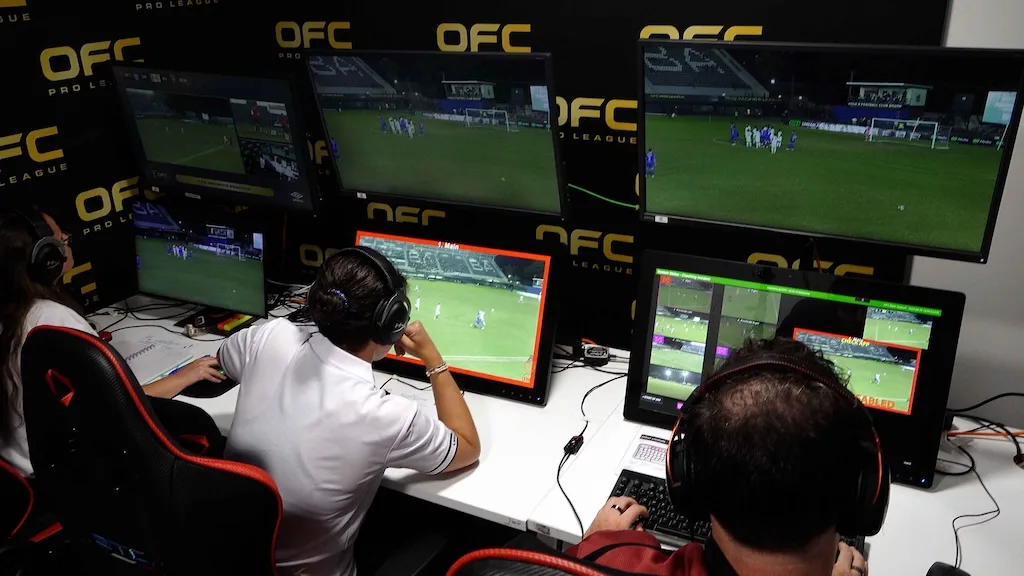
LiveU carries out a historic implementation with the Oceania Football Confederation (OFC) that sees the implementation of Video Assistant Refereeing (VAR) in the Pacific Islands for the first time, closing a gap that has existed since VAR was first introduced in football.
For years, OFC had been the only FIFA confederation to operate without VAR, a shortcoming that was raised directly with FIFA, only to conclude that traditional implementation was practically impossible for Pacific football. Standard relay equipment transported throughout the region faced repeated customs delays and damage at island ports, and high-capacity fiber does not exist in island nations such as Fiji, Papua New Guinea, the Solomon Islands, Samoa and Tahiti.
Any approach based on fixed infrastructure was unviable even before kick-off was given. When VAR became mandatory for the newly launched OFC Pro League (covering eight teams from six nations), LiveU made remote VAR possible for the first time.
Kevin Stoltenkamp, director of refereeing at the OFC, highlights that "we were the only confederation in the world without VAR, and we knew that, with traditional models, we would never achieve it. When I saw it work for the first time, I realized that this could work. Now we can carry the system like luggage on a plane and offer VAR anywhere. For us, accessibility is everything. It is not just about technology, but about people solving problems together."
Working closely with the OFC officiating and technology teams, LiveU designed and built a comprehensive end-to-end remote integration to support the platform VAR Hawk-Eye, with two portable transmitting kits and a centralized receiving server in central Auckland, capable of supporting up to 12 simultaneous camera signals with four return signals that transmit integrated two-way communications with referees back to the field. The entire system achieves round-trip latency of approximately one second between remote Pacific venues and central Auckland, meeting FIFA professional standards at a fraction of the cost of any comparable fixed infrastructure implementation.
Each LiveU transmission kit is designed specifically for travel, intended to pass through check-in as standard luggage, with the weight of each component individually checked to meet airline limits. The kits, which can be deployed by a single operator via managed internet connections, do not require freight transportation, permanent infrastructure or specialized engineers on the ground.
“We needed something light, portable and capable of transmitting multiple camera signals with audio, without depending on the transport of goods,” he says. Kelvin Lewis, head of referee technology at the OFC. "In a very short time, we realized we could transmit broadcast-quality signals over even the most difficult networks. What we have created is a low-cost, high-quality VAR solution that is unique in world football. We went from manually editing clips on a hill to offering full VAR capability - that's the magnitude of the change."
The implementation was designed to be independently managed and operated by local Pacific Island technicians. “The system is easy to use: you don't need to have great technical knowledge to handle it,” he emphasizes. Mihaly Fabian, director of the OFC VAR project. “LiveU is the heart of the system… technology is essential for this to work,” he adds.
OFC evaluated several technology providers before selecting LiveU; He ultimately chose it because the solution was based on LiveU's existing platform rather than custom development. The system reached a 100% success rate across all proof-of-concept deployments, with issues diagnosed and resolved remotely from Auckland without the need for engineers on the ground at Pacific Island headquarters.
The implementation has already extended beyond the OFC Pro League: it has been used for the New Zealand Football FIFA Series and for the OFC Women's World Cup qualifying semi-finals in Hamilton and the final in Auckland, a FIFA-sanctioned competition. The next implementation will take the system to Tahiti.
Chris Dredge, LiveU Pacific's country and sales director for the Oceania region, sums it up: "What OFC has achieved here is a working model: a broadcast-quality remote VAR, deployable anywhere, without transportation, without fixed infrastructure and without specialized engineers on the ground. The attention this has already generated beyond Oceania says it all, changing the narrative of sports organizations around the world."
Did you like this article?
Subscribe to our NEWSLETTER and you won't miss anything.
Related articles
 An alternative to virtual production based on projection versus LED arrives at NAB 2026
 Corus modernizes its newsroom with an SRT-based IP architecture with Appear
 Elements will show at NAB 2026 Grid, its new storage architecture based on Ceph
 LiveU launches Nexus, universal cloud-based gateway for digital and IP workflows
 Tabcorp's Sky Racing implements remote production with LiveU
 Actua Sport deployed a LiveU-based workflow at the European Athletics Championships
 LiveU Enables Cost-Effective Live Production and Distribution Over IP at Pacific Games
 SIC launches remote production solution based on IP from Sony and Nevion
 FOR-A promotes SOAR-A, a software-based line aimed at remote production, at IBC 2022
 Footters: remote and automated production to spread the most authentic football
 Sony expands its IP-based remote integration solutions
 LiveU and Griiip Reveal Unique Live View Platform and Data-Driven Multimedia Solution
 Austrian football reaches viewers around the world using a wide range of LiveU technology
 IP-based wireless intercom comes to BIT Experience with Riedel Bolero