





Towards a new revolutionary concept of Digital Terrestrial Television
¿Es posible optimizar el ancho de banda y la eficiencia del espectro al mismo tiempo que se reduce el consume energético en emisiones de Televisión Digital Terrestre? Un interesante trabajo desarrollado por la Universidad Politécnica de Valencia, Panasonic y Teracom, y premiado con el ‘Best Conference Paper Award’ en IBC 2016, demuestra que existen alternativas…
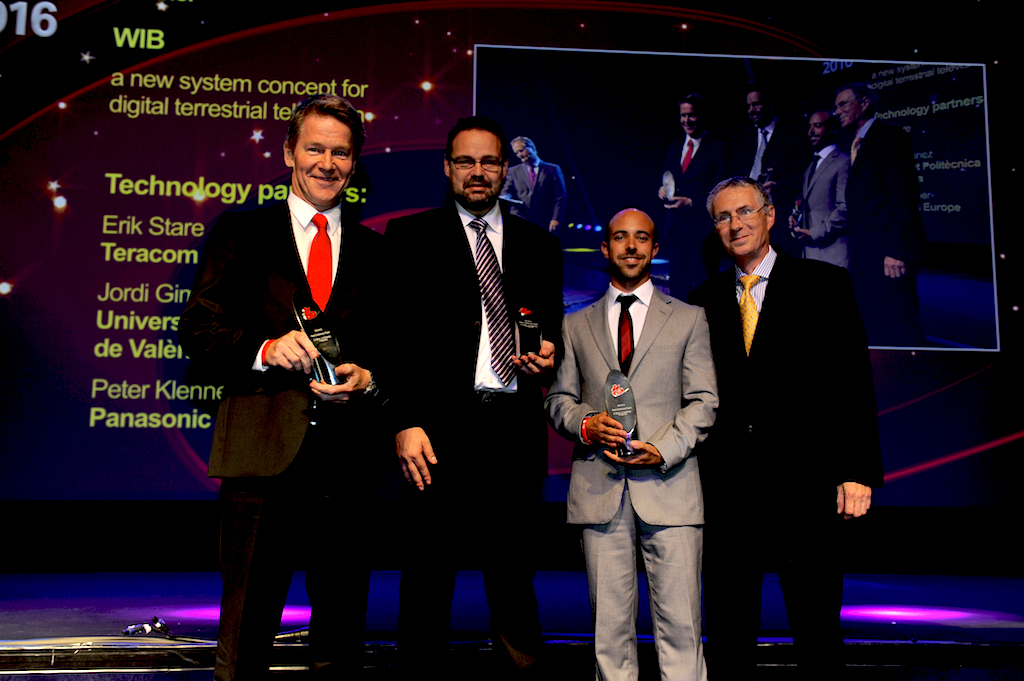
El trabajo de investigación WiB, a new system concent for Digital Terrestrial Television (DTT) logró en el último IBC hacerse con el preciado preciado ‘Best Conference Paper Award’.
El sistema propuesto, fruto de la colaboración entre Teracom, el operador sueco de TDT, la Universitat Politècnica de València y Panasonic Europe, supone un cambio en la manera de entender la recepción de la señal de TDT, donde potencialmente todas las frecuencias disponibles en la banda UHF pueden ser utilizadas desde todos los transmisores. El aumento de interferencias que esto conlleva requiere de la combinación de un modo de transmisión robusto, el aprovechamiento de la discriminación por directividad de la antena receptora y métodos de cancelación de interferencias, principalmente basados en el concepto de LDM (Layered Division Multiplexing).
WiB permitiría transmitir la señal de TDT como una señal de mayor ancho de banda ofreciendo una reducción muy importante de la potencia/coste de la señal transmitida y entre un 37-60% de incremento de capacidad para la misma cobertura ofrecida por el sistema de TDT actual. WiB permitiría la recepción en condiciones de movilidad soportando altas velocidades, así como una granularidad suficiente para ofrecer servicios locales. Los autores también destacan posibles desarrollos más avanzados, doblando la capacidad del sistema a través de MIMO, la retrocompatibilidad con las actuales antenas o incluso la adición de una capa adicional para ofrecer servicios móviles. Además, WiB permitiría definir un sistema en el que tanto los radiodifusores como los operadores móviles utilicen todo el espectro UHF, transmitiendo con LDM, lo que en un futuro acabaría con la actual “guerra” por el espectro y aseguraría, a largo plazo, el uso de la banda de 470-694 MHz.
Principios básicod
WiB es un nuevo concepto de Televisión Digital Terrestre (TDT) desarrollado por Teracom que supone un cambio disruptivo respecto a los sistemas de TDT convencional al basarse en una señal de banda ancha y permitir un reuso-1 de frecuencias. WiB evoluciona desde uno de los últimos avances tecnológicos aplicados a tecnologías TDT como es Layered Division Multiplexing (LDM), multiplexación por división en potencia.
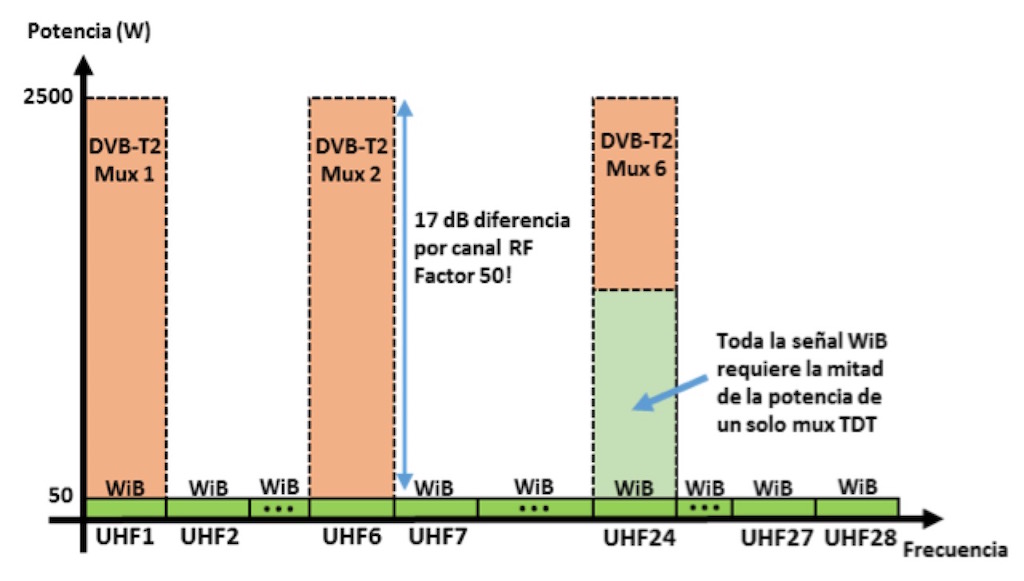
Tradicionalmente, una red de TDT está constituida de transmisores de elevada potencia que transmiten señales de gran capacidad (en torno a 33-40 Mbps en DVB-T2) sobre varios canales con un ancho de banda de 8 MHz (banda UHF). Sin embargo, esta señal de gran capacidad es a su vez más sensible a interferencias, requiriéndose una planificación adecuada de frecuencias (reúso-N, con N entre 4-7) que aleje unos de otros los transmisores interferentes. Como contrapartida, y, dado que la potencia requerida, de acuerdo con la Ley de Shannon, incrementa exponencialmente con la capacidad, son necesarios en este caso transmisores de alta potencia. WiB emplea una filosofía mucho más eficiente, que se traduce en el uso potencial de todos los canales de la banda UHF, desde todos los transmisores, expandiendo la potencia transmitida a lo largo de dichos canales, potencialmente como una única señal de banda ancha usando un único transmisor.
El reuso-1 y, por ejemplo, una modulación QPSK con codificación ½, permitirían una eficiencia espectral de aproximadamente 1 bps/Hz, que es prácticamente la misma que las actuales implementaciones de DVB-T2 usando un reúso-N (asumiendo N=5 y 40 Mbps en MFN ó N=6 y 33 Mbps en SFN). En ambos casos, podrían ofrecerse unos 200 Mbps en los 224 MHz de espectro asignado a la TDT (470-694 MHz) que quedarán tras el segundo dividendo digital en la banda de 700 MHz.
Las simulaciones llevadas a cabo indican que WiB podría ser usado con una eficiencia espectral significativamente mayor que ese 1 bps/Hz (1.37 a 1.60). Además, un diseño óptimo del proceso de demodulación permite explotar el hecho de que la señal interferente tiene unas características conocidas (misma modulación QPSK). Para 1 bps/Hz, con una C/N requerida de 0 dB, añadir una señal interferente a C/I=0 dB que es tratada simplemente como si fuera ruido no deja espacio para más ruido, lo que hace la C/N requerida infinita. Sin embargo, si se tiene en cuenta en la demodulación de la señal que la interferencia tiene una constelación QPSK, la C/N requerida acaba siendo de 6.0 dB. Explotar el conocimiento de la constelación interferente permite, pues, unas ganancias en rendimiento significativas.
Un modo de transmisión DVB-T2 comúnmente empleado en la actualidad es 256-QAM codificación 2/3 (por ejemplo, en Reino Unido). Sin embargo, con QPSK codificación ½ la potencia de transmisión requerida (para una determinada cobertura) es de unas 50 veces (17 dB) inferior por canal 8 MHz. El efecto neto es que la señal WiB requeriría fundamentalmente de sólo el 10% de toda la potencia utilizada actualmente (en todos los múltiplex) de DVB-T2.
Dado que la codificación/modulación usada en WiB está restringida, la capacidad de un simple canal UHF también lo estará, en el orden de 7-10 Mbps. Con el fin de compensar la baja capacidad de un canal UHF, WiB asume que los servicios pueden ser distribuidos sobre varios canales UHF. Asumiendo que el ancho de banda de un sintonizador básico puede incrementarse en un factor de, p.ej. cuatro, pasando de 8 MHz a 32 MHz esto posibilitaría una tasa de pico de unos 28-40 Mbps en este mayor ancho de banda. Un efecto colateral es además una mayor diversidad frecuencial, que generalmente tiene efectos positivos en el rendimiento si el servicio está apropiadamente entrelazado dentro de un determinado ancho de banda (usando, por ejemplo, Time Frequency Slicing).
Gracias a la capacidad de soportar interferencias de transmisores adyacentes el concepto WiB permite una granularidad más fina a la hora de ofrecer contenidos, usando potencialmente todos los transmisores con contenido diferente.
Cancelación de interferencias en WiB
Mediante el reuso-1 el receptor experimentará una relación señal-a-interferencia (C/I) mucho menor de lo habitual para la TDT, lo que debe ser seriamente considerado.
La primera herramienta para soportar el mayor nivel de interferencia es la utilización de un modo de transmisión robusto (por ejemplo 17 dB más robusto que la actual TDT), lo que permitiría una C/I cercana a 0 dB. La segunda herramienta (para escenarios de recepción fija) es que una antena directiva generalmente ofrece una discriminación (atenuación) en las direcciones no deseadas (o de polarización ortogonal) muy significativa (hasta 16 dB). Finalmente, existen métodos de cancelación de interferencia a través de los que señales no deseadas pueden ser canceladas bajo ciertas condiciones, como se explica a continuación.
Supongamos una señal S1 interferida por otra S2 con la misma modulación, pero de mayor potencia. La cancelación de interferencias basada en LDM consiste en, primero, demodular la señal más fuerte, re-modularla y sustraerla de la señal original de entrada, lo cual es posible ya que la señal es perfectamente conocida tras demodularla (asumiendo que ésta ha sido correcta). En un paso final, la señal deseada S1 puede ser demodulada. Este proceso es posible siempre y cuando la C/(N+I) de la señal a demodular (S2 seguida de S1) sea mayor que la C/(N+I) requerida. Para una eficiencia espectral de 1 bps/Hz (e.g. QPSK ½) la C/(N+I) requerida es cercana a 0 dB. El proceso descrito puede ser generalizado y utilizado para cualquier número de señales siempre que el requisito de C/(N+I) se cumpla para cada señal demodulada y sustraída.
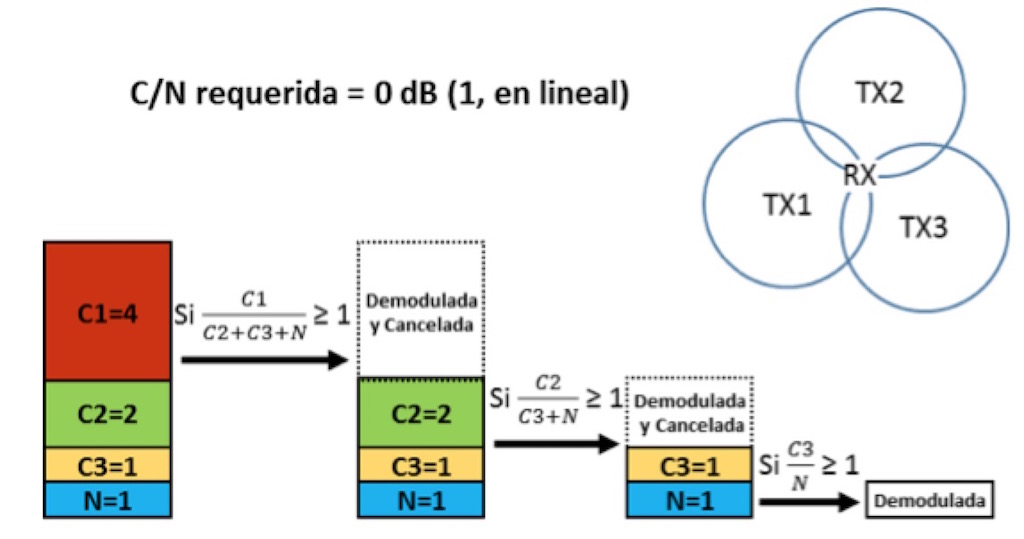
La figura muestra un ejemplo donde las potencias recibidas desde los transmisores TX1, TX2 y TX3 son C1, C2 y C3 respectivamente y con N siendo el ruido. La señal más débil del TX3 puede ser demodulada si se satisface la C/(N+I) en el proceso de cancelación de las dos señales más fuertes y existe una C/N suficiente para TX3.
Para que la cancelación de interferencias basada en LDM funcione (con una complejidad razonable) en WiB todas las señales involucradas necesitan estar totalmente sincronizadas, de modo que la recepción se asemeje a una red SFN tradicional, pero con diferentes TXs transmitiendo diferente contenido. Con el fin de permitir la cancelación de interferencias basada en LDM cada transmisor tiene que insertar una secuencia de portadoras piloto que sea ortogonal a todas las otras señales recibidas de otros transmisores cuya interferencia vaya a ser cancelada. En general, se necesitan al menos tres patrones de pilotos ortogonales.
Una alternativa completamente diferente para la cancelación de interferencias es utilizar múltiples antenas que, a través de técnicas de beam-forming, puedan maximizar la C/(N+I) de la señal recibida dinámicamente. Esta técnica podría ser, además, combinada con LDM para cancelar sucesivamente el conjunto de señales interferentes.
Reducción de costes en el despliegue red
WiB posibilitaría una reducción sustancial de los costes de capital (CAPEX) al reducirse en cerca del 90% el consume de potencia requerida en los transmisores, lo que además simplificaría el equipamiento. Esto permitiría remplazar todos los transmisores actuales por un único transmisor de banda ancha que utilizase un 50% de la potencia usada actualmente en uno de ellos. Gran parte del equipamiento actualmente utilizado en las estaciones transmisoras de TDT podría ser prescindible e incluso situarse directamente sobre las torres de transmisión.
La reducción en el consume de potencia incide directamente sobre los costes de operación (OPEX), ahorrando en el recibo de la luz y aumentando la eficiencia energética. Por ejemplo, con WiB, se podrían eliminar atenuadores en los (ahora innecesarios) combinadores, alimentadores, divisores,… que ahora mismo suponen unas pérdidas en torno a 3 dB (50% de reducción de potencia).
Conclusions
Todos los aspectos aquí resumidos se encuentran detallados en más profundidad en el artículo premiado, que puede ser consultado here. En él se abordan también otros aspectos como las características que deberían tener los receptores WiB o aspectos relativos a la introducción del nuevo sistema remplazando las redes de TDT actuales. Además, los autores discuten otras características avanzadas como la utilización de MIMO para aumentar la capacidad, el uso de dos capas LDM móvil/fijo o incluso la compartición de espectro entre una señal WiB-TDT y otra WiB-móvil.
Sobre los autores
Los autores de este análisis han sido Erik Stare (Teracom, Suecia), Jordi Joan Giménez (UPV, España), y Peter Klenner (Panasonic, Alemania).
En cuanto al Instituto de Telecomunicaciones y Aplicaciones Multimedia (iTEAM) es un centro de investigación integrado en la Universitat Politècnica de València (UPV) especializado en el área de las TIC. El Grupo de Comunicaciones Móviles (MCG), dirigido por el profesor Narcís Cardona, está formado por cerca de una treintena de investigadores que desarrollan diferentes actividades en el área de las comunicaciones inalámbricas y, particularmente, en torno a las tecnologías de radiodifusión. El MCG ha participado en diversos proyectos de i+D tanto nacionales como internacionales, destacando su contribución a la planificación y diseño de la red DVB-T2 en Colombia.
Como miembro de las organizaciones DVB, ATSC y FOBTV, iTEAM ha participado activamente en la evaluación, validación y estandarización de tecnologías como DVB-T/H, DVB-T2 o DVB-NGH, así como el estándar de TDT más reciente, ATSC3.0. En el aspecto privado, el MCG colabora con empresas tanto nacionales como internacionales del sector de las telecomunicaciones, como Sapec (España), ETRI (Corea del Sur) y NHK (Japón).
La participación de iTEAM en WiB se enmarca dentro del proyecto “E.T. Broadcast”, financiado por el Ministerio de Economía y Competitividad (TEC2014-56483-R) y co-financiado por fondos europeos FEDER. El proyecto, dirigido por el Dr. David Gómez Barquero, tiene por objetivo investigar y evaluar soluciones técnicas innovadoras para la siguiente generación de sistemas de TDT, como los sistemas MIMO (Multiple-Input Multiple-Output), técnicas de agregado de frecuencias (time-frequency slicing y channel bonding), Layered-Division Multiplexing (LDM), y non-uniform constellations, en términos de aumento de capacidad, cobertura y eficiencia espectral; y el diseño de algoritmos de procesado de señal de baja complejidad para los receptores con un reducido impacto en el rendimiento del sistema.
Did you like this article?
Subscribe to our NEWSLETTER and you won't miss anything.
Related articles
 Spain adopts the DVB-T2 standard with UHD in its new National Technical Plan for Digital Terrestrial Television
 The Portuguese Government ensures the continuity of Digital Terrestrial Television
 Sapec supplies a new Digital Terrestrial Television headend with ATSC standard in Mexico
 The Government approves the new National Technical Plan for Digital Terrestrial Television
 Switzerland will turn off digital terrestrial television next June
 Spectrum for terrestrial broadcasting: where are we going in Europe?
 Towards a new model in connected television?
 TVE takes a new step towards television connected with '+24'
 Towards a new concept in SNG contribution
 The Broadcast conferences take stock of the transition towards digital television
 El dividendo digital, nuevo reto de la televisión digital
 Digital+ on demand, a new step towards hybrid television
 Colombia finally adopts the DVB-T digital terrestrial television standard
 JustAd Tv brings a new concept of embedded advertising to television