





'Blade Runner 2049' returns us to the universe that captivated generations
Filming of the film took place entirely in Hungary, where production took place on six sets and the outdoor set of Origo Studios in Budapest, three sets at Korda Studios in Etyek and numerous other locations throughout the country.
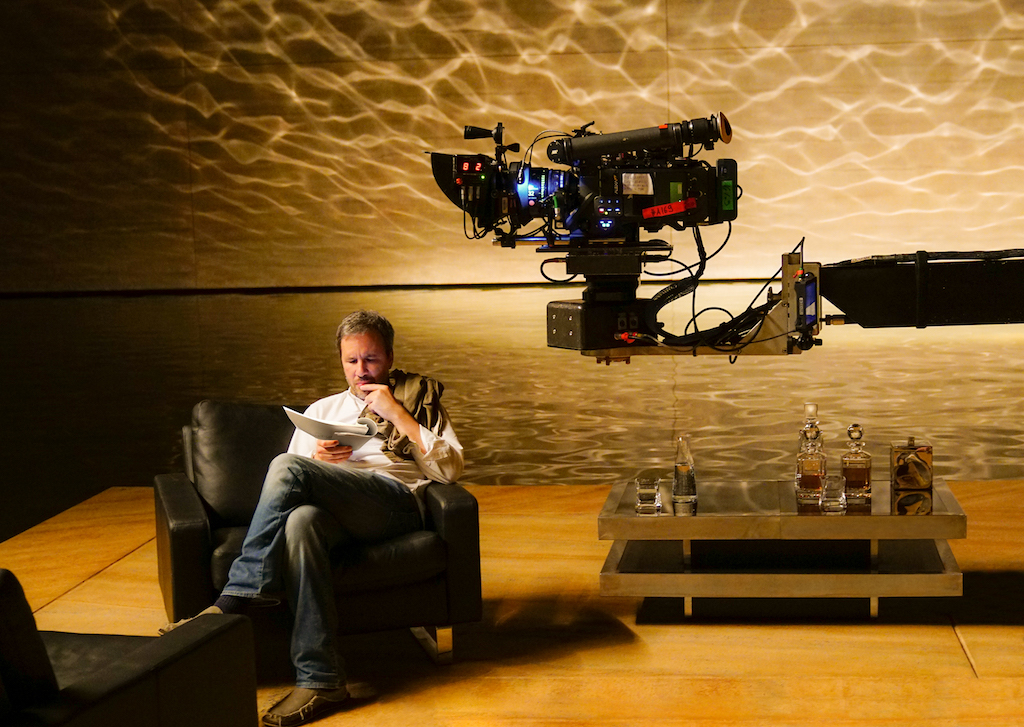
From Oscar-nominated director Denis Villeneuve (The arrival) opens next Friday around the world Blade Runner 2049, from Alcon Entertainment, the highly anticipated sequel to the acclaimed film.
30 years after the events that take place in the first film, a new blade runner, Agent K of the Los Angeles Police Department (LAPD), unearths an ancient secret that has the potential to plunge what's left of society into chaos. K's discovery leads him on a mission to find Rick Deckard, a former LAPD blade runner who has been missing for three decades.
Blade Runner 2049 stars Oscar nominee Ryan Gosling (Star City (La La Land)) as 'K', and Harrison Ford (Star Wars, Only Witness), reprising the role of Rick Deckard. The rest of the cast includes Ana de Armas (Weapons Game), Sylvia Hoeks (Renegades), Robin Wright (Wonder Woman), Mackenzie Davis (Marte (The Martian)), Carla Juri (Brimstone), Lennie James (The Walking Dead) and with Dave Bautista (Guardians of the Galaxy) and Oscar winner Jared Leto (Dallas Buyers Club).
La película ha sido producida por los nominados al Oscar Andrew A. Kosove & Broderick Johnson (The Blind Side (A Possible Dream)) y Bud Yorkin & Cynthia Sikes Yorkin. El múltiple nominado al Oscar Ridley Scott (Marte (The Martian), Gladiator), who directed the first Blade Runner, has collaborated as executive director with Tim Gamble, Frank Giustra, Yale Badik, Val Hill and Bill Carraro.
Blade Runner 2049 marks the third collaboration between Villeneuve and cinematographer Roger Deakins, after Sicario y Prisoners, for which Deakins received two of his 13 Oscar nominations. The creative team behind the camera also includes Oscar-winning production designer Dennis Gassner (Bugsy, Spectre, Into the Woods), Oscar nominee Joe Walker (12 Years of Slavery, Sicario), and costume designer Renée April (Sicario, The Arrival). The music is composed by Oscar winner Hans Zimmer (Dunkirk, The Lion King) y Benjamin Wallfisch (IT, Annabelle: Creation).
“What defines a human being?” That is the question that director Denis Villeneuve asks himself. And the surprising answers that arise in his new film, Blade Runner 2049, they challenge the idea we have about who we are… and where we are going. 35 years ago, the groundbreaking, futuristic hit Blade Runner hit the big screen. Directed by the legendary Ridley Scott and based on the novel by Philip K. Dick Do Androids Dream of Electric Sheep?, the film propelled audiences into a dystopia like they had never experienced before.
At that time, no one could have imagined how Blade Runner would resonate in modern culture, pioneering what would become a completely new genre: neo-noir cyberpunk. Today, Scott's visionary masterpiece is considered one of the best and most important films in history, although its influence not only remains in cinema, but also in the world of television, music, art, fashion and even in university courses.
Now, after more than three decades, Blade Runner 2049 returns us to the universe that has captivated generations of fans with a long-awaited sequel and a unique cinematic experience.
Villeneuve, who considers himself one of the devotees of the original film, remembers "watching Blade Runner for the first time and being struck by what I think is one of the most powerful opening scenes in cinema: flying over Los Angeles in 2019, and seeing a landscape of oil factories. Ridley Scott created such a strong image of what the future would be like that it was seductive and scary at the same time."
“The aesthetic of Blade Runner was revolutionary,” he continues. "It fuses two genres that at first glance are very different: science fiction and film noir. It's something that hadn't been seen before, and it influenced me deeply. It was part of my education as a filmmaker long before I even knew I would become a director."
Scott admits that, even with all the difficulties, he never would have predicted how iconic one of his first feature films would become. “You don't think about that kind of thing when you're in the middle of the project,” he adds, “but it was clear to me that we had done something really special.”
However, it has since become clear that Scott's film predicted a number of social concerns that have been growing. It seems more relevant than ever, with the planet about to reach the moment in which Blade Runner was set, that the issue of urban deterioration, climate change, genetic engineering, overpopulation, social division, economic strata and so on be addressed.
Harrison Ford ended up making the film's main character, Rick Deckard, one of the most indelible of his on-screen performances. "It was certainly prescient in many ways. I think as technology evolved and people began to see aspects of the film reflected in real life, there was more and more reason to accept the themes that Blade Runner talks about."
Ryan Gosling, who plays the role of an LAPD detective named 'K' in Blade Runner 2049, comments that "The original film is unforgettable. It makes you question your idea of what it means to be human. It makes you question your ability to discern the hero from the villain. It's a horrifying vision of the future that somehow seems grounded and possible, and yet it's presented to us in a romantic, dreamlike way that sticks in your memory. Time has shown how special it is."
Producer Andrew A. Kosove agrees. "Blade Runner was ahead of its time in many ways. That thought-provoking narrative and distinctive visual design that Ridley Scott brilliantly conceived made the film permeate our culture and change the perception we have about technology and the future. I think that's why it's so revered."
Understandably, this admiration made Kosove and his Alcon colleague, producer Broderick Johnson, take it easy when it came to tackling a Blade Runner sequel. “It was clear that we had to think carefully about whether we would undertake such an ambitious journey, but we both love the original so we decided to go ahead,” Johnson confesses.
The idea of recording a new episode of Blade Runner was suggested by producer Bud Yorkin, who had been part of the original production team, and his wife, producer Cynthia Sikes Yorkin. "Continuing the story was a dream that Bud had for many years and I was happy to be able to support him. Unfortunately he died before he could see the finished film, but it was a great gift for him to know that it was going to happen. Andrew and Broderick were very respectful of Bud and involved us in all aspects of the production from the beginning. They put all their effort into the project, I couldn't have had better partners to fulfill this dream" says Sikes.
The first step was to return to the origin, explains Kosove. “The most important thing for Broderick and me was going to London and meeting Ridley Scott.” “Ridley was excited about the idea of creating a new movie,” adds Johnson. “He said he had ideas that he had been brewing for years, thinking about how they could be developed while respecting the original essence.”
Scott came aboard the project as executive producer. “Blade Runner was always conceived as an independent feature film, but we were clear that there was much more to tell than we were allowed to do in two hours.”
When the opportunity came for Green to work within the Blade Runner universe, “I said yes instantly,” confesses the avid fan of the original film. "Hampton and Ridley had created the DNA of what the new Blade Runner could be, and then I had the incredible opportunity to shape the story. There are many fascinating themes covered in the first film and one of them was about the amount of life. In Blade Runner 2049 we wanted to explore quality of life. In both films there are humans and replicants, and although they look very similar, they are considered different, since some have been born and others have been created. And the innate difference between them is that someone who is born is considered to have a soul. But what is the nature of the soul? And is that something exclusively human?”
Denis Villeneuve remembers that when they presented him with the complete script "I was very excited. The degree of trust that Alcon placed in me, the fact of putting the film in my hands... has been one of the greatest compliments of my career." After working with Villeneuve on the hit drama Prisoners, producers were aware of the talent he could bring. “Denis is an incredible filmmaker with complete control of what he wants to achieve,” says Johnson. "We knew he would be perfect for this film, not only because of his ability to direct performances, but also because of the tension and atmosphere he knows how to create, both of which are very important in the film. This was essential when making Blade Runner 2049 since the true magic of the film lies in the tension, the narrative and the importance of the characters. “Denis is one of the best at capturing all of that.”
Villeneuve admits to having given a warning before agreeing to help them. "I needed Ridley Scott's approval. That was my only condition." He didn't have to worry about it since Scott did much more than give his approval. “He told me exactly what I needed to hear,” notes the director. "He gave me total freedom, but if at any time I needed him, I could call him. He would be completely available. And in fact, he was there whenever I needed him. I will be eternally grateful."
When conceiving the overall image of the film, Villeneuve wanted to be faithful to the spirit of the original. “My goal was to respect the film noir aesthetic of the first film, while giving the new one its own identity.”
In this aspect, the filmmakers emphasize that, although Blade Runner 2049 It is a continuation of the original and can also be an independent film. “Even without having seen the first film, there is no difficulty in understanding the story,” explains Yorkin. “The way it's presented and written, the plot sucks you in and keeps you totally entertained without you necessarily knowing what happened before.”
The filmmakers also had to think about the conditions of the planet three decades later. “Blade Runner It was set in 2019, and it was prophetic in many ways, although we already know that our 2019 is going to be very different. So we decided to create our own 2049 and thus propel the film into its most likely future. The world of Blade Runner 2049 "It's an extension of Blade Runner, not an extension of reality."
After having that clear, "many design decisions came. In Blade Runner we saw how nature was collapsing, so 30 years later the Earth has much more severe climatic conditions, and that is reflected in everything, from architecture to vehicles or clothing."
To achieve this, Villeneuve teamed up with director of photography Roger Deakins, production designer Dennis Gassner and costume designer Renée April. “We share a very strong artistic bond as we are all committed to the same idea, honoring what came before,” says Villeneuve.
"The entire cast was also very excited about the project," he adds, "and I would say the film owes a lot to them, but especially to Ryan Gosling and Harrison Ford. They contributed very good ideas and they were both my muses on the set."
Gosling and Ford equally praise their director. "Denis is a quiet, thoughtful and incredibly intelligent guy who takes the time to come to conclusions for himself. I found him to be a great intellectual companion," Ford admits. “In the first conversation with Denis I felt immediately safe,” says Gosling. "All of his instincts were to ground the movie...make it feel real. He had great respect for the original, but he didn't seem to let it intimidate him. He used his admiration and turned it into inspiration, and I think as a result he inspired all of us to do the same."
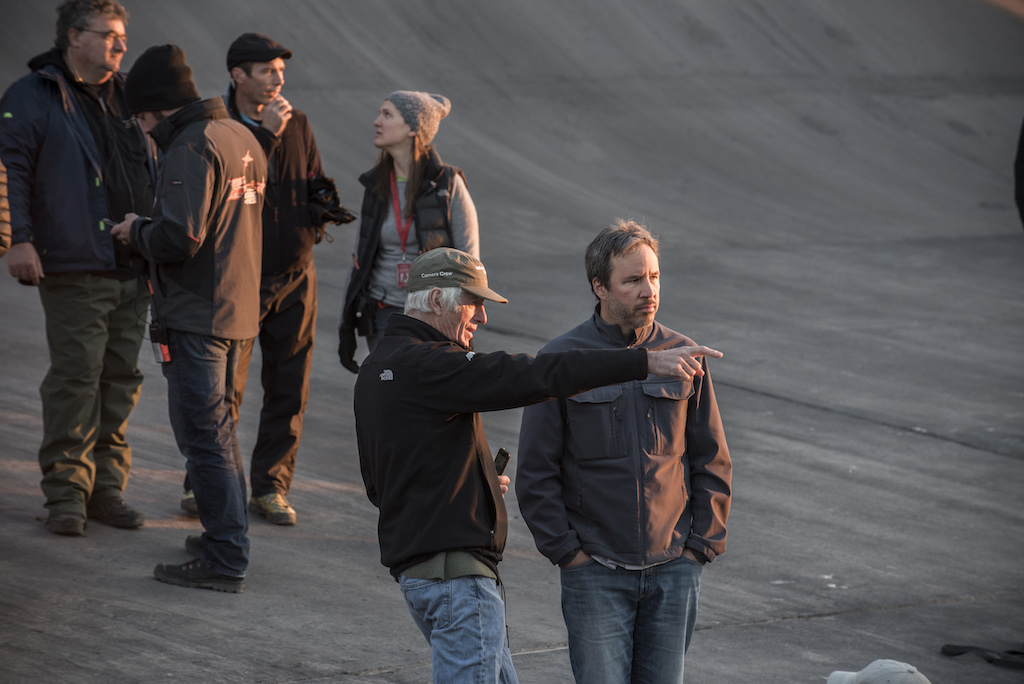
Filming in Hungary
Filming of the film took place entirely in Hungary, where production took place on six sets and the outdoor set of Origo Studios in Budapest, three sets at Korda Studios in Etyek and numerous other locations throughout the country.
As much as possible, the production team avoided using special effects and color schemes, striving to capture the action on camera on real sets. "I love working with real sets, with real objects. It was very important to me to build a tangible world that the actors and I could live in instead of just trying to imagine it," explains Villeneuve.
For the actors, getting into a real environment had the desired result. "It was incredible to have those sets. As an actor, you can focus on the inner world of the character, since the outside world was already so well represented," says Gosling.
“It's like having a fantastic world around you, but the human scale is always maintained,” adds Villeneuve. “BLADE RUNNER 2049 is a very intimate story told with a very broad perspective.”
Before beginning principal photography on BLADE RUNNER 2049, Villeneuve spent several weeks with his trusted cinematographer Roger Deakins drawing the storyboard and giving the film a visual look. “Roger was an integral part of the film's cinematic language from the beginning,” says the director.
Andrew Kosove adds, "Roger, who is one of the greatest cinematographers of all time, took a year off to prepare for this film. He said it involved some of the most complex lighting designs and patterns he had ever done." “It was too exciting an opportunity to miss,” says Deakins. “Denis and I were not constrained by the original, but inspired, it offered us one of the first and most stylized visions of an apocalyptic future.”
“One of the biggest challenges was to visually unite the two films, to have the impression of walking towards a future inspired by the past,” adds Villeneuve.
Arguably the biggest visual imprint of the first Blade Runner was its dark, humid and oppressive atmosphere, and those conditions haven't improved in 30 years.
"I come from Montreal," explains the director, "so the climate of the film was more influenced by the bad Canadian weather, where it can be very cold. So instead of having constant rain, there is also snow and mud." “Style is important,” Ridley Scott emphasizes, “and Denis nailed it compared to what we did in the first film.” The majority of the population, who are not among the super-rich, barely survive in cities crowded with buildings that cross eternal gray skies. Production designer Dennis Gassner remembers how "the first thing I asked Denis was, if I had to define design in one word, what would it be? And Denis said, 'Brutal. I want the architecture to be brutal.' And so, we dove into searching for images to develop what I call the 'pattern language.'"
“The thing about Blade Runner 2049 "It's that everything is designed around survival, from technology to architecture," adds Villeneuve. "The buildings were designed to resist the weather, so many of them look like underground shelters."
Brutal was also the motto for the costumes, designed by Renée April. "It's a harsh environment. It rains and sometimes it snows. That was our starting point. For the materials, I worked a lot with synthetic leather and plastic, which I had never worked with before. I couldn't use leather or wool or any organic materials, since they wouldn't exist anymore, so everything was synthetic and man-made. We also wore large sizes because of the cold," explains April.
“I was very lucky to work with such a good cast and that they liked the costumes so much,” the designer continues. "Ryan Gosling, for example, is very aware of what he can wear, what he likes and what he doesn't. And I must say, he could already like it, because K wears the same coat throughout the movie." “We all wanted that coat,” says Sikes Yorkin. "Even the women were obsessed with the coat. Renée is brilliant and ended up creating a costume that suited the character and the place she inhabited."
According to April, Luv and Joi's costumes required two different approaches. "For Luv, the silhouette of the clothes is soft and pure. There are no ruffles or pleats or real colors, everything is beige, white or gray. On the other hand, Joi is seen with much more variety of wardrobe, saturated colors and with more feminine and not so structured clothes."
April explains that to design Niander Wallace's costumes, "I was inspired by Dennis Gassner's incredible set of Wallace's office. It was huge, with very strong lines and a touch of Zen. So I chose similar simple lines, almost a uniform or pajamas for someone who doesn't usually go out and has nothing to prove."
Rick Deckard's clothes fit that of someone who has been out of touch for decades, "so what he wears looks like older, more threadbare clothes."
Among the most memorable images of the first Blade Runner are the giant illuminated billboards with moving advertisements. For the sequel, Broderick Johnson admits that "we took it to the next level, since we are 30 years later. There are 3D holograms with a certain degree of intelligence. So, if you are walking down a street for example, the ad may interact with you, which is a terrifying thought," he laughs.
“Our reasoning is that the air in Los Angeles in 2049 is so dense that you can project things in 3D into the atmosphere,” explains Villeneuve. "So the ads are no longer just billboards, they are among the population. And that is something that, again, is an extension of our own reality. That is where we are going."
"As we were planning the film," Villeneuve continues, "we met with scientists, doctors, architects, designers, computer scientists... experts who told us what they thought the future would be like. That greatly influenced the design of the film."
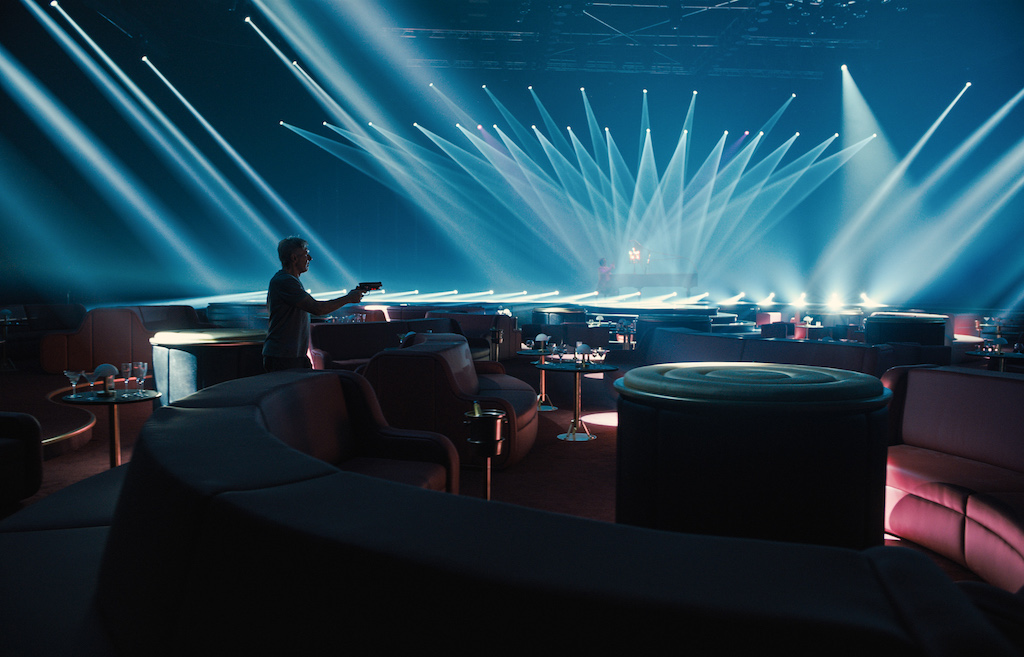
Photograph
The main photography of Blade Runner 2049 took place in Hungary, where production took place on six sets and the outdoor set of Origo Studios in Budapest, three sets at Korda Studios in Etyek and numerous other locations throughout the country.
“The facilities there are top-notch,” says executive producer and production manager Bill Carraro, “just as good as anywhere else, but what attracted us to Hungary, and Budapest in particular, was the city's aesthetic diversity: Eastern European architecture mixed with Soviet-era Brutalist structures.” “Budapest has a specific aesthetic that influenced the film,” explains Villeneuve. “We were able to shoot some scenes on the streets of the city, as some of the architecture we found fit perfectly with the spirit of the film.”
At Origo and Korda Studios, Dennis Gassner's team built the film's universe almost from scratch, satisfying Villeneuve's desire to work on real sets. “I need real environments because these are the ones that trigger new ideas,” says the director. "At the beginning of the process the decision was made to build as much as possible and use almost no color schemes, and everyone was excited about that idea. Of course, there had to be some special effects, to extend certain sets, but everything you see in close-up is real."
“The real sets are a big help,” says Harrison Ford. "People behave more realistically when the environment affects things like the sound of your footsteps. As an actor I think that helps a lot."
“Blade Runner 2049 begins with K flying to Sapper Morton's farm in a vehicle that fans of the first film know as a Spinner. “The first thing we designed was the K Spinner,” Gassner reveals. “The intention was for it to be a tribute to the original, but in context with the brutalist style that Denis wanted.”
K's Spinner is a bit squarer and has sharper angles than the one Deckard had in Blade Runner, although it's also an older model. “We tried to make the interior of the vehicle look 10 or 15 years old,” says art direction supervisor Paul Ingis. "That space has been lived in a lot and it's aged. Everything is worn and you can see stains, marks and scratches... It's a set in itself."
Two Spinners were built for K, one of which could actually be driven and had doors that opened vertically. It was equipped with power steering and an electric motor, and could reach 80 km/h, although it was not recommended for filming. The other was designed to fly hanging from cables or to be installed on top of a crane with Gosling inside. Cameras were mounted behind the actor to capture his perspective as the windshield wipers drove away the constant rain.
K's Spinner has a new feature that didn't exist in the first film: an intelligent drone-like object that visual effects supervisor John Nelson calls "the pilot fish. It lives in the back of the Spinner, and when it stops, it flies above and hovers like a drone. It's like K's digital henchman, which you can ask to watch the car, but it can also photograph the area and send the information back to you." Aside from K's Spinner, there are other vehicles in the film, such as a multi-seat Spinner limousine and another one belonging to Deckard, which is an updated version of the one he drove in the first film.
Sapper Morton's farm was built on the outside set of Origo Studios. There, the confrontation between K and Sapper was choreographed by stunt coordinator Joel Kramer, who remembers how "Ryan put effort into everything he did. He sacrificed any free minute he had to come and train with us, and he learned the moves very quickly."
Krammer approached the fight between K and Luv later in the film in a different way. "Although Luv is a woman, she has the same fighting skill as K, if not more. I found martial arts expert Chloé Bruce, who can do things with her body that I had never seen done before... moves that didn't even look human. I showed her demonstration video to Denis, Andres and Broderick and they were amazed. We brought Chloé and she was training with Sylvia Hoeks to teach her some of her moves. Sylvia couldn't do them all, obviously, none of them "We could, but she put a lot of effort into it. I was impressed by how well Sylvia did, especially since she had never fought before."
“The action scenes were a big challenge for me,” Hoeks admits. "I was training for six months and I loved seeing how I could do more and more things with my body. I felt like I was transforming into an increasingly stronger human being, and that helped me get into the character better. As an actress, it has been incredible to have had the opportunity to work on those movements and to have learned those techniques."
The large sets for the Wallace Corporation offices and archives were made in the two studios. The aseptic, minimalist design of Wallace's personal office belies the complexity of the set, where the center is surrounded by a pool of water and accessed only by an automated stone path. Roger Deakins used water to bounce and reflect light against the walls and ceiling creating a stunning effect.
“Lighting was more a part of the set than any other particular architectural style,” Inglis offers. "Roger made it very clear from the beginning that he wanted the light to be natural, almost like sunlight, which is actually nonexistent outside where the sun is always hidden by fog. If you look closely, there isn't a single window in those sets, but in Wallace's universe you get the feeling that there is an artificial sun when you see rays of light navigate the space." Jared Leto comments how being in his character's environment "I could feel the energy of the set. Being my character blind I was able to experience it in a unique way. If you close your eyes, it's incredible everything you can say about the space you are in. And one of the great gifts were the voices that reverberated off the walls. The sound helped me feel very safe in my role."
There is a stark contrast between the Wallace Tower and the environment where it is located, with the less fortunate who subsist outside its walls. Bibi's Bar is a family gathering space, a bustling open market where crowds of humans and replicants can buy everything from food and drink to goods and sex. It was built in Korda's setting, with rows of vending machines with well-lit displays and kiosks. Trains passed overhead and tuk-tuks maneuvered among more than 300 extras.
“Bibi's gave us the first concentration of real color,” says Gassner. “Given the perpetual state of winter, almost everything has a de-saturated, gray quality, but Bibi’s is where we were able to dress people in color just like Roger did with light.” Other notable sets in Los Angeles in 2049 are K's small apartment, the rooftop of his building where he dances in the rain with Joi, and the police station with Lieutenant Joshi's office.
Unlike the first film, Blade Runner 2049 It takes the story out of the confines of Los Angeles, a welcome change for Villeneuve. “That gave me the opportunity to think about what the world would be like outside the city,” explains the director. "This brought a different vision to the film. For example, as you get further away, the fog and the atmosphere is less dense, so there is more light. I'm not talking about nice bright sunlight, it's still quite dim, but a little more than what there is in Los Angeles."
K's investigation takes him south to the San Diego area, where his Spinner crash-lands in a vast landfill that stretches as far as the eye can see. The Garbage Plateau, as it was nicknamed, was the largest set in the entire production and was built on the outside set in Origo. The immense set was later expanded using miniatures and special effects, allowing it to extend to the horizon and beyond.
Gassner based the design of the garbage plateau on the giant shipyards where large ships are dismantled. Among the tons of debris were pieces of rusted metal of various sizes, some of which were still recognizable as parts of large ships. For safety reasons, any metal pieces found near the actors were made of painted rubber.
Protruding from the mountains of debris are enormous satellite dishes that have become the headquarters of Mr. Cotton's business, as well as the grim home of the unfortunate people who have to live and work there. The interiors were assembled in separate locations: a set in Origo, a Soviet nuclear plant near Budapest, and a former electronic warehouse in Kistarcsa, Hungary.
Following Rick Deckard's trail takes K out of California to the city of Las Vegas, which looks nothing like the bright, neon-lit city we know. All of its color and light have been reduced to a monochromatic reddish-orange haze, the result of a catastrophic explosion 50 years earlier that left the vibrant city in ruins and desert... except for one person.
To imagine a post-apocalyptic Las Vegas, Villeneuve and Gassner consulted famed futurist and conceptual artist Syd Mead, who had previously guided Ridley Scott with 2019's City of Angels. “We were trying to imagine what Las Vegas would be like in 2049,” he explains. "And for that, there was only one man who could give us an answer. We talked to teacher Syd Mead, we explained the problem to him and he ended up giving us back some incredible views of Las Vegas."
“What happened in Las Vegas and its surroundings made it a desolate place where no one wants to go,” adds Gassner, “which in turn, made it the perfect place for Deckard to hide.”
The production transformed an unoccupied building in downtown Budapest, which had been Hungary's largest television channel, into the lobby of a Las Vegas hotel, its former grandeur covered in a layer of red dust. The rest of the sets for hotels, casinos, the penthouse and the exhibition hall were built at Origo Studios.
In the exhibition hall you can see vestiges of the golden days of Las Vegas in the form of holograms such as Elvis Presley or Frank Sinatra. There are starlets dancing on the main stage, dressed by Renée April in feathers and sequins. For Deakins, the performance had to have a really complex lighting design. "The show starts suddenly, but slowly starts to fall apart, sort of malfunctioning, becoming more of a chaotic light show. I spent weeks mapping out different lighting patterns and then worked with a local company in Budapest to produce a computer preview of everything. We worked from there until I got the light pattern I needed."
Without a doubt, some of the most demanding days of filming were in a huge water tank, built specifically for the production of a central action sequence of Blade Runner 2049. Special effects supervisor Gerd Nefzer and his team oversaw the construction of the one million gallon (approximately 3785m3) tank that ranged from one to five meters deep.
The only problem with the tank is that the water was calm and the scene required crashing waves. “I was looking at different wave machines,” explains Nefzer, “but they didn't give us the size of waves we needed, so we had to invent something different.” Nefzer's team acquired several commercial-sized propane tanks, which they sealed and secured to cranes. Then they began experimenting with synchronized movement, taking the tanks in and out of the water. As they repeated the movement, they created increasingly large waves.
The special effects team also had to create a system to transport the Spinner and be able to move it with the impact of the waves. "For Denis it was very important that the limousine not stay still in the water like a rock. When a wave hits it, it should not stay stable. That scaffolding was very complicated to build," admits Nefzer.
To protect the actors who were inside the tank working for hours, diesel heaters were installed to keep the water at a comfortable temperature of 27ºC. During the cold nights, a mist was created that came out of the tank, adding even more character to the atmosphere created.
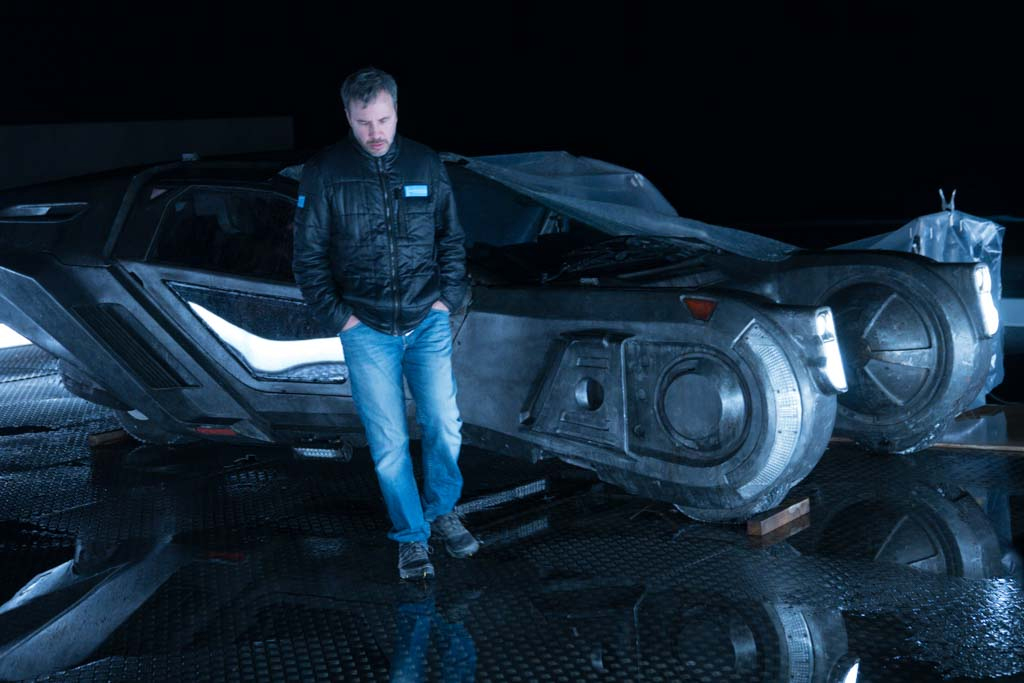
Scale and scales
Far from Hungary, the cityscape and other views seen from above were created in miniature by a team at the Weta Workshop in New Zealand. Although Villeneuve points out that “miniature” is not a very appropriate term. “Some of those miniatures were gigantic!” the director clarifies.
Weta's director of photography, Alex Funke, comments that "we built the Wallace Tower, which in history is one of the tallest buildings on Earth, at a scale of 1/600, and yet it was about four meters high. In each case we decided what scale to build each element at as there were many things to take into account: How close are you going to get to the object? What kind of surface texture does it have? How big would the element actually be? And, to be practical, how complicated is it? to take it out of the store and take it to the studio? The incredible trash plateau, for example, was built at 1/48 scale so we could have handled it well at 1/24 scale, but then it would literally not have entered the studio.
As the film was completed, Villeneuve began to pay more attention to video editing in collaboration with editor Joe Walker. He also worked with composers Hans Zimmer and Benjamin Wallfisch to create the final creative element: the soundtrack.
"There was an incredible camaraderie and connection between us since we all love Blade Runner. From there, we faced the great challenge of discovering where we would be 30 years later, musically speaking," recalls Wallfisch.
“Vangelis set a precedent that is difficult to follow,” adds Zimmer, referring to the composer who created the first film's evocative soundtrack and whose innovative use of synthesizers became legendary. “I did what Denis had managed to do, accept the DNA of what he had been while adding a completely fresh artistic vision.”
In that regard, one of the first decisions the composers made was to break with the traditional orchestra in favor of a synthesizer-based soundtrack. "We made an artistic choice to ensure that the music was cohesive with the sound world of Blade Runner. If we had chosen a full orchestra it would have been a very different film," Zimmer continues.
"The goal from the beginning," says Wallfisch, "was to find the essence of the film. To find a musical analogue of K's conflict with the idea of what defines a human compared to highly developed replicants who are indistinguishable. What does that sound like? It was a process of discovery. And then we ended up with the simplest possible theme, a four-note melody with some symmetry. As soon as we got to that it was like the doors opened to the rest of the soundtrack."
Aside from Zimmer and Wallfisch's music, moviegoers will distinguish echoes of Vangelis' “Tears in the Rain” from the Blade Runner soundtrack. The familiar notes create a sonic bridge between the two films.
"For me, Blade Runner 2049 It is a love letter to Blade Runner,” Villeneuve confesses, “and I know that all the artists who have worked on this film have been deeply inspired by its universe and by Ridley Scott's vision. Even people who don't know that universe will discover that while this is a science fiction film, above all, it is a captivating drama about humanity."
"The story is not focused on technology," the director concludes, "but it is definitely focused on the human condition, and I think that is what makes it so powerful. I don't like to say what people will take away from a movie, but what I can say is that I hope they enjoy it. I hope they are moved by K's journey."
https://www.youtube.com/watch?v=dZOaI_Fn5o4
Did you like this article?
Subscribe to our NEWSLETTER and you won't miss anything.
Related articles
 The broadcast horizon passes through the multicloud universe
 Arkona and Manifold will demonstrate the Blade//runner AT300 platform at IBC 2025
 Alejandro Amenábar shoots 'The Captive', produced by MOD and Himenóptero about Cervantes
 Sony returns the big premieres to IBC 2023: Burano, Verona, Networked Live teams...
 Benidorm Fest returns Saturday's leadership to RTVE with a 21% share in its final gala
 Visual Three delves into the UHD universe with solutions from AJA
 TV3 captivated the audience on election night from a large virtual building with augmented reality
 'Gaza' wins the Goya for Best Documentary Short and brings the Palestinian conflict back to the news
 Audio-Technica Unveils New Generations of 3000 and 5000 Series Wireless Microphones
 MasterCheck Pro puts control of the listening experience back in the hands of producers
 Reasons to migrate to new generations of smart tape from Fujifilm
 Real-time motion capture with Vicon Blade 2
 Toshiba Blade X-Gale: new range of miniature solid drives
 Broadcast'09 returns a certain optimism to the sector