





Brainstorm participates in the New Technologies Observatory
Brainstorm's marketing and communication director, Miguel Churruca, assures in Malaga that the use of real-time technologies, even in the highest resolutions, is providing an important boost to virtual and augmented reality.
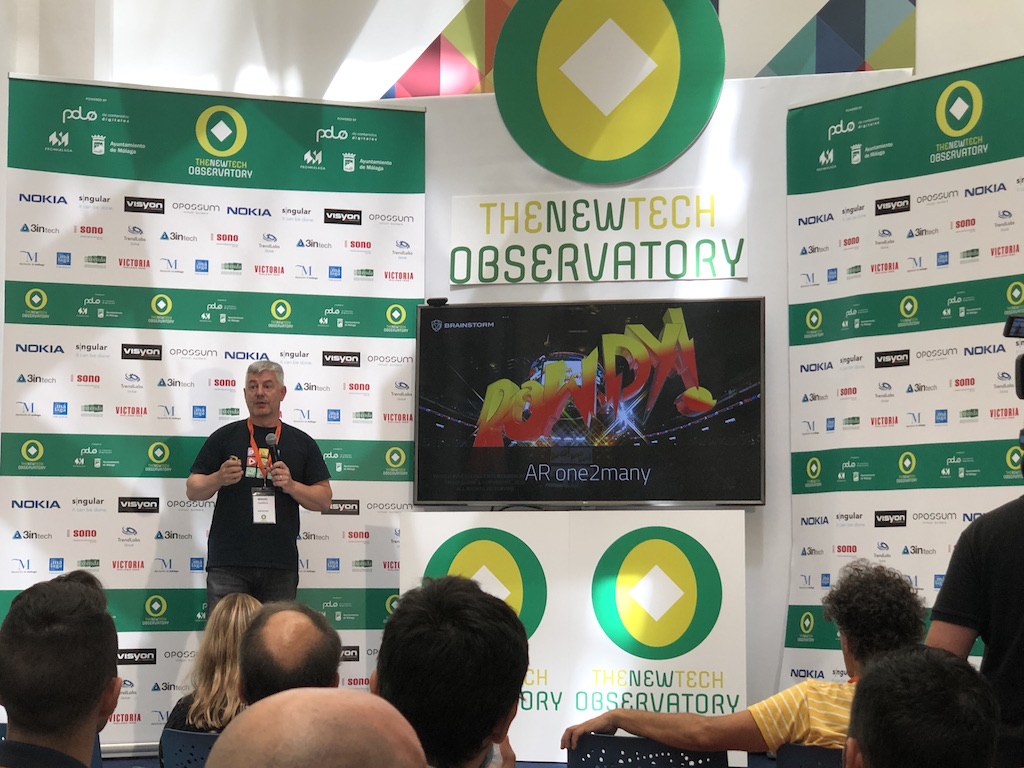
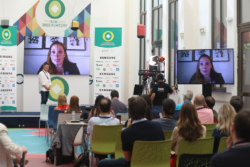
Miguel Churruca, marketing and communications director of Brainstorm Multimedia, has participated in the first day of the New Technologies Observatory that takes place today and tomorrow in the National Digital Content Center of Malaga.
Since its founding in 1993, this Spanish company has carried virtual and augmented reality in its DNA. Just one year later, in 1994, Brainstorm made television history with a live, real-time 3D virtual studio.
Brainstorm's product line currently includes a wide range of solutions for real-time 3D graphics, photorealistic augmented reality and virtual studios, news and sports, entertainment, elections, weather or corporate presentations, covering a wide range of needs, while their open approach makes them compatible with a wide variety of broadcast ecosystems.
At the Malaga New Technologies Observatory, Churruca began his presentation by ensuring that the use of these real time technologies, even at the highest resolutions, is providing a significant boost.
But, What is required to generate augmented reality? Integrate a real environment, with real footage, camera tracking, embed objects and characters, and create virtual sets or 2D/3D graphics based on external data, he stated.
About him camera tracking, commented that already in 1994 Braintorm had to adapt a mouse ball to transmit movement to the zoom and pan of the camera since reliable tracking systems did not yet exist on the market.
Currently there are two types of tracking: mechanical (PTZF on pedestals, cranes, rails...) and optical (using the main camera or cameras on the other side that point to the video camera, or through auxiliary cameras).
Churruca has highlighted that augmented reality allows mejorar la narración y la imagen de cadena; apoyar datos en contexto que cambian continuamente como es el caso de las elecciones con información en tiempo real atractiva para la audiencia; producir eventos mejorados para llevar el evento más allá de la transmisión del mismo con impactantes narrativas visuales capaces de ampliar escenario con elementos virtuales; y generar retroalimentación con los espectadores que siguen un evento presencialmente con realidad aumentada desde smartphones o pantallas gigantes.
Did you like this article?
Subscribe to our NEWSLETTER and you won't miss anything.
Related articles
 Spanish Television demonstrates its commitment to VR and AR at the New Technologies Observatory
 The Observatory of New Technologies anticipates the future in Malaga
 The Malaga Observatory celebrates its third edition, consolidated as the main multidisciplinary event on new technologies
 Atresmedia and Brainstorm add their VR/AR reality experiences to the Malaga Observatory
 María Rua (IHS Markit) will analyze the evolution of new technologies at the Malaga Observatory
 The leaders of eSports will hold a plenary session at the Observatory of New Technologies in Malaga
 The latest from Silicon Valley, at the New Technologies Observatory, on July 17 and 18 in Malaga
 Artificial intelligence, eSports and video games, focuses of the Third Observatory of New Technologies of Malaga
 The Observatory of New Technologies consolidates itself as a world reference in immersive audiovisual environments
 Éxito de participación en la Demo Área del Segundo Observatorio de las Nuevas Tecnologías
 The Observatory of New Technologies starts in Malaga
 The Malaga Observatory consolidates itself as the reference event in Spain on new immersive technologies
 La Demo Area del Observatorio de Nuevas Tecnologías contará con más de treintena de experiencias
 La emoción del deporte en 360, en el Observatorio de las Nuevas Tecnologías