





Sound in big football matches: technique, automation, immersion and a future 2110


Imanol Fernández Durán, sound technician at Mediapro Group who has worked for top-level meetings of the UEFA Champions League, LaLiga o America's Cup, analyzes the current state of sound in the construction of the narrative of football matches, addressing some of the most relevant trends in this key area such as immersiveness, automation or remote production.
In a moment of refinement and redefinition of the visual aspect of football, with the HDR prevailing over 4K and with the second windows occupying a rol residual (far from what the big bets on platforms and broadcasters), the sound continues a path of constant evolution. On the playing field of the beautiful sport, sound achievements are not trivial, but the result of a continuous process of test and adjustment that relies on all kinds of techniques and solutions.
The differentiation of kick sound with the bass drum of the cheering stands; that coach's indication that suggests a reaction, in the absence of full intelligibility; the field draw, with a light conversation that is cushioned by previous euphoria at the beginning of the meeting. The refinement of all these processes, without hurry, but without pause, benefits from a transversal effort of technology providers, which polish microphones and open them to immersive experiences; of software developers, which improve their automation processes to free up the operator, and transportation technologies, which allow processes to be relocated and reduce latencies to previously unimaginable minimums.
Imanol Fernandez, sound technician at Mediapro Group, has been in charge of the sound of key matches in the first and second divisions of LaLiga, as well as clashes in competitions such as the Copa del Rey, UEFA Champions League, UEFA Europa League or Copa América matches. In addition, he has dealt with such relevant events as the 2025 UEFA Europa League final, which took place at the San Mamés stadium in Bilbao. Responsible for the audio in broadcasts of other sports such as basketball, handball or motorcycling, this time he stops at football to analyze how it is built in the the sound of these competitions today and where it is going.
The objective of audio in a football match
“Our main function is to experience of consuming the audiovisual product is as complete as possible. In the same way that cameras are searched for ultra slow motion or cameras are placed in the locker room tunnel to be able to see the players a few minutes before leaving, we seek to accompany the entire broadcast with sound," says Fernández, summarizing his philosophy when working on audio in football matches. To achieve this objective, it is necessary understand the pillars that shape sport, to the broadcasts and to their viewers, who seek a complex balance between familiarity and continuous improvement of the television show.
“We try to have that shot, a shout when there is a corner, the goalkeeper's instructions to his teammates…”.
By constructing the sound image of the meeting, Fernández seeks to equate the narration to the sensations experienced in the stadium itself: reflect that atmosphere, hear the cheering stands in the background, accompany the “oops!” after a failed opportunity and feeling the euphoria of the stands after a goal, sometimes even going so far as to overshadow the announcement by the narrator: "We try to have that shot, a shout when there is a corner, the instructions from the goalkeeper to his teammates...; when, for example, there is a ball against the post and we manage to capture that impact... it is amazing for the sound engineer!"
The moment the soccer match begins, the mission is clear: backup from the audio everything that the images reflect. And, to be able to offer each sound variable, preparation is key.
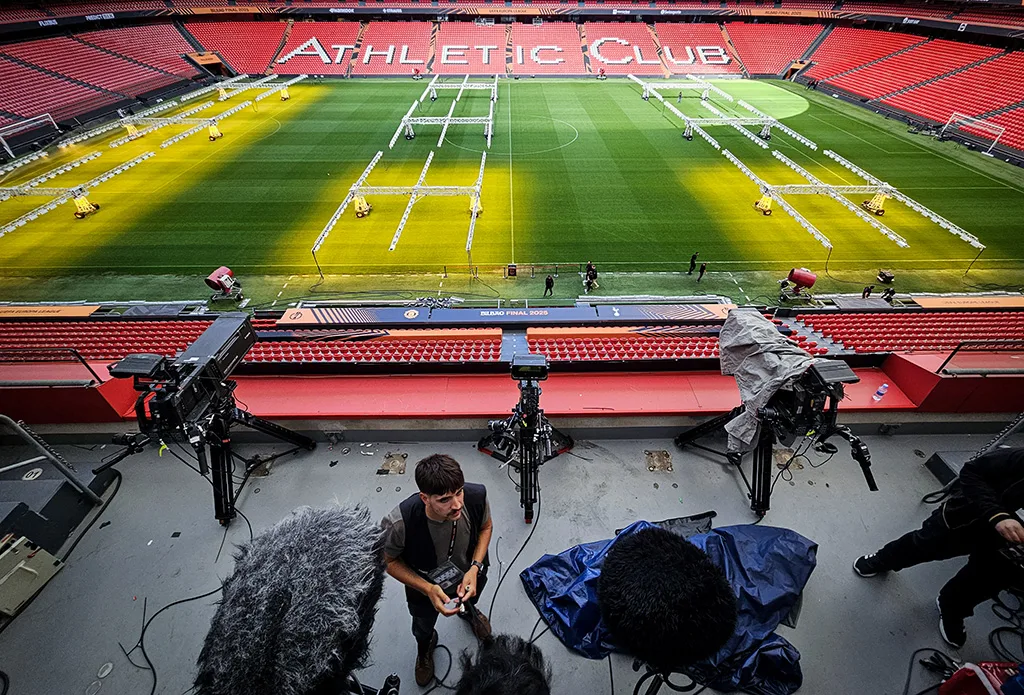
The location of the microphone on the playing field
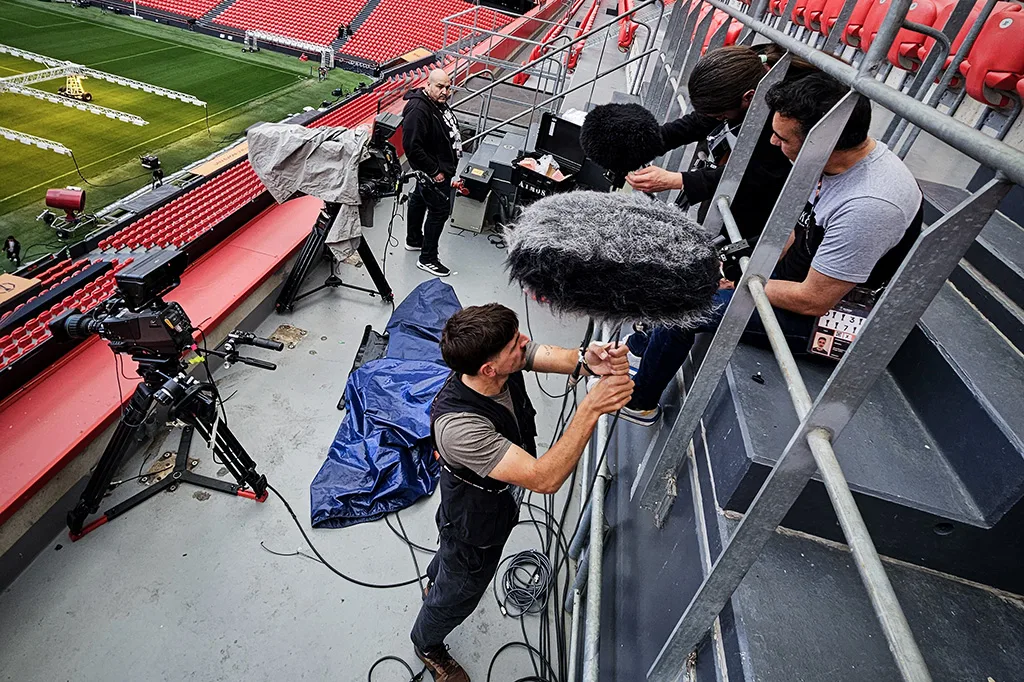
In a top-level soccer match, Fernández figures around twenty las ambient sound pickup sources available to construct the story of the encounter, between “rings, chambers that reflect arrivals and tunnel chambers.” The locations of each of the sources are agreed with the different competitions, which usually offer freedom to broadcasters to arrange them in the key corners: "The criteria are specific to each technician. There are general guidelines, as well as processes that are always done in the same way, but then each professional can play with those guidelines."
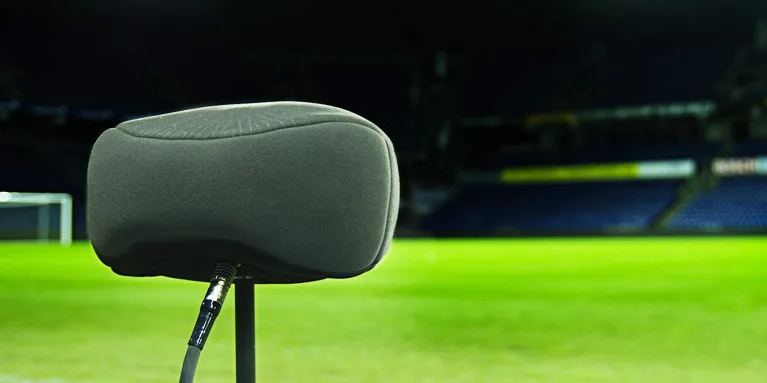
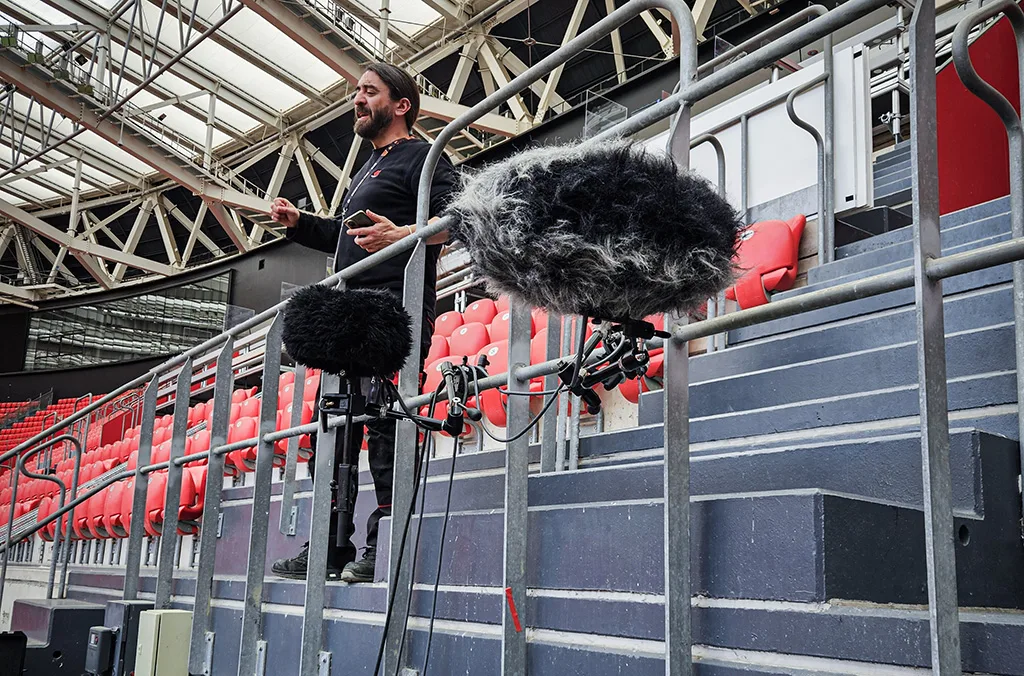
To capture the sources necessary to compose the mix 5.1 that accompanies most of the football matches, Fernández opts for brand microphones DPA of six capsules that are placed in locations close to the master chamber.
For his sound designs, Fernández usually opts for capturing the entire stadium area with a directional microphone like the one provided by Sennheiser MKH 416. This display is complemented with microphones attached to cameras such as Steadicam, in charge of providing the cinematographic look to the broadcast, or to the locker room tunnel mini cameras, and with several stereo microphones placed among the audience; everything, in favor of immersiveness.
Special mention deserves the immersive audio. To capture the sources necessary to compose the mix 5.1 that accompanies most of the football matches, Fernández opts for brand microphones DPA of six capsules that are placed in locations close to the master chamber. In the event that the match is of the first level, such as a final, the format comes into play Dolby Atmos 5.1.4, for which a DPA model is used again that provides, on this occasion, ten signs.
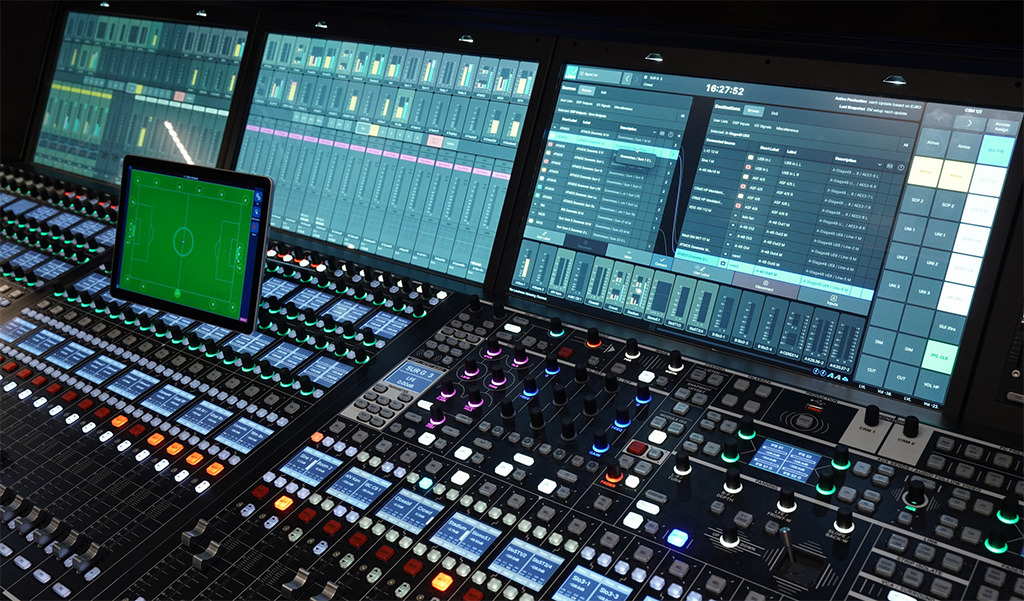
Transport and audio protocols in football
Once the microphones are placed, the sound engineer solves the transport by placing a stage box on the left side of the stadium to capture the analog signals from each of the devices, so that these travel a total of between 100 and 150 meters: “This way we have much less loss.” The signal is then transported to the mobile unit via fiber optic.
““The question of signs can go on to infinity. Sometimes, we are managing more than 190 channels at the table”.
Regarding signal management, Mediapro gives preference to communication MADI, complemented by signal flows Dante (Audinate) o AES3. To this heterogeneous set are added internal protocols of some of the brands with which the company usually works, such as EVERYTHING, own of the intercom solutions provider RTS.
This confluence of formats, managed by different brand switches such as Cisco, requires protocol converters to be able to redirect the signal to different destinations; at least, until the consolidation of the ST 2110 systems: "From MADI to AES3; from analog to Dante... In the end, due to needs, you end up needing to convert a signal. For example, it is necessary that the signals that end up in Lawo solutions end up being transformed to MADI."
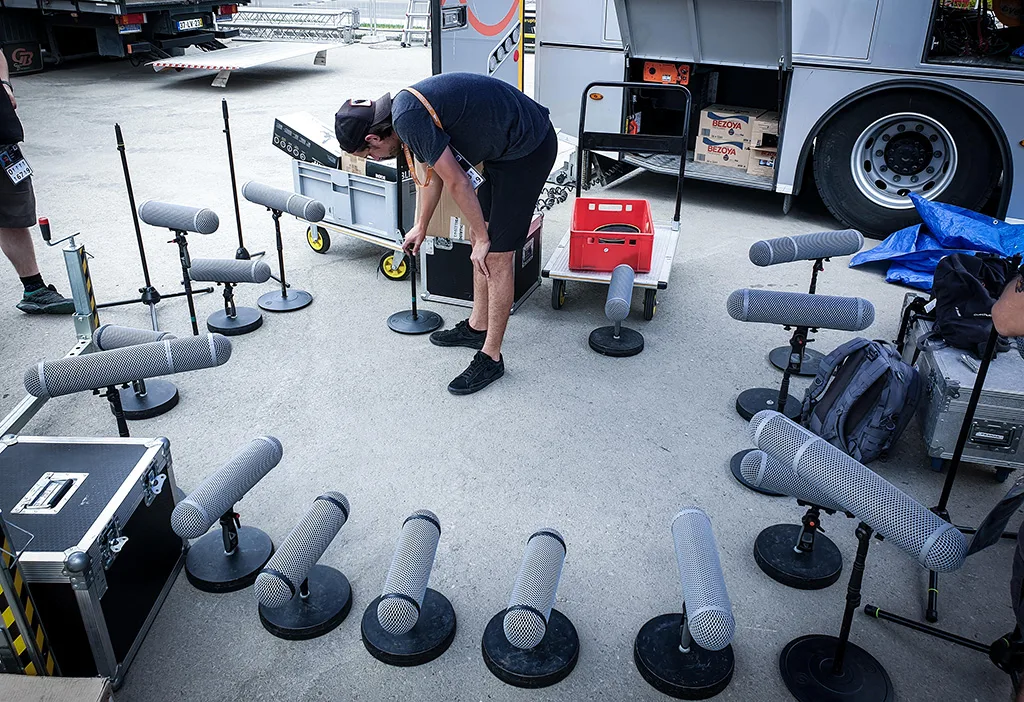
Sources for standard and premium matches
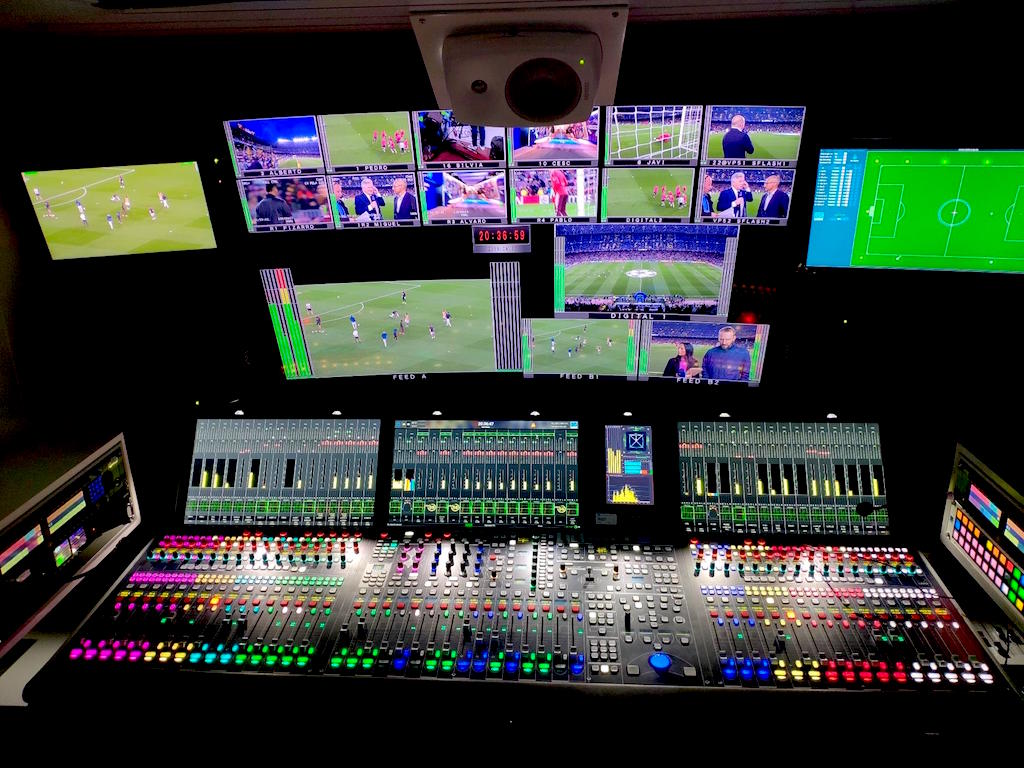
To mix the signals, Fernández uses control surfaces from the German manufacturer Theirs. Specifically, small and medium-sized mobile units usually integrate the table mc²36, while larger vehicles operate with the mc²56 in their versions MKII o III.
All the signals from the stage boxes converge on these consoles; the channels of the six servers repeat EVS, adding a total of twelve signals, and all the audio sources coming from the commentary team, program signal o advertising spots, in the event that they are introduced into the development of the meeting itself.
 In international or top-level matches, signal management becomes even more complex, given that the before or after the match, such as press conferences, flash interviews or slots on the match ground are also channeled from the mobile unit: "We recently produced the match between F.C. Barcelona and PSG. In these cases, the signals produced by Canal+ France, like main visitor, and the sign of Movistar Plus+, he host broadcaster. These signs enter our table and we distribute them to the feeds that correspond to each one.”
There is an additional element: the intercom management. Although this work depends on each sound technician, Fernández chooses to manage them directly, process them and return them to the intercom matrix: "The issue of signals can go to infinity. Sometimes, we are managing more than 190 channels on the table. They are not elements that you have to be mixing, those would be approximately up to 30 signals, but supervising; if they fail, it is your role to see which point in the chain has caused the problem."
The power of automation
Once the console controls are taken, the fight for frequency becomes fundamental. A clear example is getting identify and soundly isolate the touches of the ball, a particularly complex issue on Spanish soccer fields: "Frequently, the entertainment stands usually include the bass drum and that gives us a lot of problems, since they are in the same frequency range as the kick. Depending on the stadium, especially in those in which the animation continues throughout the game, it is very difficult for us to find it."
Lawo Kick, a system that benefits from the same metadata it uses MediaCoach, allows you to manage the location of the ball at all times. Once the microphones are mapped within the Lawo solution, it can lift channels automatically in each of the positions.
This is a problem that has accompanied audio in football for years. As Fernández remembers, there was a time when he chose to place two microphones on both sides of the goal, or in which it was decided to bet on the rugby model and place in the bands to microphone players with a satellite dish to follow the audio of the plays. This issue has now been resolved with the deployment of Lawo Kick, quite a “full stop”.
It is automation software, which benefits from the same metadata used by MediaCoach, allows you to manage the location of the ball at all times. Once the microphones are mapped within the Lawo solution, it can lift channels automatically in each of the positions. "It even has a second function with which it can detect if there are certain players who are together, such as in a corner kick. The system is capable of creating a point of interest that allows the microphone to be raised in that area," adds Fernández.
Starting from this point, each technician is in charge of putting his experience into play and taking advantage of the different hardware and software options sound for limit frequencies and find those most suitable for narrating the meetings: “I also really like to use some plugins Waves sound suppression, or simply display the booms in the microphones, which act naturally. In the end, you can find what your sound is.”
Immersivity and expanded audio
Mediapro addresses expanded audio formats by establishing the 5.1 as the base signal of production, with the Dolby Atmos 5.1.4. reserved for special gatherings. In those games that are not premium category, both the mixing in this format and in stereo are carried out by a same operator.
“We usually mix the largest signal, a Dolby Atmos or a 5.1, and then make a downmix through the tools that Lawo systems provide us. Then, during the match, we can do switch between the different mixes to check that everything is correct in each of the versions,” Fernández explains.
Remote audio production in football
Although during Mediapro's period as responsible for LaLiga production it was not used, Fernández does not hesitate to affirm that remote production applied to sound contexts in football matches is “100% viable". The greatest handicap is found in the distance, but achievements like those achieved by Dorna Sports They show that the technology is already more than ready.
"Former referee Mateu Lahoz occasionally announces from a studio set up in a room in his house. I won't say that we achieved zero latency. Maybe a music group couldn't rehearse with this workflow, but, for announcing a match, the quality is incredible."
"I have a colleague who works in MotoGP. They have managed to reduce the latency so that it is possible to work comfortably. We are talking about productions that are carried out in Sant Just Desvern, here next door in Barcelona, while the capture is being done in Malaysia," says Fernández, who can also confirm that HBS It is already implementing remote flows in the implementation of LaLiga.
Although the ambient mix is still carried out in person, Mediapro has already consolidated the introduction of remote commentators in top-level live matches of the Champions League. To do this, they benefit from VoIP codecs and encoders like the system Quantum of Prodys: "Former referee Mateu Lahoz occasionally announces from a studio set up in a room in his house. I won't say that we achieved zero latency. Maybe a music group couldn't rehearse with this workflow, but, for announcing a game, the quality is incredible. It's as if it were in the stadium."
2110 and AI: opportunities for the present
The refinement of sound production for football matches, with consolidated automation and remote production as a plausible medium-term solution, will improve its versatility in signal management with the introduction of workflows in ST 2110. As Fernández can confirm, he will soon take part with Mediapro in the production of a large global sporting event in which they will put into operation a stationary one in which everything from the cameras to the audio, including all the exchange of signals and metadata, will be managed with this IP technology.
"The 2110 will change the way we work, especially in terms of protocol management. We will be able to have a kind of supermatrix in which all the signals fall, regardless of their origin, and distribute them as we wish," explains the sound engineer, who points out that this reformulation of the processes will also affect the way in which future mobile units are planned."
"2110 will change the way we work, especially in terms of protocol management. We will be able to have a kind of supermatrix in which all signals fall, regardless of their origin, and distribute them as we wish."
Another area that Fernández aspires to explore in the medium term is the application of IA in your sound management processes. With latency as the main obstacle to overcome, it has already been able to verify the viability of the system in other productions in which he has worked for Mediapro as Future Imperfect (RTVE), for whom you use the software Clarity of Techivation to clean the PA return in the different sound sources.
"There are some tables, I don't know if they are from Calrec, that are also beginning to use artificial intelligence: when you put a signal in the table, you can ask it to study the voice and it can take advantage of these workflows to create an optimized equalization line. It will be a matter of time, because AI is entering almost all areas," concludes Fernández.
A report by Sergio Julián Gómez
Did you like this article?
Subscribe to our NEWSLETTER and you won't miss anything.
Related articles
 RTVE invests in free-to-air football, adding LaLiga and Primera RFEF matches
 Remote football production is consolidated in the UK with Riedel's Simplylive: up to 30 simultaneous matches
 Audiovisual fraud, the biggest threat to the future of football according to LaLiga
 Pebble launches one of the largest ST 2110-based playouts in Europe at SRF
 SPL Globally Distributes Saudi Pro League Soccer Matches with Grass Valley AMPP
 WTVision bets on real-time data visualization for football matches at NAB 2024
 Blackmagic presents great news at NAB 2024: new cameras, switchers, monitors, ST 2110 solutions...
 9 broadcast innovations from the NFL, MLB, NBA and NHL… with a future in football?
 Mediaset will broadcast Kings League matches, the football league of Ibai and Piqué, openly
 Five US soccer preseason games will be produced by Grup Mediapro
 ‘Adú’ wins the Goya for Best Sound for its technical expertise in outdoor capture
 More than 2,000 hospitality establishments inspected for the illicit broadcast of football matches
 Nagra and NOS intensify the fight against piracy of Benfica football league matches in Portugal
 The Professional Football League must guarantee Mediaset access to the matches