





MasOrange presents BTA, a new antenna design that was born with a global ambition

After four years of research and real validation in the field, the new radio link design methodology promoted by The Oranges, BTA (Backhaul Traffic Availability), becomes a standard by the ETSI (European Telecommunications Standards Institute).
BTA breaks the paradigm that has traditionally associated size from the antennas to the distance and retransmission capacity, proposing a redesign based on actual traffic behavior and weather conditions. In this way, it is possible resize with greater precision in radio links, “avoiding oversizing and optimizing resources.”
The project began in 2021 with the aim to analyze the real dimensioning of the radio links. After developing a tool capable of separating the impact of traffic and weather conditions, MasOrange detected that many facilities They were oversized.
Based on this discovery, the company developed a new theoretical model based on a more efficient concept of service availability. The methodology was validated for one year in real environments, with tests in provinces with very different climatic conditions, Seville, Alicante, Asturias and Pontevedra, and with different technological providers. Once the project is completed, MasOrange is ready to deploy smaller, lighter and more efficient antennas, maintaining, “and even improving”, the capacity and range of wireless connections
For the telecommunications company, the adoption of BTA on the part of the ETSI supposes a qualitative leap for the sector. “This evolution will force developers of radio link design tools to adapt their solutions, extending the benefits of this innovation to operators around the world,” MasOrange points out.
Did you like this article?
Subscribe to our NEWSLETTER and you won't miss anything.
Related articles
 Tokland, a new VFX studio based in Madrid, is born
 New Paramount is born, a union of Skydance Media and Paramount Global that will build its future around new platforms
 Masorange (Orange and Másmóvil) presents itself as the “leader” of the market and promises investments of 4,000 million euros
 Blackmagic renews the four HyperDeck Studio with a new design and more features
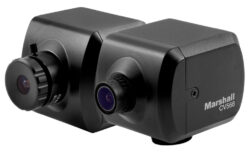 Marshall Electronics presents the CV568 and CV368, “global shutter” cameras with genlock
 Discovery presents Discovery+, its new global streaming service that will arrive in Spain in 2021
 PXW-Z750: Sony's new XDCAM camcorder with HDR and HFR recording in a portable and ergonomic design
 Atresplayer launches new design, 4K content and an international version
 The new Inmarsat-5 F2 takes a new step towards global access to high-speed broadband
 Basque Audiovisual presents a global and multiplatform catalog at the Asia TV Forum
 Telefónica Studios, Telefónica's global audiovisual content production company, is born
 The CNMC, the new “superregulatory” body, is born
 The new Mac Pro will have an innovative cylindrical design
 Canon presents the new KJ20x8.2B KRSD 2/3” HD lens: great performance in a compact, affordable and lightweight design