





ITU establishes new technical specifications for UHDTV
The Study Group on Broadcasting Services of the International Telecommunication Union (ITU) has outlined new technical specifications for Ultra High Definition Television (UHDTV).
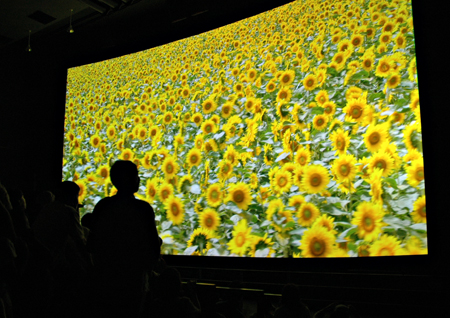 A group of global experts that is part of Study Group 6 of the OUT on ITU-R Broadcasting Services, have reached agreement on most of the relevant technical features of the new television standard, representing an advance on current high-definition television standards, with resolutions up to 8K and beyond.
Japanese public broadcaster NHK has demonstrated UHDTV (dubbed 'Super Hi-Vision') at a number of trade shows, including the IBC Show in Amsterdam in September. The screen features a resolution of 33 million pixels, compared to the maximum of 2 million pixels on the highest quality HDTV screens available today.
In September, a live UHDTV link test was carried out between London and Amsterdam (which worked perfectly) and plans are underway to cover part of the London 2012 Olympic Games on UHDTV and have the images projected in public locations around the world.
David Wood, Chairman of the ITU Working Group on the Broadcasting Service Study Group, said: “The extremely high quality of UHDTV will have a definitive impact on our lifestyle and our relationship with the programs we watch.”
For his part, Christoph Dosch, president of the ITU Broadcasting Service Study Group, commented that "UHDTV is going to represent one of the biggest changes in audiovisual and broadcast communications in recent decades. The technology is really at the cusp of transforming how people will experience audiovisual communication from now on."
Hamadoun Touré, Secretary-General of the ITU, already assured that UHDTV would create an immersive experience for viewers and generate a wealth of new business and marketing opportunities.
Consumer products using this technology will take years to become generally available, but an important application of the extra pixels available in UHDTV displays could be to avoid having to use 3D glasses. 3D without glasses is very difficult to achieve due to the large number of pixels required on the screen to accommodate different viewing angles.
Did you like this article?
Subscribe to our NEWSLETTER and you won't miss anything.
Related articles
 Virtual art direction: techniques to stop the world
 IBC opens the call for Technical Presentations for the 2025 edition
 DVB will take energy efficiency into account in new specifications
 DVB publishes the first specifications for the provision of 8K UHD video services
 Panasonic releases the technical specifications of the new AU-EVA1 compact camera
 Hans Hoffman (UER/EBU) defends in Seville the need for standardization for UHDTV
 BT Sport selects Ericsson to launch UK's first UHDTV channel
 Hispasat presents its pilot channel in UHDTV for America
 AEDETI sets some technical recommendations for the development of HBB solutions
 Agreement on minimum specifications for 3D satellite broadcasting
 DVB makes public its commercial specifications for 3D
 Specifications for DRM receivers approved
 Panasonic releases specifications for its AG-3DA1 camera
 Agreed specifications for pay DTT and HD receivers