





Uneven coverage of the strike on public and private television
Alto seguimiento de la huelga en RTVE y las autonómicas y bajo en las privadas.
La huelga general convocada por las centrales sindicales para el 29M ha tenido un seguimiento desigual en los medios públicos y privados del país. El seguimiento de la huelga general entre los trabajadores y trabajadoras de los medios públicos alcanza el 75 por ciento de participación, en una horquilla que va desde el 80 por ciento de seguimiento en RTVE a un 70 por ciento en las radios y televisiones autonómicas, según señala UGT.
En el caso de RTVE, mientras que la dirección de la Corporación ha cifrado el seguimiento en un 40,5% de los trabajadores, los sindicatos elevan esta cifra al 80%. La televisión pública estatal ha mantenido una programación informativa y con programación grabada.
En RTVE, el seguimiento ha llegado a alcanzar el 95 por ciento en los centros de Barcelona y Bilbao, tanto para RNE como para TVE y la media para la estructura territorial, mientras para los centros de Torrespaña y Prado del Rey se sitúa por encima el 80 por ciento, según UGT.
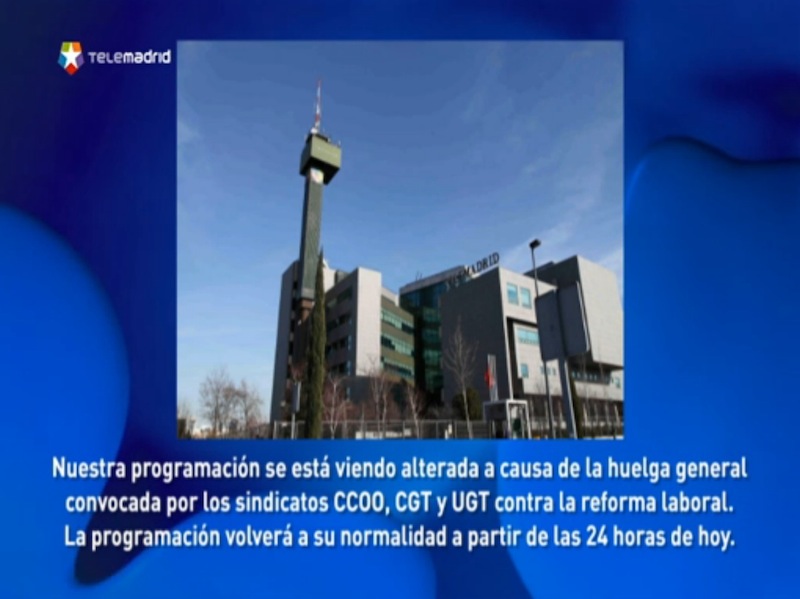
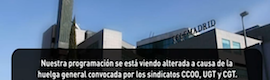
Mientras que Telemadrid has mostradp durantes las 24 horas de la jornada un bucle en el que advertían del parón en la programación debido a la huelga, en Canal Sur se interrumpía la programación entre las 0 y las 6 horas.
Por su parte, en la gallega CRTVG no han ido a trabajar alrededor del CRTVG (61%), viéndose alterada notablemente su parrilla. En la valenciana RTVV el paro se ha estimado en un 23.3%.
La huelga general ha tenido un amplio seguimiento en los medios de comunicación públicos catalanes, con una adhesión del 90% en TV3 y TVE y del 80% en BTV, sin tener en cuenta los servicios mínimos, según CC.OO.
En las privadas, mientras que en Antena 3 el seguimiento ha sido del 8%, en Mediaset España, el paro ha alcanzado el 9.8%, y en PRISA Tv ha rondado el 29% de respaldo. Sin embargo, los sindicatos cifran el seguimiento del paro en las privadas entre el 35% y el 45%.
Es de destacar que, a diferencia de otras huelgas precedentes, el Ministerio de Industria no ha fijado servicios mínimos para las televisiones privadas, ya que la Audiencia Nacional estableció en una sentencia el año pasado que la actividad desarrollada por estas empresas no puede ser calificada como de “servicio publico” y por tanto el Gobierno no puede establecer servicios mínimos.
Ya que la Ley General Audiovisual derogó el Estatuto de la Radio y la Televisión que disponía que “la radiodifusión y la televisión son servicios públicos esenciales cuya titularidad corresponde al Estado” y la Ley de Televisión Privada, que regulaba la gestión indirecta, por sociedades anónimas, actualmente el servicio de televisión no encajaría en el concepto de “servicio público”.
En la última huelga general, celebrada el 29 de septiembre de 2010, Industria emitió una orden en la que impuso unos servicios mínimos “estrictamente necesarios para garantizar la prestación del servicio esencial” de información y los fijó en “la producción y emisión de programas informativos en sus horarios habituales, reduciendo en un 20% su duración habitual”. Asimismo, se establecía un porcentaje mínimo del 12% del personal de la empresa.
En cuanto a la radio, la jornada de huelga transcurrió con completa normalidad.
Did you like this article?
Subscribe to our NEWSLETTER and you won't miss anything.
Related articles
 Input 2025: the future of public television is debated with the push of EITB
 Public television stations in Europe and Latin America strengthen ties at the 2023 Quirino Awards
 FORTA identifies the main challenges facing European public televisions
 Ukraine unifies all public and private news television under the same platform
 The Government helps private television stations with 15 million in subsidies
 The large European public television stations, faced with the challenge of the coronavirus
 Mediaset abandons UTECA and opens a schism in the private television employers' association
 Public and private television broadcast to Antonio Tajani their concern about the role of online platforms
 Five DTT operators create the Spanish Association of Private Digital Terrestrial Televisions
 Private television stations urge the Government to resolve the uncertainty about the digital dividend
 Desigual seguimiento de la huelga general en televisión
 Rajoy advocates new management models in public television
IEC supplies audiovisual equipment to different public and private facilities
Rajoy advocates new management models in public television
IEC supplies audiovisual equipment to different public and private facilities
 Public and private television, once again confronted over sports rights