





Impact of OTT services on broadband
Although pay TV operators rightly argue that the impact OTTs have had on basic video subscribers is negligible, if one focuses exclusively on broadband subscribers, who are most likely to have access to OTT services, the numbers tell a completely different story.

New research by TDG has revealed that 13% of broadband subscribers in the United States, approximately eleven million households, are not subscribed to pay television services.
TDG's latest report, Pay TV Refugees: A Primary Profile of Cord Cutters and Cord Nevers, provides a detailed profile of this small segment that is on the rise among home entertainment consumers.
“According to our research, the percentage of households with broadband that are not paid TV subscribers has increased from 9.5% at the end of 2010, to 11.2% at the end of 2011, currently reaching a percentage of 12.5%,” underlines Michael Greeson, founding partner of TDG and director of research. “While pay-TV operators rightly argue that the impact OTTs have had on basic video subscribers is negligible, if one focuses exclusively on broadband subscribers, who are most likely to have access to OTT services, the numbers tell a completely different story.”
TDG separates pay-TV refugees into two segments of families: cord-cutters (broadband users who had been pay-TV subscribers but no longer are) and cable-nevers (broadband users who have never been pay-TV subscribers). Although it is obvious that they share some positions (both segments subscribe to broadband but not to pay television), the two segments show radically different profiles. Cord cutters, for example, are somewhat older, have higher annual incomes, and are more likely to have children under the age of eighteen living at home. On the contrary, almost a third of those who have never subscribed to cable service are between the ages of 18 and 24, more than half have annual incomes of less than €23,000 and only a fifth have children under 18 living at home.
While the TDG expects the number of pay-TV refugees in both segments to increase over the next five years, it is actually those who have never subscribed to cable service who represent the most immediate challenge for pay-TV operators. The logic, Greeson indicates, is quite simple. Currently, the young consumer is much more technologically sophisticated than their predecessors, particularly when it comes to entertainment. Coming of age in a world of networked screens and online services like Netflix and Hulu, these potential pay-TV subscribers are fully aware of the existence and costs of such services.
Did you like this article?
Subscribe to our NEWSLETTER and you won't miss anything.
Related articles
 Eight out of every ten fixed broadband lines in Spain are already fiber
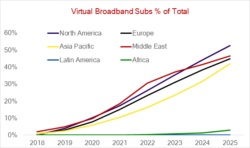 Fixed broadband access infrastructure is virtualized
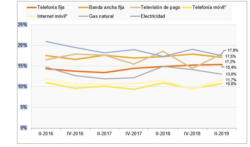 Pay television, electricity and fixed broadband, the services least valued by Spanish households
 Audiovisual services and mobile broadband, drivers of growth in the telecommunications sector in 2018
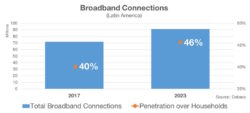 46% of households in Latin America will have fixed broadband in 2023
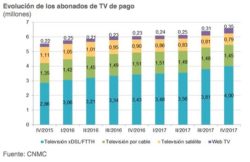 The billing of audiovisual services and broadband pulled the telecommunications sector in 2017
 Three out of every four mobile lines in Spain have broadband
 Three out of every four mobile lines in Spain have mobile broadband services
 Almost half of European households with broadband already have a smart TV
 61% of Spaniards already have access to 100 megabytes broadband
 R will improve its broadband services with Arris RFoG technology
 63% of households with broadband in the US have at least one connected television
Six out of ten households with broadband in the US already use connected television
63% of households with broadband in the US have at least one connected television
Six out of ten households with broadband in the US already use connected television
 The CMT improves the technical conditions for the provision of broadband services by alternative operators