





Sonosphere designs the new Dolby Atmos mixing room at Metropolis Studios
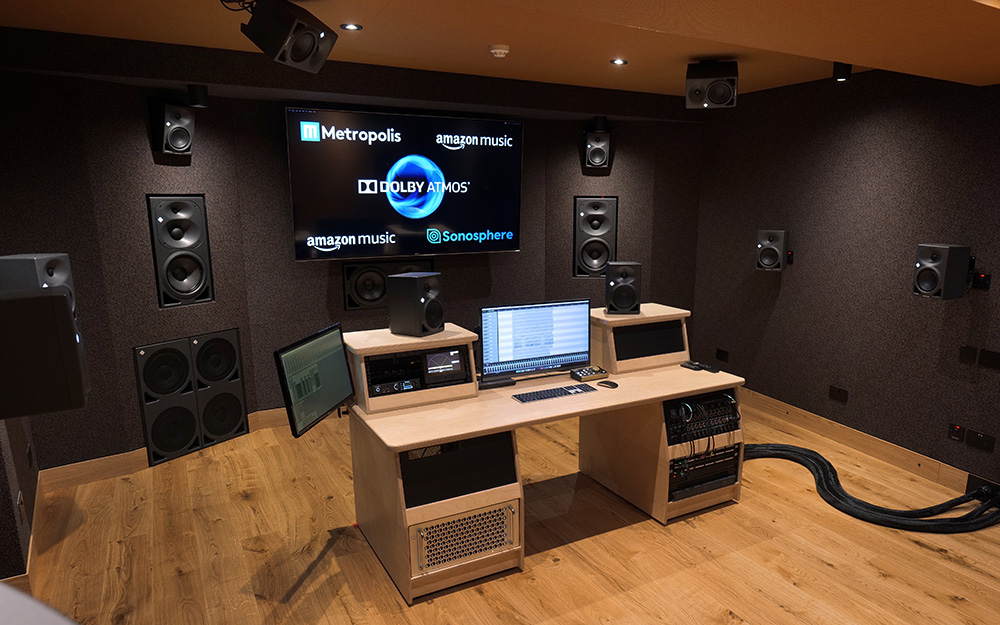
The new mixing room Metropolis Studios, integrated and designed by Sonosphere in collaboration with Munro Acoustics, will allow the audio specialist to create content Dolby Atmos.
The new space of Metropolis It features a centralized mix position that provides immersive audio monitoring designed to accommodate a wide variety of surround sound formats. In any case, Sonosphere has designed the space thinking about Dolby Atmos, “the main industry standard.” The production environment, capable of creating tracks 11.1.8, has a server Dolby Atmos Mastering Suite, three tri-amplified monitors Neumann KH 420 front wall mounted and two Neumann subwoofers KH 870. From monitoring surround 17 Neumann bi-amplified compact studio monitors ordered KH 120, famous for their uniformity between units, and with a linearity deviation of ± 1.0dB between 100Hz-10kHz.
One of the main challenges of this installation, located at the Metropolis headquarters Power House of London, was to ensure a clean, extended low frequency from the twin subwoofers. To achieve this, the isolation necessary to accurately judge the tone of a full octave below the effective range of many monitoring systems was essential. To achieve this goal, the construction of the mixing room required almost two tons of sand to insulate the back wall, which adjoins another Metropolis studio.
Phil Wright's vision
The Sonosphere Mixing Engineer Phil Wright, who has worked with the BBC Symphony Orchestra or Paul McCartney, has considerable experience working with Dolby Atmos. This is how he interprets one of the main virtues of the system: "The goal of Atmos is to not depend on any speaker system. A master file, called Dolby Atmos Master File (DAMF), is mixed. This file is used to deliver the content to the end user and then the end user's equipment plays a version of the content suitable for the connected equipment. You can have a completely discrete 7.1.4 cinema system - or a sound bar - and the Atmos file can be decoded to better reflect the equipment you have."
Starting from this premise, Wright explains the design philosophy of the Metropolis room: "We decided on three speakers along the back wall, with all the speakers around the room arranged 30° apart from each other, so the configuration was completely symmetrical. Atmos is more focused on the front, so one of the rear speakers will not be used; and two of the others will be electronically adjusted for Dolby using a monitor controller AX32 from DAD (Digital Audio Denmark). “The AX32 allows any number of virtual room presets to be optimized for different immersion formats.”
Jamie Gosney, commercial director of Sonosphere, reveals that the new Atmos room in Metropolis will be used by Sonosphere itself to provide high definition streaming services: "We are in talks with several venues, production companies and promoters, as the studio can very easily connect, via fiber, to practically any room in the country and be used as a live broadcast and streaming center, which eliminates the need for production companies to park large OB vehicles outside their rooms. We can also take care of the soundtracks and post-production for the film industry. The possibilities are truly endless.”
Did you like this article?
Subscribe to our NEWSLETTER and you won't miss anything.
Related articles
 The Film Academy updates its projection room with Dolby Atmos technology
 Molok Studios launches with Genelec the first Dolby Atmos game studio in Italy
 La Tina post-production studio (Colombia) creates a new Dolby Atmos room with Genelec
 Nut Academy integrates its new Atmos training room with Genelec
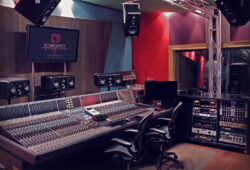 Comeback Studios is born, the first professional music studio to adopt Dolby Atmos in Spain
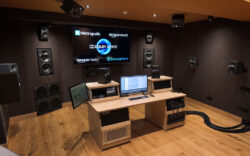 Sonosphere designs new Dolby Atmos mixing room at Metropolis Studios
 Netflix launches first combined Dolby Atmos and Dolby Vision experience
 CSS equipa la sala Dolby Atmos de International Sound Studio
 Best Digital launches its new Dolby Atmos room
 Best Digital inaugurates the first Dolby Premier Atmos mixing room in Spain
 First room for Dolby Atmos with Reflexion Arts monitors
 Yamaha makes the new Dolby Atmos surround audio experience a reality
 Soundub launches room with the new Dolby Atmos format
 Dolby Atmos: the new generation of surround sound